


Aurantimonas manganoxydans, sp. nov. and Aurantimonas litoralis, sp. nov.: Mn(II) oxidizing representatives of a globally distributed clade of alpha-Proteobacteria from the order Rhizobiales
- PMID: 19768133
- PMCID: PMC2746641
- DOI: 10.1080/01490450902724840
Aurantimonas manganoxydans, sp. nov. and Aurantimonas litoralis, sp. nov.: Mn(II) oxidizing representatives of a globally distributed clade of alpha-Proteobacteria from the order Rhizobiales
Abstract
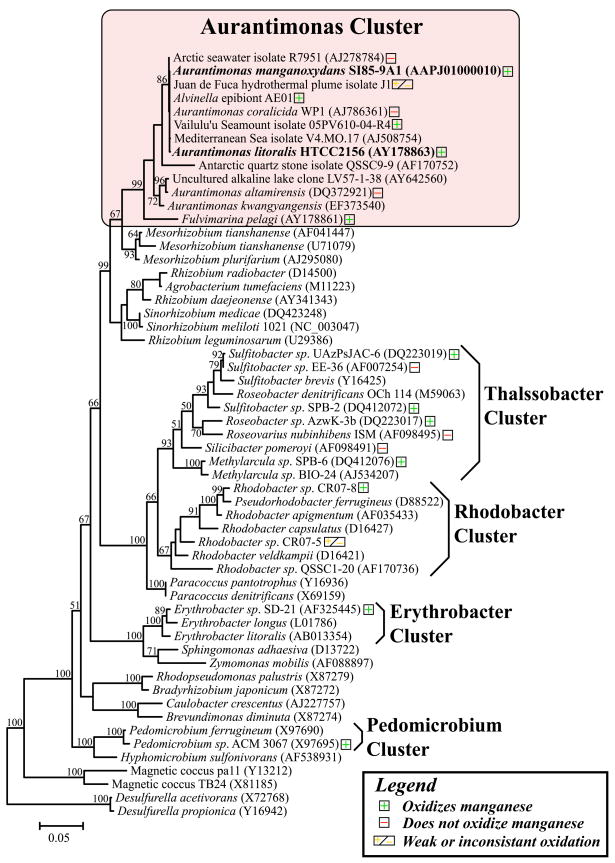
Several closely related Mn(II)-oxidizing alpha-Proteobacteria were isolated from very different marine environments: strain SI85-9A1 from the oxic/anoxic interface of a stratified Canadian fjord, strain HTCC 2156 from the surface waters off the Oregon coast, and strain AE01 from the dorsal surface of a hydrothermal vent tubeworm. 16S rRNA analysis reveals that these isolates are part of a tight phylogenetic cluster with previously characterized members of the genus Aurantimonas. Other organisms within this clade have been isolated from disparate environments such as surface waters of the Arctic and Mediterranean seas, a deep-sea hydrothermal plume, and a Caribbean coral. Further analysis of all these strains revealed that many of them are capable of oxidizing dissolved Mn(II) and producing particulate Mn(III/IV) oxides. Strains SI85-9A1 and HTCC 2156 were characterized further. Despite sharing nearly identical 16S rRNA gene sequences with the previously described Aurantimonas coralicida, whole genome DNA-DNA hybridization indicated that their overall genomic similarity is low. Polyphasic phenotype characterization further supported distinguishing characteristics among these bacteria. Thus SI85-9A1 and HTCC 2156 are described as two new species within the family 'Aurantimionadaceae': Aurantimonas manganoxydans sp. nov. and Aurantimonas litoralis sp. nov. This clade of bacteria is widely distributed around the globe and may be important contributors to Mn cycling in many environments. Our results highlight the difficulty in utilizing 16S rRNA-based approaches to investigate the microbial ecology of Mn(II) oxidation.
Figures
References
-
- Alayse-Danet AM, Desbruyeres D, Gaill F. The possible nutritional or detoxification role of the epibiotic bacteria of Alvinellid polychaetes: Review of current data. Symbiosis. 1987;4:51–62.
-
- Caspi R, Haygood MG, Tebo BM. Unusual ribulose-1,5-bisphosphate carboxylase/oxygenase genes from a marine manganese-oxidizing bacterium. Microbiology. 1996;142:2549–2559. - PubMed
-
- Cho JC, Giovannoni SJ. Fulvimarina pelagi gen. nov., sp. nov., a marine bacterium that forms a deep evolutionary lineage of descent in the order “Rhizobiales”. Int J Syst Evol Microbiol. 2003;53:1853–9. - PubMed
Grants and funding
LinkOut - more resources
Full Text Sources
Molecular Biology Databases