


Disparities in the prevalence of diabetes: is it race/ethnicity or socioeconomic status? Results from the Boston Area Community Health (BACH) survey
- PMID: 19769011
- PMCID: PMC3706078
Disparities in the prevalence of diabetes: is it race/ethnicity or socioeconomic status? Results from the Boston Area Community Health (BACH) survey
Abstract
Objectives: Many researchers and clinicians continue to believe that non-modifiable race/ ethnicity is a major contributor to diabetes, prompting a well-intentioned search for genetic and bio-physiological explanations. We seek to reinforce earlier findings showing that socioeconomic status is more strongly associated with diabetes prevalence than race/ ethnicity and suggests a very different and potentially modifiable etiologic pathway.
Methods: A community-based epidemiologic survey of 5503 Boston residents aged 30-79 years (1767 Black, 1877 Hispanic, 1859 White; 2301 men and 3202 women).
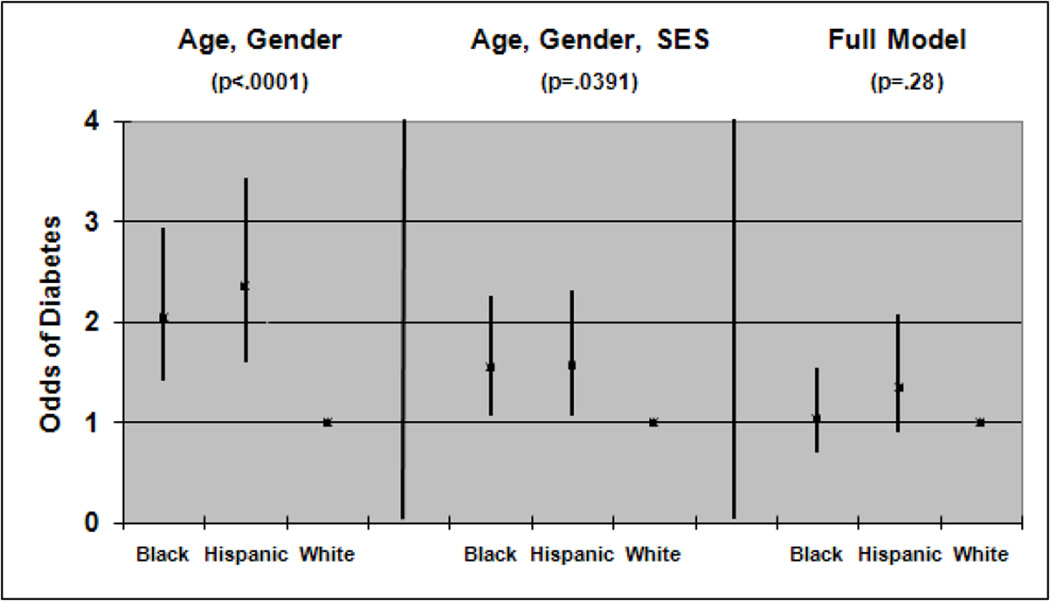
Results: After adjusting for age and sex, Blacks and Hispanics have statistically significantly increased odds of having diabetes: Black (OR, 2.0; 95% CI, 1.4-2.9) and Hispanic (2.4; CI 1.6-3.4) compared to Whites. If socioeconomic status, a combination of education and income, is added to the model, these odds are reduced for both Blacks (OR 1.6; CI, 1.1-2.2) and Hispanics (OR 1.6; CI, 1.1-2.3). In a multivariate logistic regression adjusting for age, sex, socioeconomic status, obesity, hypertension, gestational diabetes, physical activity, trouble paying for basics, health insurance status, and family history of diabetes, these odds are reduced further: Black (OR 1.0; CI, 0.7-1.5) and Hispanic (OR 1.3; CI, 0.9-2.1) and are no longer statistically significant.
Conclusions: Consistent with other reports, we find socioeconomic status has a much stronger association with diabetes prevalence than race/ethnicity. Continuing to focus on race/ethnicity as a primary determinant of diabetes prevalence overemphasizes the importance of biomedical factors and diverts effort from socio-medical interventions such as improving social circumstances, access to effective care, and upstream redistributive social policies.
Figures
Summary for patients in
-
For the patient. Little education and low income are more associated with diabetes than ethnicity.Ethn Dis. 2009 Summer;19(3):364-5. Ethn Dis. 2009. PMID: 19771632 No abstract available.
References
-
- American Diabetes Association. Diabetes risk test.
-
- National Institute of Diabetes, Digestive, and Kidney Diseases, National Institutes of Health. Am I at risk for type 2 diabetes?
-
- Center for Disease Control. National Diabetes Fact Sheet.
Publication types
MeSH terms
Grants and funding
LinkOut - more resources
Full Text Sources
Medical
Miscellaneous