Review
. 2010 Apr 1;12(7):905-20.
doi: 10.1089/ars.2009.2892.

The syndrome of inherited partial SBP2 deficiency in humans

Affiliations
Review

The syndrome of inherited partial SBP2 deficiency in humans

Alexandra M Dumitrescu et al. Antioxid Redox Signal. .

Abstract

Selenium (Se) is an essential trace element required for the biosynthesis of selenoproteins. Selenocysteine insertion sequence (SECIS) binding protein 2 (SBP2) represents a key trans-acting factor for the co-translational insertion of selenocysteine into selenoproteins. In 2005, we reported the first mutations in the SBP2 gene in two families in which the probands presented with transient growth retardation associated with abnormal thyroid function tests. Intracellular metabolism of thyroid hormone (TH) and availability of the active hormone, triiodothyronine, is regulated by three selenoprotein iodothyronine deiodinases (Ds). While acquired changes in D activities are common, inherited defects in humans were not known. Affected children were either homozygous or compound heterozygous for SBP2 mutations. Other selenoproteins, glutathione peroxidase, and selenoprotein P were also reduced in affected subjects. Since our initial report, another family manifesting a similar phenotype was found to harbor a novel SBP2 mutation. In vivo studies of these subjects have explored the effects of Se and TH supplementation. In vitro experiments have provided new insights into the effect of SBP2 mutations. In this review we discuss the clinical presentation of SBP2 mutations, their effect on protein function, consequence for selenoproteins, and the clinical course of subjects with SBP2 defects.


Figures
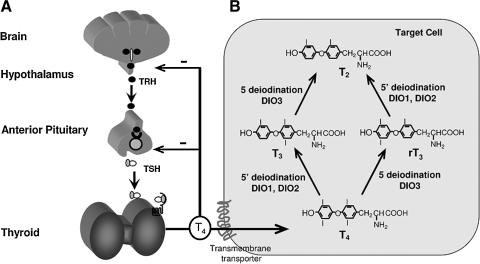
FIG. 1.
FIG. 1.
Central regulation of TH synthesis and TH metabolism. (A) Feedback system maintaining TH homeostasis. TRH secreted by the hypothalamus, stimulates the synthesis and secretion of TSH by the thyrotrophs, located in the anterior pituitary gland. TSH stimulates TH synthesis and secretion by the thyroid gland. TSH is also regulated by TH through a negative feedback system. (B) Activation and metabolism of TH. After active cellular uptake of TH through transmembrane transporters, the precursor 3,3′,5,5′-tetraiodothyronine (thyroxine, T4) is converted into the active 3,3′,5-triiodothyronine (T3) hormone or inactive 3,3′,5′-triiodothyronine metabolite (reverse T3, rT3). D1 and D2 are the principal enzymes that catalyze 5′-deiodination, converting T4 to T3 and rT3 to 3,′3-diiodothyronine (T2), while D3 catalyzes 5-deiodination, converting T4 to rT3 and T3 to T2.
FIG. 2.
FIG. 2.
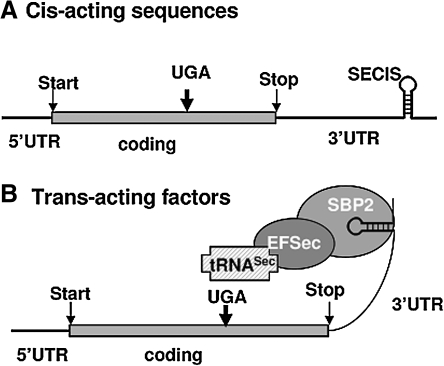
Some of the important components involved in Sec incorporation. (A) Cis-acting sequences present in the mRNA of selenoproteins: an in frame UGA codon, and Sec incorporation sequence (SECIS) element, a stem loop structure located in the 3′UTR (untranslated region). (B) Binding of the trans-acting factor SECIS-binding protein (SBP2) recruits the Sec-specific elongation factor (EFSec) and Sec-specific tRNA (tRNASec), resulting in the recoding of the UGA codon and Sec incorporation.
FIG. 3.
FIG. 3.
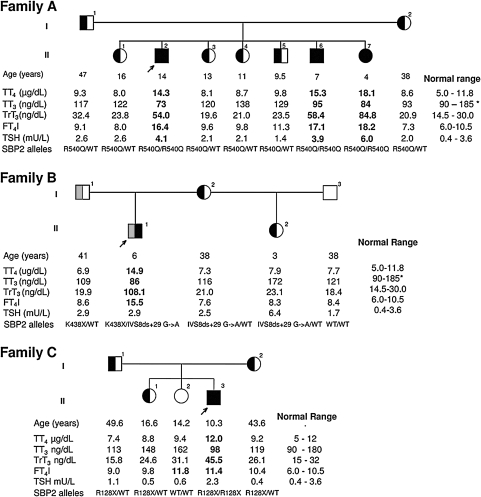
Pedigrees and thyroid function tests of the three families. (A, B, and C) Values are aligned under each subject symbol. TT4, total T4; TT3, total T3; TrT3, total reverse T3; FT4I, free T4 index. Abnormal values are in bold characters. Note that the blood sample from the proband of family C was obtained 5 days after interruption of L-T3 treatment. *The normal range for children younger than 10 years is 100–205 μg/dL. SBP2 alleles present in each individual are indicated.
FIG. 4.
FIG. 4.
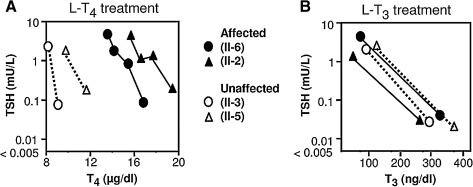
Evidence for abnormal TH metabolism. In vivo studies in members of family A. Serum TSH and corresponding serum T4 and T3 levels, before and during the oral administration of incremental doses of L-T4 (A) and L-T3 (B). Note that higher concentrations of T4, but not T3, are required to reduce serum TSH in the affected subjects. Affected and normal individuals are identified in the legend and described in detail in Fig. 3A.
FIG. 5.
FIG. 5.
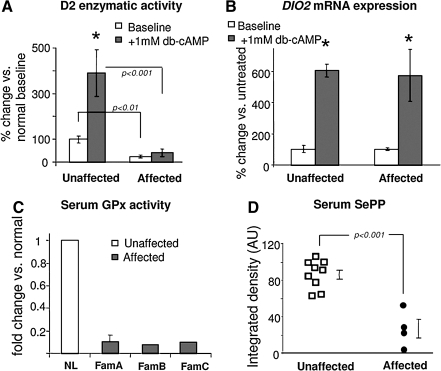
In vitro studies. (A) Deiodinase 2 enzymatic activity and (B) DIO2 mRNA expression in cultured fibroblasts from two affected children and four unaffected individuals from family A. Bars indicate ± SEM. Baseline and stimulated D2 activity is significantly lower in affected. There is significant increase of DIO2 mRNA with db-cAMP, in both normals and affected (*p < 0.001). There are no significant differences in baseline and db-cAMP-stimulated DIO2 mRNA in affected versus the unaffected. (C and D) Effect of SBP2 deficiency on selenoproteins other than deiodinases. (C) Glutathione peroxidase (GPx) enzymatic activity in serum from all five affected children and nine unaffected individuals (NL) from families A, B, and C. Results are expressed as fold change compared to unaffected subjects. Bars indicate mean ± SD. (D) SePP levels in serum from four affected and available unaffected members of families A and B were quantified by scanning the Western blot (AU, arbitrary units).
FIG. 6.
FIG. 6.
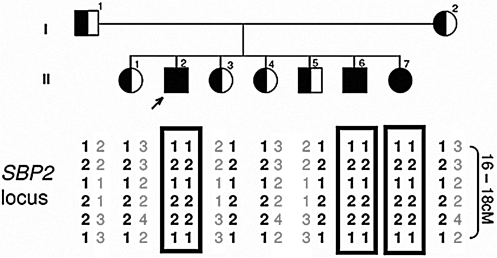
Identification of a SBP2 gene mutation; Haplotyping of family A with genetic markers overlapping the SBP2 locus. Affected share homozygous haplotypes while the unaffected parents and siblings are heterozygous.
FIG. 7.
FIG. 7.
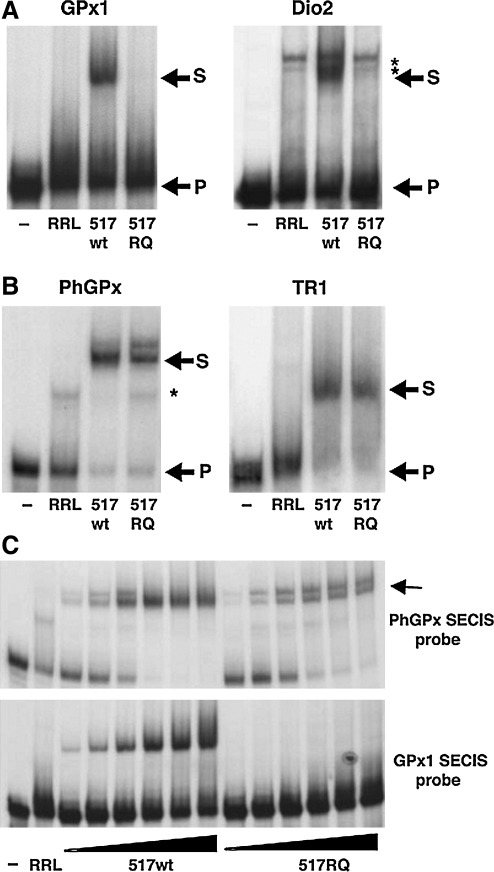
In vitro studies using the rat Sbp2 R531Q, the equivalent mutation to the human SBP2 R540Q mutation identified in family A. Rat Sbp2 R531Q results in selective perturbations in SECIS interactions. (A) REMSA assay with in vitro translated rat Sbp2[517–777] or rat Sbp2[517–777,R531Q] using rat GPx1 and human Dio2 SECIS elements as probes. P, unbound probe; S, shift caused by the functional SBP2/SECIS interaction; *shift caused by interaction with endogenous protein in the lysate. (B) REMSA assay as above, using rat PhGPx and TR1 SECIS as probe. (C) REMSA with increasing concentrations of rat Sbp2[517–777] or Sbp2[517–777,R531Q], corresponding to a 24-fold range, with probes as indicated; wt, wild type. Arrow indicates the functional band, the lower band of the two. [Figure reproduced from Bubenik et al. (9) JBC 282: 34658, 2007, with permission from the authors and publisher].
FIG. 8.
FIG. 8.
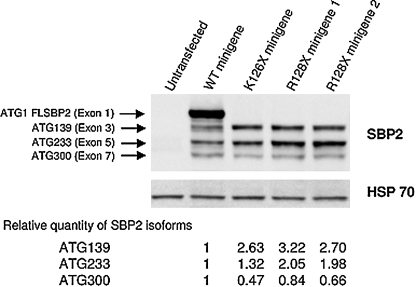
Western blot of SBP2 synthesized by minigenes expressing the mutation identified in family C. Minigenes constructs, identified above each lane, were transiently transfected into HEK293T cells and products were electophoresed, blotted, and developed with antibodies to SBP2. Bands generated from different ATGs are identified as described previously (68). Their relative proportion was quantified by density measurement using Image J and expressed relative to the corresponding band generated by the WT full length (FL) minigene and corrected for HSP 70; HSP, heat shock protein.
FIG. 9.
FIG. 9.
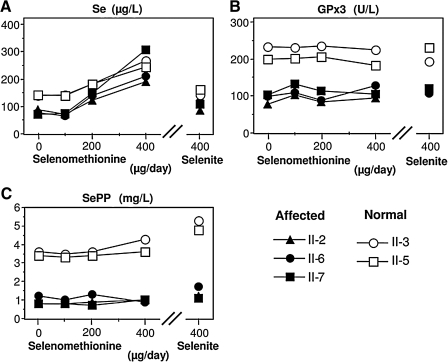
Effects of selenium (Se) supplementation in the form of Se-rich yeast (primarily selenomethionine) and selenite for SBP2-deficient individuals of family A and their normal siblings. (A) Serum Se concentration; (B) glutathione peroxidase (GPx) 3 enzymatic activity in serum; (C) serum selenoprotein P (SePP) concentration. Affected and normal individuals are identified in the legend and described in detail in Fig. 3A.
FIG. 10.
FIG. 10.
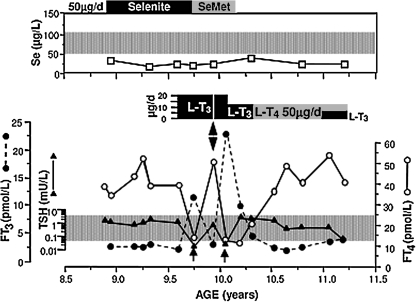
Clinical course of the proband of family C (subject II-3, Fig. 3C). Note the low serum Se concentration that did not respond to Se treatment in the form of selenite or selenomethionine (SeM). Normal range is for children and adults living in England and Wales as provided by the Trace Elements Laboratory Department of Clinical Biochemistry, City Hospital, Birmingham, UK. The thyroid function test abnormalities (high serum T4 and low T3 concentrations in the presence of a normal serum TSH level), characteristic of SBP2 defects, were persistent during the initial 7-month period of observation. Treatment with 20 μg L-T3, reduced the serum T4 levels but also suppressed the serum TSH concentration (arrows). Variations in serum FT3 concentrations are due to different interval of time between blood sampling and the last dose of L-T3. The double head arrow indicates cessation of L-T3 treatment for 5 days which promptly returned the baseline thyroid test abnormalities.
FIG. 11.
FIG. 11.
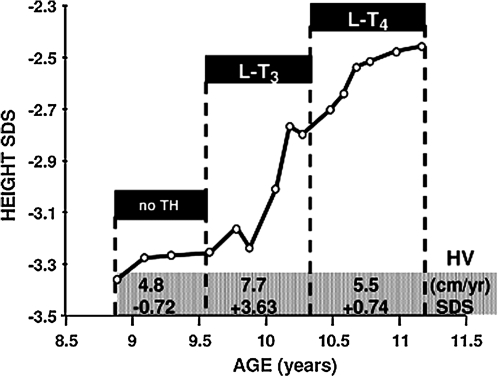
Effect of thyroid hormone treatment on linear growth of the proband of family C (subject II-3, Fig. 3C). Height is expressed as standard deviation score in the ordinate and as a function of chronological age (31). Height velocities (HV) are changes in height over a >6-month interval and expressed in cm/year (87) and as SDS. In this plot, they are averaged for the three periods defined by the treatment given.

References

    1. Balazs AE. Athanassaki I. Gunn SK. Tatevian N. Huang SA. Haymond MW. Karaviti LP. Rapid resolution of consumptive hypothyroidism in a child with hepatic hemangioendothelioma following liver transplantation. Ann Clin Lab Sci. 2007;37:280–284. - PubMed
    1. Baqui MM. Gereben B. Harney JW. Larsen PR. Bianco AC. Distinct subcellular localization of transiently expressed types 1 and 2 iodothyronine deiodinases as determined by immunofluorescence confocal microscopy. Endocrinology. 2000;141:4309–4312. - PubMed
    1. Bellinger FP. Raman AV. Reeves MA. Berry MJ. Regulation and function of selenoproteins in human disease. Biochem J. 2009;422:11–22. - PMC - PubMed
    1. Berry MJ. Grieco D. Taylor BA. Maia AL. Kieffer JD. Beamer W. Glover E. Poland A. Larsen PR. Physiological and genetic analyses of inbred mouse strains with a type I iodothyronine 5′ deiodinase deficiency. J Clin Invest. 1993;92:1517–1528. - PMC - PubMed
    1. Bessho K. Etani Y. Ichimori H. Miyoshi Y. Namba N. Yoneda A. Ooue T. Chihara T. Morii E. Aoki T. Murakami M. Mushiake S. Ozono K. Increased type 3 iodothyronine deiodinase activity in a regrown hepatic hemangioma with consumptive hypothyroidism. Eur J Pediatr. 2009 June 23 [Epub ahead of print]. - PubMed

Publication types

MeSH terms

LinkOut - more resources