


Pin1 regulates parathyroid hormone mRNA stability
- PMID: 19770518
- PMCID: PMC2752089
- DOI: 10.1172/JCI40784
Pin1 regulates parathyroid hormone mRNA stability
Abstract
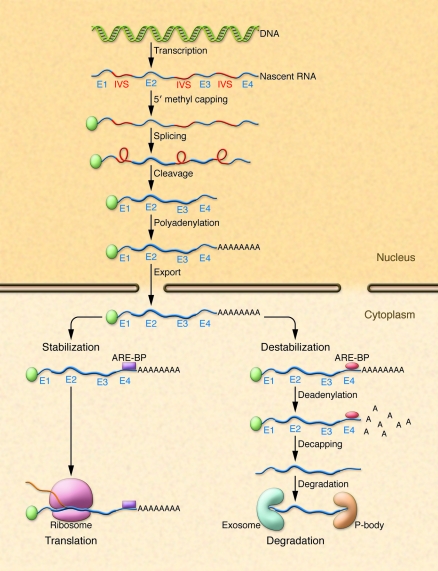
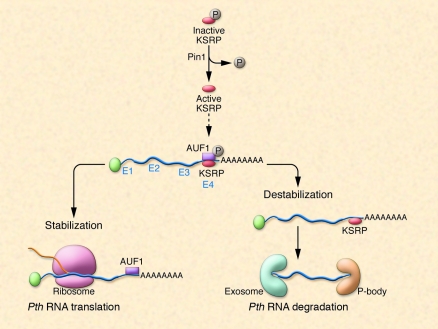
Secondary hyperparathyroidism often occurs in chronic kidney disease (CKD) and vitamin D deficiency, resulting in increased fractures and mortality. Understanding factors that stimulate parathyroid hormone (PTH) synthesis is important for devising methods to treat this condition. Previous work has demonstrated that murine Pth mRNA levels are regulated by proteins that bind AU-rich elements (AREs) within the 3' UTR region of Pth mRNA and influence Pth mRNA stability. In this issue of the JCI, Nechama et al. demonstrate that in murine secondary hyperparathyroidism associated with CKD or Ca deficiency, the activity of Pin1, a peptidyl-prolyl isomerase, is reduced (see the related article beginning on page 3102). Reduced Pin1 activity resulted in the phosphorylation and degradation of an ARE-binding protein, K-homology splicing regulator protein (KSRP), which normally enhances the degradation of Pth mRNA. The activity of other ARE-binding proteins, such as AU-rich binding factor 1 (AUF1), that increase Pth mRNA stability, was increased, thereby increasing PTH synthesis. This work suggests new ways by which to regulate PTH synthesis in secondary hyperparathyroidism.
Figures
Comment on
-
The peptidyl-prolyl isomerase Pin1 determines parathyroid hormone mRNA levels and stability in rat models of secondary hyperparathyroidism.J Clin Invest. 2009 Oct;119(10):3102-14. doi: 10.1172/JCI39522. Epub 2009 Sep 21. J Clin Invest. 2009. PMID: 19770516 Free PMC article.
References
Publication types
MeSH terms
Substances
Grants and funding
LinkOut - more resources
Full Text Sources
Miscellaneous
