Review
doi: 10.3324/haematol.2008.001628.
Epub 2009 Sep 22.
Anti-CD20 monoclonal antibodies: historical and future perspectives
Affiliations
- PMID: 19773256
- PMCID: PMC2805725
- DOI: 10.3324/haematol.2008.001628
Item in Clipboard
Review
Anti-CD20 monoclonal antibodies: historical and future perspectives
Haematologica.
2010 Jan.
Abstract
Antibodies to CD20 have confirmed the hypothesis that monoclonal reagents can be given in vivo to alleviate human diseases. The targeting of CD20 on normal, malignant and auto-immune B-lymphocytes by rituximab has demonstrated substantial benefits for patients with a variety of B-cell lymphomas, as well as some with autoimmune disorders. There has been a notable increase in the survival rates from B-cell lymphoma in the decade since anti-CD20 therapy was introduced.
Figures
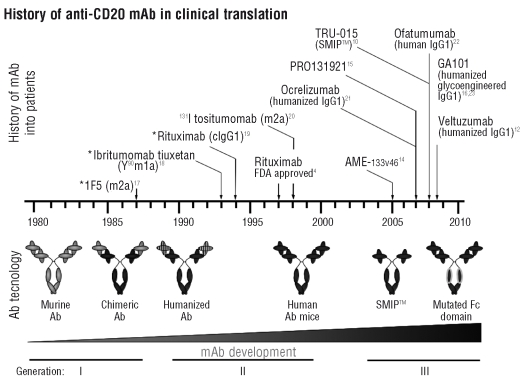
History of CD20 mAb in clinical translation. The time-line describes the chronological introduction over the last three decades of respective anti-CD20 mAb in human trials, as well as the corresponding progress in Ab technology from 1st through to 3rd generation reagents: generation Ab are murine or human/mouse chimeric Ab, 2nd generation Ab are either humanized or fully human and 3rd generation Ab have further modifications to the Ab structure e.g. mutation or a-fucosylation of the Fc domain for enhanced FcR binding profiles.
References
-
- Fisher RI, Gaynor ER, Dahlberg S, Oken MM, Grogan TM, Mize EM, et al. Comparison of a standard regimen (CHOP) with three intensive chemotherapy regimens for advanced non-Hodgkin’s lymphoma. N Engl J Med. 1993;328(14):1002–6. - PubMed
-
- Sehn LH, Donaldson J, Chhanabhai M, Fitzgerald C, Gill K, Klasa R, et al. Introduction of combined CHOP plus rituximab therapy dramatically improved outcome of diffuse large B-cell lymphoma in British Columbia. J Clin Oncol. 2005;23(22):5027–33. - PubMed
-
- Salles GA. Clinical features, prognosis and treatment of follicular lymphoma. Hematology Am Soc Hematol Educ Program. 2007:216–25. - PubMed
-
- Leget GA, Czuczman MS. Use of rituximab, the new FDA-approved antibody. Curr Opin Oncol. 1998;10(6):548–51. - PubMed
-
- Emmanouilides C. Radioimmunotherapy for non-Hodgkin’s lymphoma. Semin Oncol. 2003;30(4):531–44. - PubMed
Publication types
MeSH terms
Substances
Grants and funding
LinkOut - more resources
Full Text Sources
Other Literature Sources
Molecular Biology Databases