


Monitoring bacterial community of human gut microbiota reveals an increase in Lactobacillus in obese patients and Methanogens in anorexic patients
- PMID: 19774074
- PMCID: PMC2742902
- DOI: 10.1371/journal.pone.0007125
Monitoring bacterial community of human gut microbiota reveals an increase in Lactobacillus in obese patients and Methanogens in anorexic patients
Abstract
Background: Studies of the bacterial communities of the gut microbiota have revealed a shift in the ratio of Firmicutes and Bacteroidetes in obese patients. Determining the variations of microbial communities in feces may be beneficial for the identification of specific profiles in patients with abnormal weights. The roles of the archaeon Methanobrevibacter smithii and Lactobacillus species have not been described in these studies.
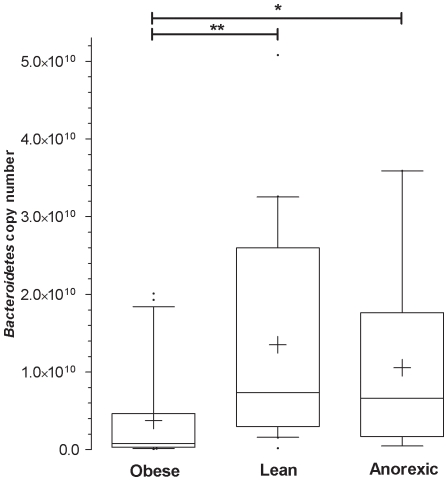
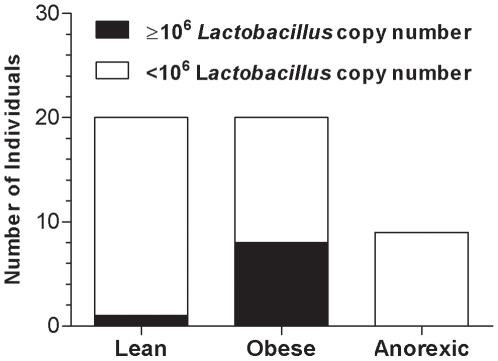
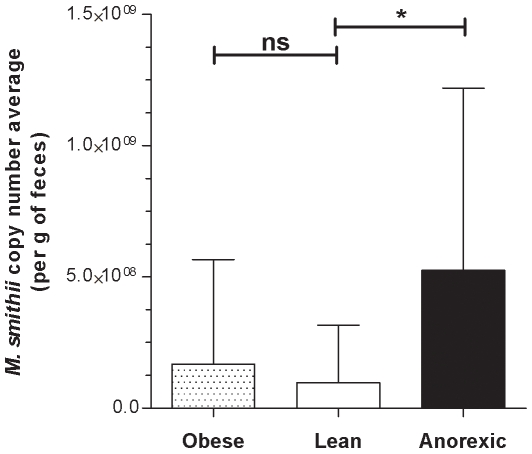
Methods and findings: We developed an efficient and robust real-time PCR tool that includes a plasmid-based internal control and allows for quantification of the bacterial divisions Bacteroidetes, Firmicutes, and Lactobacillus as well as the methanogen M. smithii. We applied this technique to the feces of 20 obese subjects, 9 patients with anorexia nervosa, and 20 normal-weight healthy controls. Our results confirmed a reduction in the Bacteroidetes community in obese patients (p<0.01). We found a significantly higher Lactobacillus species concentration in obese patients than in lean controls (p=0.0197) or anorexic patients (p=0.0332). The M. smithii concentration was much higher in anorexic patients than in the lean population (p=0.0171).
Conclusions: Lactobacillus species are widely used as growth promoters in the farm industry and are now linked to obesity in humans. The study of the bacterial flora in anorexic patients revealed an increase in M. smithii. This increase might represent an adaptive use of nutrients in this population.
Conflict of interest statement
Figures
References
-
- DiBaise JK, Zhang H, Crowell MD, Krajmalnik-Brown R, Decker GA, et al. Gut microbiota and its possible relationship with obesity. Mayo Clin Proc. 2008;83:460–469. - PubMed
-
- Raoult D. Obesity pandemics and the modification of digestive bacterial flora. Eur J Clin Microbiol Infect Dis. 2008;27:631–634. - PubMed
-
- Turnbaugh PJ, Ley RE, Mahowald MA, Magrini V, Mardis ER, et al. An obesity-associated gut microbiome with increased capacity for energy harvest. Nature. 2006;444:1027–1031. - PubMed
MeSH terms
LinkOut - more resources
Full Text Sources
Other Literature Sources
Medical
