Review
doi: 10.1111/j.1462-5822.2009.01368.x.
Epub 2009 Sep 23.
Salmonella--the ultimate insider. Salmonella virulence factors that modulate intracellular survival
Affiliations
- PMID: 19775254
- PMCID: PMC2774479
- DOI: 10.1111/j.1462-5822.2009.01368.x
Item in Clipboard
Review
Salmonella--the ultimate insider. Salmonella virulence factors that modulate intracellular survival
Cell Microbiol.
2009 Nov.
Free PMC article
Abstract
Salmonella enterica serovar Typhimurium is a common facultative intracellular pathogen that causes food-borne gastroenteritis in millions of people worldwide. Intracellular survival and replication are important virulence determinants and the bacteria can be found in a variety of phagocytic and non-phagocytic cells in vivo. Invasion of host cells and intracellular survival are dependent on two type III secretion systems, T3SS1 and T3SS2, each of which translocates a distinct set of effector proteins. However, other virulence factors including ion transporters, superoxide dismutase, flagella and fimbriae are also involved in accessing and utilizing the intracellular niche.
Figures
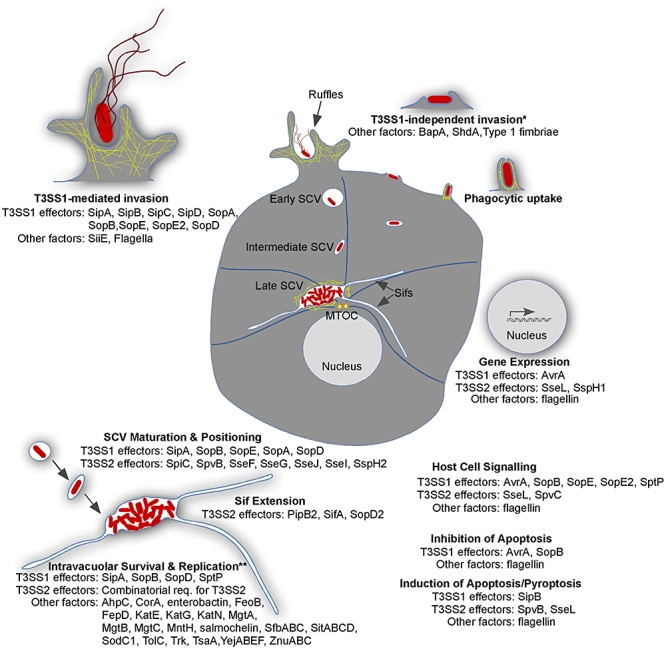
Virulence factors involved in the intracellular survival of Salmonella. Salmonella can enter host cells by invasion (T3SS1-mediated) or phagocytosis. In addition, a T3SS1-independent invasion* has been shown to occur in several cell types that may be mediated by fimbriae or non-fimbrial adhesins. Following internalization Salmonella remain within a modified phagosome known as the SCV (Salmonella-containing vacuole). Biogenesis of the SCV and its translocation to the MTOC (microtubule-organizing centre) involves interactions with the host cell endocytic pathway and microtubules and is mediated by a variety of T3SS1 and T3SS2 effector proteins. Survival and replication within the SCV are dependent on a number of factors including nutrient acquisition and avoidance of host antibacterial activities. **Listed are a number of factors implicated but not necessarily proven to be required for intracellular survival. Yellow and blue lines indicate actin, associated with invasion and the SCV, and microtubules, required for positioning of the SCV and Sif extension respectively.
References
-
- Ammendola S, Pasquali P, Pistoia C, Petrucci P, Petrarca P, Rotilio G, Battistoni A. High-affinity Zn2+ uptake system ZnuABC is required for bacterial zinc homeostasis in intracellular environments and contributes to the virulence of Salmonella enterica. Infect Immun. 2007;75:5867–5876. - PMC - PubMed
-
- Beuzon CR, Salcedo SP, Holden DW. Growth and killing of a Salmonella enterica serovar Typhimurium sifA mutant strain in the cytosol of different host cell lines. Microbiology. 2002;148:2705–2715. - PubMed
Publication types
MeSH terms
Substances
Grants and funding
LinkOut - more resources
Full Text Sources
Other Literature Sources