


Long-term care cost drivers and expenditure projection to 2036 in Hong Kong
- PMID: 19775476
- PMCID: PMC2765433
- DOI: 10.1186/1472-6963-9-172
Long-term care cost drivers and expenditure projection to 2036 in Hong Kong
Abstract
Background: Hong Kong's rapidly ageing population, characterised by one of the longest life expectancies and the lowest fertility rate in the world, is likely to drive long-term care (LTC) expenditure higher. This study aims to identify key cost drivers and derive quantitative estimates of Hong Kong's LTC expenditure to 2036.
Methods: We parameterised a macro actuarial simulation with data from official demographic projections, Thematic Household Survey 2004, Hong Kong's Domestic Health Accounts and other routine data from relevant government departments, Hospital Authority and other LTC service providers. Base case results were tested against a wide range of sensitivity assumptions.
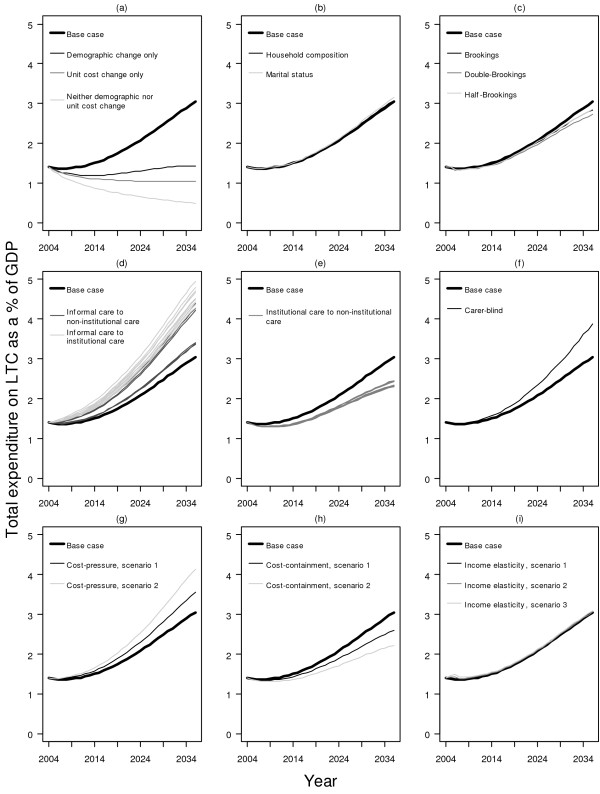
Results: Total projected LTC expenditure as a proportion of GDP reflected secular trends in the elderly dependency ratio, showing a shallow dip between 2004 and 2011, but thereafter yielding a monotonic rise to reach 3.0% by 2036. Demographic changes would have a larger impact than changes in unit costs on overall spending. Different sensitivity scenarios resulted in a wide range of spending estimates from 2.2% to 4.9% of GDP. The availability of informal care and the setting of formal care as well as associated unit costs were important drivers of expenditure.
Conclusion: The "demographic window" between the present and 2011 is critical in developing policies to cope with the anticipated burgeoning LTC burden, in concert with the related issues of health care financing and retirement planning.
Figures
References
-
- Wittenberg R, Comas-Herrera A, King D, Malley J, Pickard L, Darton R. Future demand for long-term care, 2002 to 2041: projections of demand for long-term care for older people in England. Canterbury: Personal Social Services Research Unit, London School of Economics; 2006.
-
- Organisation for Economic Cooperation and Development . Projecting OECD health and long-term care expenditures: what are the main drivers? OECD Economics Department working paper no. 477. Paris: Organisation for Economic Cooperation and Development; 2006.
-
- Hancock R, Comas-Herrera A, Wittenberg R, Pickard L. Who will pay for long-term care in the UK? Projections linking macro- and micro-simulation models. Fiscal Studies. 2003;24:387–426.
-
- Stone R. Long-term care for the elderly with disabilities: current policy, emerging trends, and implications for the twenty-first century. New York: Millbank Memorial Fund; 2000.
Publication types
MeSH terms
LinkOut - more resources
Full Text Sources
