


Incident heart failure prediction in the elderly: the health ABC heart failure score
- PMID: 19777072
- PMCID: PMC2748334
- DOI: 10.1161/CIRCHEARTFAILURE.108.768457
Incident heart failure prediction in the elderly: the health ABC heart failure score
Abstract
Background: Despite the rising heart failure (HF) incidence and aging United States population, there are no validated prediction models for incident HF in the elderly. We sought to develop a new prediction model for 5-year risk of incident HF among older persons.
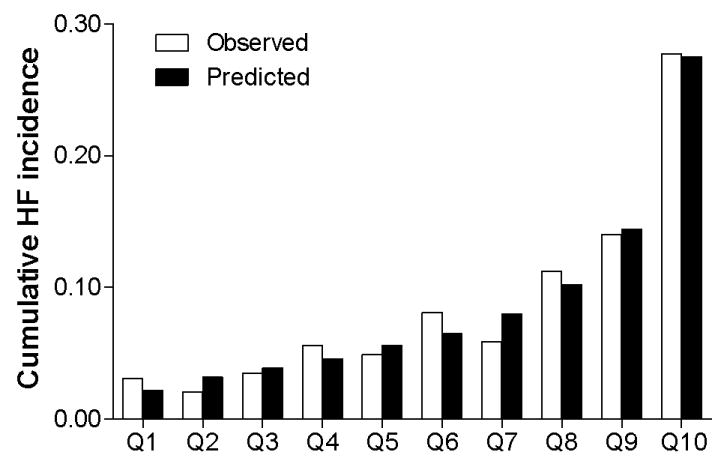
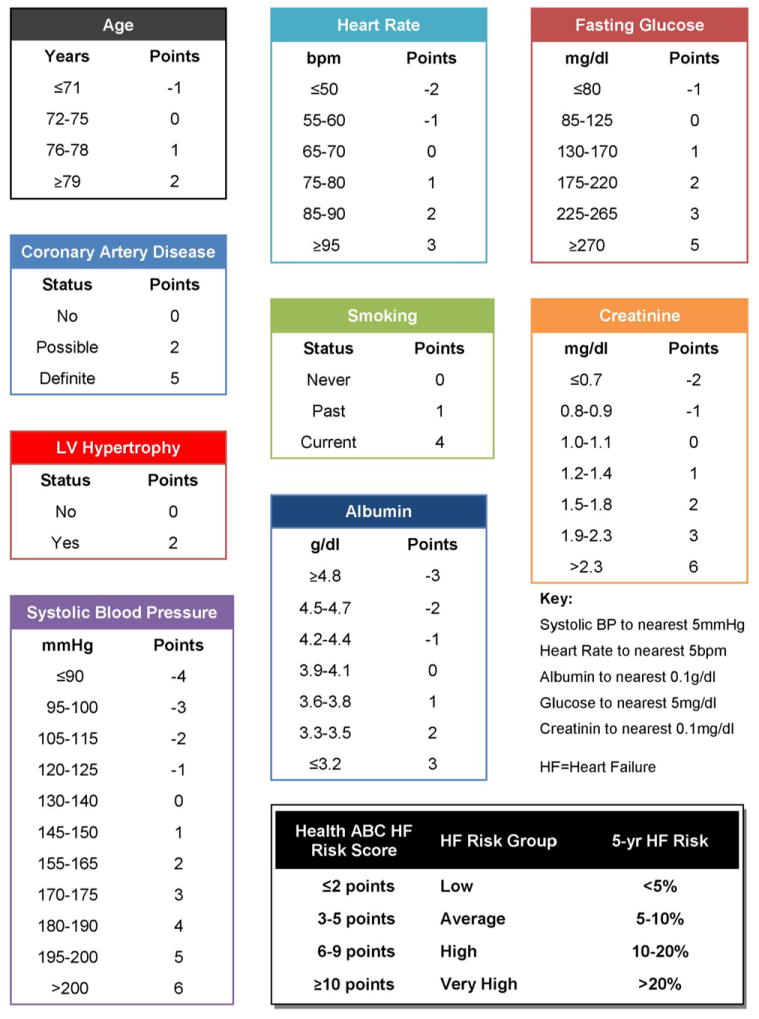
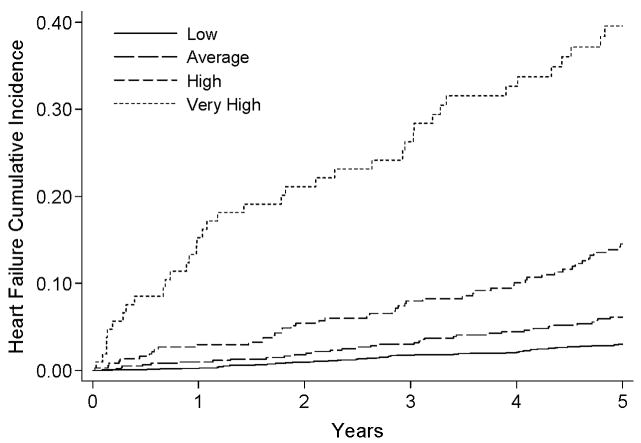
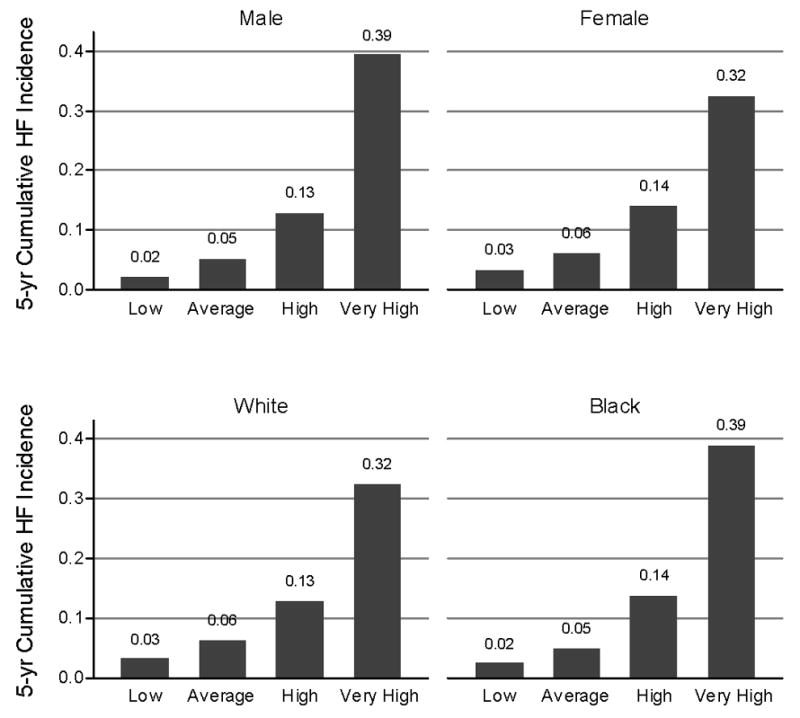
Methods and results: Proportional hazards models were used to assess independent predictors of incident HF, defined as hospitalization for new-onset HF, in 2935 elderly participants without baseline HF enrolled in the Health ABC study (age, 73.6 +/- 2.9 years, 47.9% males, 58.6% whites). A prediction equation was developed and internally validated by bootstrapping, allowing the development of a 5-year risk score. Incident HF developed in 258 (8.8%) participants during 6.5 +/- 1.8 years of follow-up. Independent predictors of incident HF included age, history of coronary disease and smoking, baseline systolic blood pressure and heart rate, serum glucose, creatinine, and albumin levels, and left ventricular hypertrophy. The Health ABC HF model had a c-statistic of 0.73 in the derivation dataset, 0.72 by internal validation (optimism-corrected), and good calibration (goodness-of-fit 2 6.24, P=0.621). A simple point score was created to predict incident HF risk into 4 risk groups corresponding to <5%, 5% to 10%, 10% to 20%, and >20% 5-year risk. The actual 5-year incident HF rates in these groups were 2.9%, 5.7%, 13.3%, and 36.8%, respectively.
Conclusion: The Health ABC HF prediction model uses common clinical variables to predict incident HF risk in the elderly, an approach that may be used to target and treat high-risk individuals.
Keywords: elderly; epidemiology; heart failure; risk factors; statistical models.
Figures
Similar articles
-
Validation of the health ABC heart failure model for incident heart failure risk prediction: the Cardiovascular Health Study.Circ Heart Fail. 2010 Jul;3(4):495-502. doi: 10.1161/CIRCHEARTFAILURE.109.904300. Epub 2010 Apr 28. Circ Heart Fail. 2010. PMID: 20427700 Free PMC article.
-
Risk for Incident Heart Failure: A Subject-Level Meta-Analysis From the Heart "OMics" in AGEing (HOMAGE) Study.J Am Heart Assoc. 2017 May 2;6(5):e005231. doi: 10.1161/JAHA.116.005231. J Am Heart Assoc. 2017. PMID: 28465299 Free PMC article. Review.
-
Glycemic status and incident heart failure in elderly without history of diabetes mellitus: the health, aging, and body composition study.J Card Fail. 2009 Sep;15(7):593-9. doi: 10.1016/j.cardfail.2009.03.001. Epub 2009 Apr 25. J Card Fail. 2009. PMID: 19700136 Free PMC article.
-
Machine Learning to Predict the Risk of Incident Heart Failure Hospitalization Among Patients With Diabetes: The WATCH-DM Risk Score.Diabetes Care. 2019 Dec;42(12):2298-2306. doi: 10.2337/dc19-0587. Epub 2019 Sep 13. Diabetes Care. 2019. PMID: 31519694 Free PMC article.
-
Resting heart rate and risk of incident heart failure: three prospective cohort studies and a systematic meta-analysis.J Am Heart Assoc. 2015 Jan 14;4(1):e001364. doi: 10.1161/JAHA.114.001364. J Am Heart Assoc. 2015. PMID: 25589535 Free PMC article. Review.
Cited by
-
Use of Polygenic Risk Score for Prediction of Heart Failure in Cancer Survivors.JACC CardioOncol. 2024 Aug 30;6(5):714-727. doi: 10.1016/j.jaccao.2024.04.010. eCollection 2024 Oct. JACC CardioOncol. 2024. PMID: 39479322 Free PMC article.
-
Prediction of incident heart failure in general practice: the Atherosclerosis Risk in Communities (ARIC) Study.Circ Heart Fail. 2012 Jul 1;5(4):422-9. doi: 10.1161/CIRCHEARTFAILURE.111.964841. Epub 2012 May 15. Circ Heart Fail. 2012. PMID: 22589298 Free PMC article.
-
Asymptomatic cardiac toxicity in long-term cancer survivors: defining the population and recommendations for surveillance.Semin Oncol. 2013 Apr;40(2):229-38. doi: 10.1053/j.seminoncol.2013.01.005. Semin Oncol. 2013. PMID: 23540748 Free PMC article.
-
Stable but Progressive Nature of Heart Failure: Considerations for Primary Care Physicians.Am J Cardiovasc Drugs. 2018 Oct;18(5):333-345. doi: 10.1007/s40256-018-0277-0. Am J Cardiovasc Drugs. 2018. PMID: 29761293 Free PMC article. Review.
-
Predicting Incident Heart Failure in Women With Machine Learning: The Women's Health Initiative Cohort.Can J Cardiol. 2021 Nov;37(11):1708-1714. doi: 10.1016/j.cjca.2021.08.006. Epub 2021 Aug 13. Can J Cardiol. 2021. PMID: 34400272 Free PMC article.
References
-
- Hunt SA. ACC/AHA 2005 guideline update for the diagnosis and management of chronic heart failure in the adult: a report of the American College of Cardiology/American Heart Association Task Force on Practice Guidelines. J Am Coll Cardiol. 2005;46:e1–82. - PubMed
-
- Thom T, Haase N, Rosamond W, Howard VJ, Rumsfeld J, Manolio T, Zheng ZJ, Flegal K, O’Donnell C, Kittner S, Lloyd-Jones D, Goff DC, Jr, Hong Y, Adams R, Friday G, Furie K, Gorelick P, Kissela B, Marler J, Meigs J, Roger V, Sidney S, Sorlie P, Steinberger J, Wasserthiel-Smoller S, Wilson M, Wolf P. Heart disease and stroke statistics--2006 update: a report from the American Heart Association Statistics Committee and Stroke Statistics Subcommittee. Circulation. 2006;113:e85–151. - PubMed
-
- Roger VL, Weston SA, Redfield MM, Hellermann-Homan JP, Killian J, Yawn BP, Jacobsen SJ. Trends in heart failure incidence and survival in a community-based population. JAMA. 2004;292:344–350. - PubMed
-
- The Booming Dynamics of Aging. The 2005 White House Conference on Aging. [Accessed 08/08/2007]. Available at: www.whcoa.gov.
-
- Mokdad AH, Ford ES, Bowman BA, Dietz WH, Vinicor F, Bales VS, Marks JS. Prevalence of obesity, diabetes, and obesity-related health risk factors, 2001. JAMA. 2003;289:76–79. - PubMed
Publication types
MeSH terms
Grants and funding
LinkOut - more resources
Full Text Sources
Other Literature Sources
Medical
Research Materials
Miscellaneous
