


The kynurenine pathway in adolescent depression: preliminary findings from a proton MR spectroscopy study
- PMID: 19778568
- PMCID: PMC2815014
- DOI: 10.1016/j.pnpbp.2009.09.015
The kynurenine pathway in adolescent depression: preliminary findings from a proton MR spectroscopy study
Abstract
Background: Cytokine induction of the enzyme indoleamine 2,3-dioxygenase (IDO) has been implicated in the development of major depressive disorder (MDD). IDO metabolizes tryptophan (TRP) into kynurenine (KYN), thereby decreasing TRP availability to the brain. KYN is further metabolized into several neurotoxins. The aims of this pilot were to examine possible relationships between plasma TRP, KYN, and 3-hydroxyanthranilic acid (3-HAA, neurotoxic metabolite) and striatal total choline (tCho, cell membrane turnover biomarker) in adolescents with MDD. We hypothesized that MDD adolescents would exhibit: i) positive correlations between KYN and 3-HAA and striatal tCho and a negative correlation between TRP and striatal tCho; and, ii) the anticipated correlations would be more pronounced in the melancholic subtype group.
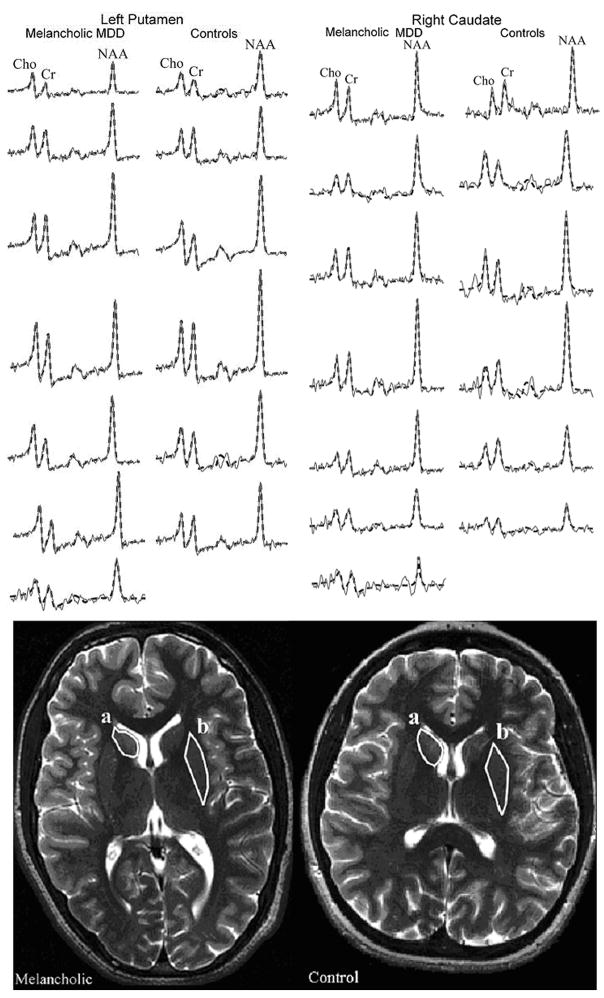
Methods: Fourteen adolescents with MDD (seven with melancholic features) and six healthy controls were enrolled. Minimums of 6 weeks MDD duration and a severity score of 40 on the Children's Depression Rating Scale-Revised were required. All were scanned at 3T with MRI, multi-voxel 3-dimensional, high, 0.75 cm(3), spatial resolution proton magnetic resonance spectroscopic imaging. Striatal tCho concentrations were assessed using phantom replacement. Spearman correlation coefficients were Bonferroni-corrected.
Results: Positive correlations were found only in the melancholic group, between KYN and 3-HAA and tCho in the right caudate (r=0.93, p=0.03) and the left putamen (r=0.96, p=.006), respectively.
Conclusions: These preliminary findings suggest a possible role of the KYN pathway in adolescent melancholic MDD. Larger studies should follow.
Copyright 2009 Elsevier Inc. All rights reserved.
Figures


References
-
- Anderson IM, Parry-Billings M, Newsholme EA, Poortmans JR, Cowen PJ. Decreased plasma tryptophan concentration in major depression: relationship to melancholia and weight loss. J Affect Disord. 1990;20:185–91. - PubMed
-
- Baumann B, Danos P, Krell D, Diekmann S, Leschinger A, Stauch R, et al. Reduced volume of limbic system-affiliated basal ganglia in mood disorders: preliminary data from a postmortem study. J Neuropsychiatry Clin Neurosci. 1999;11:71–8. - PubMed
-
- Bernstein MA, Fain SB, Riederer SJ. Effect of windowing and zero-filled reconstruction of MRI data on spatial resolution and acquisition strategy. J Magn Reson Imaging. 2001;14:270–80. - PubMed
-
- Caetano SC, Fonseca M, Olvera RL, Nicoletti M, Hatch JP, Stanley JA, et al. Proton spectroscopy study of the left dorsolateral prefrontal cortex in pediatric depressed patients. Neurosci Lett. 2005;384:321–6. - PubMed
-
- Capuron L, Neurauter G, Musselman DL, Lawson DH, Nemeroff CB, Fuchs D, et al. Interferon-alpha-induced changes in tryptophan metabolism. relationship to depression and paroxetine treatment. Biol Psychiatry. 2003;54:906–14. - PubMed
Publication types
MeSH terms
Substances
Grants and funding
- R01 NS050520/NS/NINDS NIH HHS/United States
- M01 RR000096/RR/NCRR NIH HHS/United States
- R01 EB001015/EB/NIBIB NIH HHS/United States
- AT004576/AT/NCCIH NIH HHS/United States
- R56 NS050520/NS/NINDS NIH HHS/United States
- AT002395/AT/NCCIH NIH HHS/United States
- EB01015/EB/NIBIB NIH HHS/United States
- MH077072/MH/NIMH NIH HHS/United States
- R21 AT004576/AT/NCCIH NIH HHS/United States
- K23 MH077072/MH/NIMH NIH HHS/United States
- R21 AT002395/AT/NCCIH NIH HHS/United States
- M01-RR00096/RR/NCRR NIH HHS/United States
- NS050520/NS/NINDS NIH HHS/United States
LinkOut - more resources
Full Text Sources
Medical
Research Materials
