


Stem cells for liver repopulation
- PMID: 19779345
- PMCID: PMC3725723
- DOI: 10.1097/MOT.0b013e3283328070
Stem cells for liver repopulation
Abstract
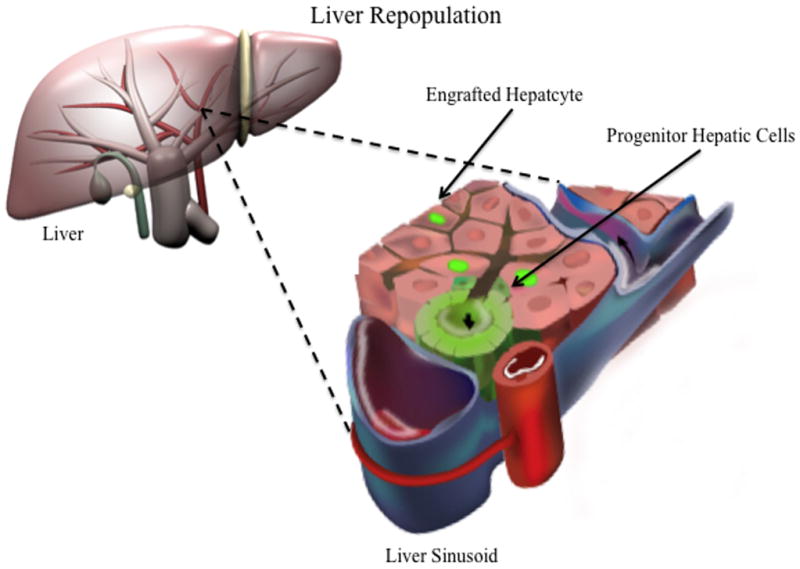
Purpose of review: The capacity of the liver to regenerate and maintain a constant size despite injury is unique. However, the exact mechanisms are not completely clear. Cell transplantation has been proposed as an alternative treatment of liver diseases. Recent progress has been reported on the generation of stem/progenitor cells that may differentiate toward the hepatic lineage. However, it is currently difficult to determine which of the stem/progenitor cell populations are the best for therapy of a given disease.
Recent findings: The limited access to donor human hepatocytes has led to a great interest in the generation of hepatocyte-like cells. Several potential cell sources have been identified. However, general standardization of the methods to evaluate these cells is particularly important for the promise of stem/progenitor-derived hepatocyte-based therapies. Moreover, innovations aimed at improving hepatocyte delivery, survival, and engraftment have recently opened the field of organ engineering that may improve liver repopulation.
Summary: Here we review current evidence reported from the perspective of potential clinical applications of different hepatic cell sources with repopulation capacities and the future perspectives and tools that can facilitate the translation of laboratory work into clinical success.
Figures
References
-
- Strom SC, Fisher RA, Rubinstein WS, Barranger JA, Towbin RB, Charron M, Mieles L, Pisarov LA, Dorko K, Thompson MT, et al. Transplantation of human hepatocytes. Transplant Proc. 1997;29:2103–2106. - PubMed
-
- Horslen SP, McCowan TC, Goertzen TC, Warkentin PI, Cai HB, Strom SC, Fox IJ. Isolated hepatocyte transplantation in an infant with a severe urea cycle disorder. Pediatrics. 2003;111:1262–1267. - PubMed
-
- Mitry RR, Dhawan A, Hughes RD, Bansal S, Lehec S, Terry C, Heaton ND, Karani JB, Mieli-Vergani G, Rela M. One liver, three recipients: segment IV from split-liver procedures as a source of hepatocytes for cell transplantation. Transplantation. 2004;77:1614–1616. - PubMed
-
- Puppi J, Tan N, Mitry RR, Hughes RD, Lehec S, Mieli-Vergani G, Karani J, Champion MP, Heaton N, Mohamed R, et al. Hepatocyte transplantation followed by auxiliary liver transplantation--a novel treatment for ornithine transcarbamylase deficiency. Am J Transplant. 2008;8:452–457. First report of the experience of hepatocyte transplantations as a bridge therapy for auxiliary partial orthotopic liver transplantation. - PubMed
-
- Meyburg J, Hoerster F, Weitz J, Hoffmann GF, Schmidt J. Use of the middle colic vein for liver cell transplantation in infants and small children. Transplant Proc. 2008;40:936–937. - PubMed
Publication types
MeSH terms
Grants and funding
LinkOut - more resources
Full Text Sources
Medical
