


Quantitative metabolic profiles of 2nd and 3rd trimester human amniotic fluid using (1)H HR-MAS spectroscopy
- PMID: 19779747
- PMCID: PMC4852483
- DOI: 10.1007/s10334-009-0184-0
Quantitative metabolic profiles of 2nd and 3rd trimester human amniotic fluid using (1)H HR-MAS spectroscopy
Abstract
Object: To establish and compare normative metabolite concentrations in 2nd and 3rd trimester human amniotic fluid samples in an effort to reveal metabolic biomarkers of fetal health and development.
Materials and methods: Twenty-one metabolite concentrations were compared between 2nd (15-27 weeks gestation, N = 23) and 3rd (29-39 weeks gestation, N = 27) trimester amniotic fluid samples using (1)H high resolution magic angle spinning (HR-MAS) spectroscopy. Data were acquired using the electronic reference to access in vivo concentrations method and quantified using a modified semi-parametric quantum estimation algorithm modified for high-resolution ex vivo data.
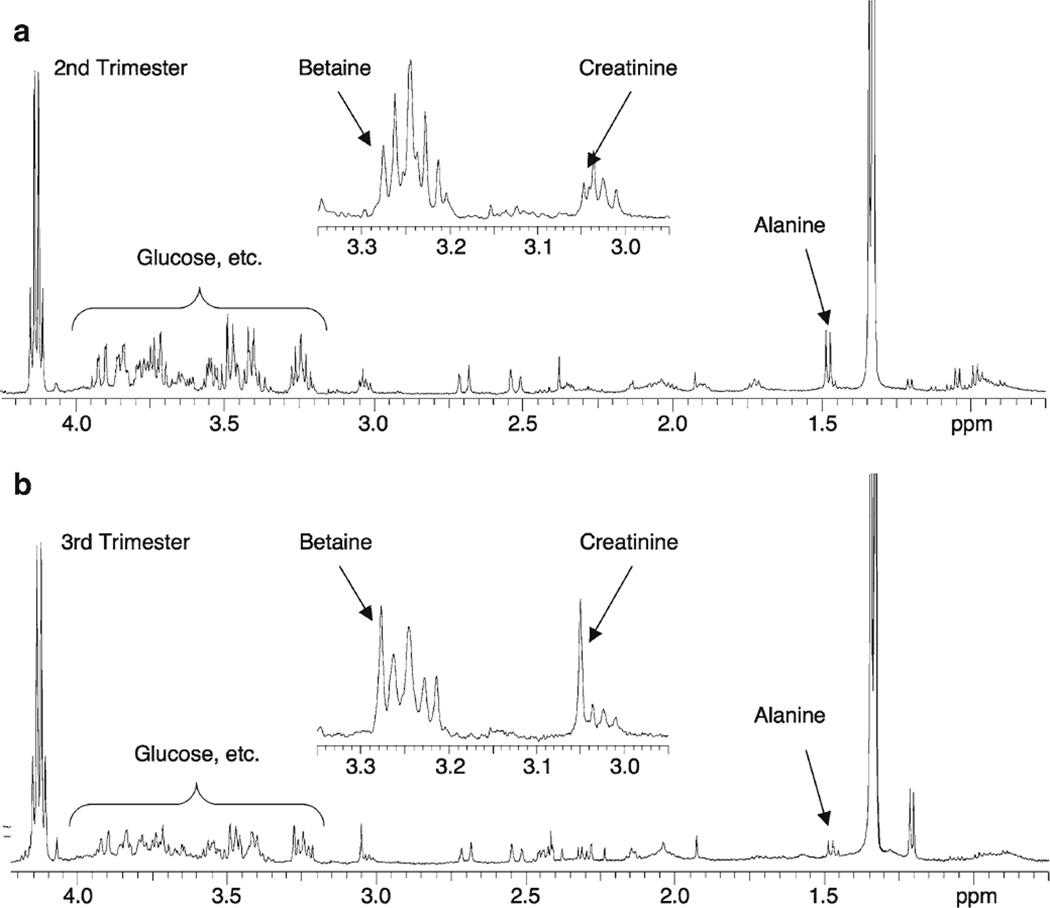
Results: Sixteen of 21 metabolite concentrations differed significantly between 2nd and 3rd trimester groups. Betaine (0.00846+/-0.00206 mmol/kg vs. 0.0133+/-0.0058 mmol/kg, P < 0.002) and creatinine (0.0124+/-0.0058 mmol/kg vs. 0.247+/-0.011 mmol/kg, P < 0.001) concentrations increased significantly, while glucose (5.96+/-1.66 mmol/kg vs. 2.41+/-1.69 mmol/kg, P < 0.001), citrate (0.740+/-0.217 mmol/kg vs. 0.399+/-0.137 mmol/kg, P < 0.001), pyruvate (0.0659+/-0.0103 mmol/kg vs. 0.0299+/-0.286 mmol/kg, P < 0.001), and numerous amino acid (e.g. alanine, glutamate, isoleucine, leucine, lysine, and valine) concentrations decreased significantly with advancing gestation. A stepwise multiple linear regression model applied to 50 samples showed that gestational age can be accurately predicted using combinations of alanine, glucose and creatinine concentrations.
Conclusion: These results provide key normative data for 2nd and 3rd trimester amniotic fluid metabolite concentrations and provide the foundation for future development of magnetic resonance spectroscopy (MRS) biomarkers to evaluate fetal health and development.
Figures
References
-
- McGowan PE, Reglinski J, Wilson R, Walker JJ, Wisdoms S, McKillop JH. Quantitative 1H-NMR analysis of amniotic fluid. J Pharm Biomed Anal. 1993;11(8):629–632. - PubMed
-
- Fenton BW, Lin CS, Ascher S, Macedonia C. Magnetic resonance spectroscopy to detect lecithin in amniotic fluid and fetal lung. Obstet Gynecol. 2000;95(3):457–460. - PubMed
-
- Clifton MS, Joe BN, Zektzer AS, Kurhanewicz J, Vigneron DB, Coakley FV, Nobuhara KK, Swanson MG. Feasibility of magnetic resonance spectroscopy for evaluating fetal lung maturity. J Pediatr Surg. 2006;41(4):768–773. - PubMed
-
- Nelson TR, Gillies RJ, Powell DA, Schrader MC, Manchester DK, Pretorius DH. High resolution proton NMR spectroscopy of human amniotic fluid. Prenat Diagn. 1987;7(5):363–372. - PubMed
-
- Pearce JM, Komoroski RA. Resolution of phospholipid molecular species by 31P NMR. Magn Reson Med. 1993;29(6):724–731. - PubMed
