Review
. 2009 Nov;111(4):915-33.
doi: 10.1111/j.1471-4159.2009.06397.x. Epub 2009 Sep 23.

Multifunctional roles of enolase in Alzheimer's disease brain: beyond altered glucose metabolism

Affiliations
Review

Multifunctional roles of enolase in Alzheimer's disease brain: beyond altered glucose metabolism

D Allan Butterfield et al. J Neurochem. 2009 Nov.

Abstract

Enolase enzymes are abundantly expressed, cytosolic carbon-oxygen lyases known for their role in glucose metabolism. Recently, enolase has been shown to possess a variety of different regulatory functions, beyond glycolysis and gluconeogenesis, associated with hypoxia, ischemia, and Alzheimer's disease (AD). AD is an age-associated neurodegenerative disorder characterized pathologically by elevated oxidative stress and subsequent damage to proteins, lipids, and nucleic acids, appearance of neurofibrillary tangles and senile plaques, and loss of synapse and neuronal cells. It is unclear if development of a hypometabolic environment is a consequence of or contributes to AD pathology, as there is not only a significant decline in brain glucose levels in AD, but also there is an increase in proteomics identified oxidatively modified glycolytic enzymes that are rendered inactive, including enolase. Previously, our laboratory identified alpha-enolase as one the most frequently up-regulated and oxidatively modified proteins in amnestic mild cognitive impairment (MCI), early-onset AD, and AD. However, the glycolytic conversion of 2-phosphoglycerate to phosphoenolpyruvate catalyzed by enolase does not directly produce ATP or NADH; therefore it is surprising that, among all glycolytic enzymes, alpha-enolase was one of only two glycolytic enzymes consistently up-regulated from MCI to AD. These findings suggest enolase is involved with more than glucose metabolism in AD brain, but may possess other functions, normally necessary to preserve brain function. This review examines potential altered function(s) of brain enolase in MCI, early-onset AD, and AD, alterations that may contribute to the biochemical, pathological, clinical characteristics, and progression of this dementing disorder.


Figures
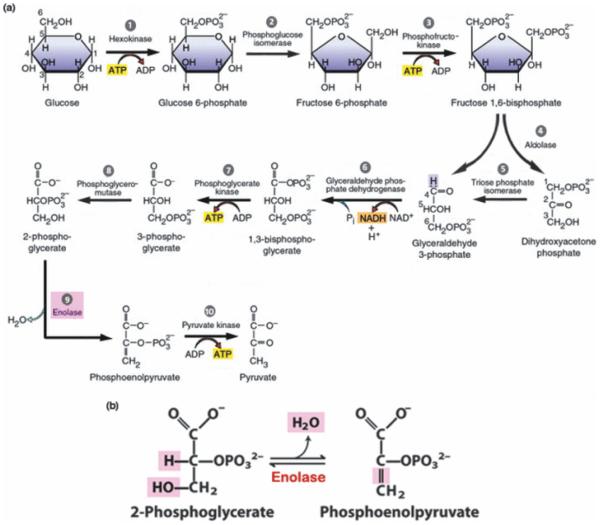
Figure 1
Figure 1
a) Glycolysis. Schematic representation of aerobic glycolysis. Because two 3-carbon triose chains are produced from the reaction between aldolase and fructose-1,6-bisphosphate, steps 5-10 are completed twice (not shown). ATP production in steps 7 and 10 is thought to be the chief fuel-source for plasma membrane ion pumps, including the Na+/K+-ATPase and Ca2+-ATPase, rather than ATP produced by mitochondrial oxidative phosphorylation [adapted from (Karp 2003)]. b) Enolase reaction. Step 9 in the glycolytic chain involves conversion of 2-phosphoglycerate (2-PGA) to phosphoenolpyruvate (PEP) by enolase [adapted from (Nelson & Cox 2009)].
Figure 2
Figure 2
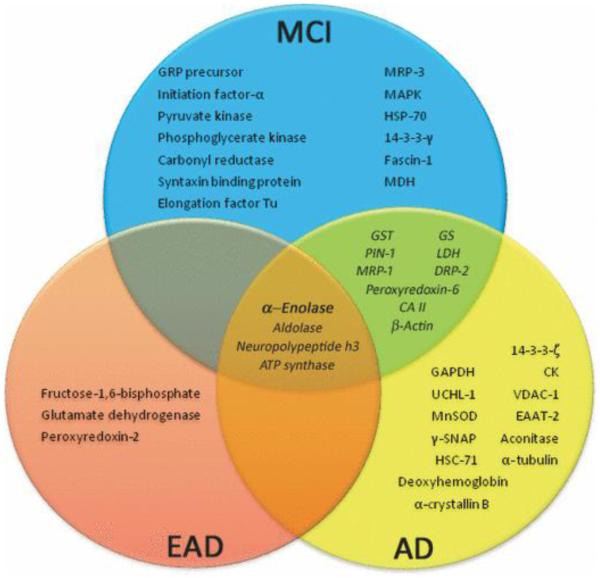
Oxidatively modified and/or glutathionylated proteins in MCI, EOAD, and AD brain identified by redox proteomics studies from our laboratory (Perluigi et al. 2009, Butterfield et al. 2006a, 2006b, Sultana et al. 2006a, 2006b, Castegna et al. 2002, 2003, Reed et al. 2008a, 2008b, Newman et al. 2007). This diagram shows the interrelation of all proteins found to be oxidatively modified in MCI, EOAD, and AD brain from our laboratory. Abbreviations: GRP precursor, Glucose-regulated protein precursor; MRP-1, Multidrug-resistant protein; MAPK, Mitogen-associated protein kinase; HSP-70, Heat-shock protein-70; MDH, Malate dehydrogenase; GST, Glutathione S-transferase; GS, Glutamine synthetase; PIN-1, Peptidyl-prolyl cis/trans isomerase (PPIase) ; LDH, Lactate dehydrogenase; DRP-2, Dihydropyrimidinase-related protein-2; CAII, Carbonic anhydrase II; HSC-71, Heat-shock cognate-71; γ-SNAP, Soluble N-ethylmaleimide-sensitive factor attachment protein-γ ; GAPDH, Glyceraldehyde-3-phosphate dehydrogenase; UCHL-1, Ubiquitin carboxy-terminal hydrolase L-1; VDAC-1, Voltage dependent anion channel-1; CK, Creatine kinase; EAAT-2, Excitatory amino acid transporter-2; MnSOD, Manganese superoxide dismutase.
Figure 3
Figure 3
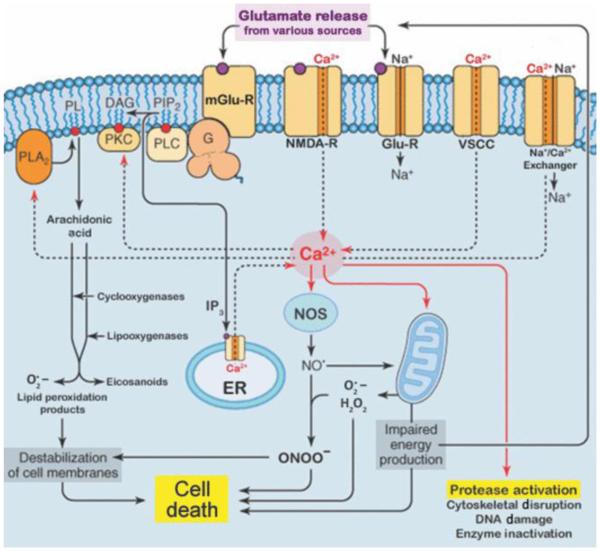
Glutamate excitotoxicity. This diagram depicts the many intracellular signaling events elicited by excess release and impaired uptake of glutamate, leading to neuronal death. Glu-R, AMPA/Kainate receptors; mGlu-R, metabotropic glutamate receptor; NMDA-R, N-methyl-D-aspartate receptor; VSCC, voltage-sensitive Ca2+ channel; PL, phospholipids; DAG, Diacylglycerol; PIP2, phosphatidylinositol 4,5-bisphosphate; IP3, inositol 1,4,5-trisphosphate; G, G-protein; PLA2, phospholipase A2; PLC, phospholipase C; PKC, protein kinase C; ER, endoplasmic reticulum; H2O2, hydrogen peroxide; NO, nitric oxide; ONOO-, peroxynitrite; NOS, nitric oxide synthase; O2•−, superoxide radical [adapted from (Siegel et al. 2006)].
Figure 4
Figure 4
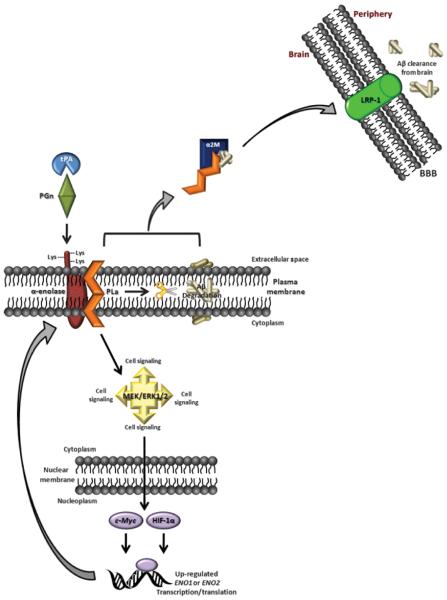
Possible role of enolase in MCI, EOAD, and AD. This scheme illustrates an alternate role for enolase, in addition to glucose metabolism, in normal and/or MCI, EOAD, and AD brain. In this model, up-regulation and membrane integration of α-enolase, promotes surface-binding of the tPA/PGn complex, which produces the protease plasmin (PLa). Plasmin, in turn, can degrade Aβ peptides associated with the bilayer and activate the MAPK/MEK/ERK1/2 pathway, promoting up-regulation of ENO1 transcription, and therefore, production of α-enolase. In this way, up-regulation of enolase would catalytically amplify an internal signal for cell survival during AD progression. Moreover, by complexing with a2M, plasmin may also be involved with Aβ clearance from the brain via LRP-1 at the blood-brain barrier (BBB). Unfortunately, due to significant oxidative modification, it is hypothesized that enolase becomes unable to facilitate the initiation of these pathways, which would lead to the augmentation of neuronal death in brain of subjects with MCI, EOAD, and AD versus normal aged brain.

References

    1. Aaronson RM, Graven KK, Tucci M, McDonald RJ, Farber HW. Non-neuronal enolase is an endothelial hypoxic stress protein. J. Biol. Chem. 1995;270:27752–27757. - PubMed
    1. Aksenov MY, Aksenova MV, Butterfield DA, Geddes JW, Markesbery WR. Protein oxidation in the brain in Alzheimer's disease. Neuroscience. 2001;103:373–383. - PubMed
    1. al-Giery AG, Brewer JM. Characterization of the interaction of yeast enolase with polynucleotides. Biochim. Biophys. Acta. 1992;1159:134–140. - PubMed
    1. Andrade-Gordon P, Strickland S. Interaction of heparin with plasminogen activators and plasminogen: effects on the activation of plasminogen. Biochemistry. 1986;25:4033–4040. - PubMed
    1. Apostol BL, Illes K, Pallos J, et al. Mutant huntingtin alters MAPK signaling pathways in PC12 and striatal cells: ERK1/2 protects against mutant huntingtin-associated toxicity. Hum. Mol. Genet. 2006;15:273–285. - PubMed

Publication types