


Environmental surveillance of Non-Polio Enteroviruses in Iran
- PMID: 19781063
- PMCID: PMC2761390
- DOI: 10.1186/1743-422X-6-149
Environmental surveillance of Non-Polio Enteroviruses in Iran
Abstract
Background: Enteroviruses can shed in feces for several weeks, so many excrete viruses can remain infectious for a long time in environment. Therefore, by detecting enteroviruses in environmental specimens and sewage, we can understand this virus circulation, the approximate ratio of contaminated persons in society and they are suitable indicators for environmental surveillance.
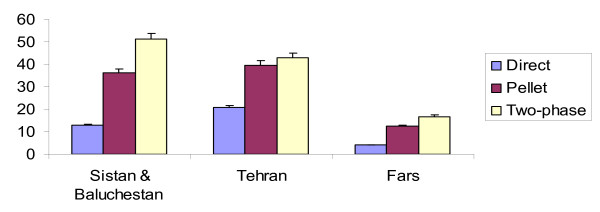
Methods: Since March 2006 to February 2007, 86 specimens from Sistan & Balouchestan, 63 specimens from Tehran and 48 samples from Fars sewage disposal systems and surface water were collected by Grab Sample method and tested for enteroviruses directly by using two concentration methods: Pellet and Two-phase. Then Non-Polio Enteroviruses (NPEV) were serotyped by microneutralization method.
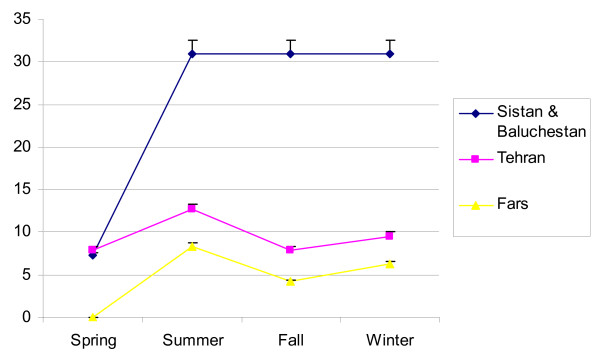
Results: Enteroviruses were isolated from 49(56.98%) of specimens in Sistan & Baluchestan,38(60.32%) in Tehran and 11(22.92%) in Fars. Besides, the majority of Non-Polio Enteroviruses related to Non-typable Enteroviruses (N.T.E.V), E11 (31.52%), COX-B (27.58%), E7 (17.73%) and E4 (21.67%).
Conclusion: Environmental surveillance has been used successfully in monitoring enteric virus circulation and assessing the extent or duration of epidemic non polioviruses in specific populations. The results of this research show the seasonal circulation of enteroviruses in different parts of Iran.
Figures
References
-
- Pallansch M, Roos RP. Picornaviridae:The Viruses and Their Replication. In: Filds BN, et al, editor. Fileds virology. 1. Lippincott Raven., New Yourk; 2001. pp. 723–776.
-
- Paul AV, Wimmer E, Rieder E. Application Number: 09/282351, Publication Date:, International Classes 2001, C12Q1/48; G01N33/50; C12Q1/00; C12Q1/68
-
- Centers for Disease Control and Pervention Enterovirus Surveillance--United States, 2002-2004. JAMA. 2006;295:1993–1994. doi: 10.1001/jama.295.17.1993. - DOI
-
- World Health Organization Enteroviruses-non polio Media centre. 2002. http://www.who.int/mediacentre/factsheets/fs174/en
-
- World Health Organization Polio laboratory case definition. Australian Government. 2000. http://www.Health.gov.au/internet/wcms/Publishing.nsf/Content/cda-phlncd...
Publication types
MeSH terms
Substances
LinkOut - more resources
Full Text Sources
