


The Tilburg double blind randomised controlled trial comparing inguinal hernia repair according to Lichtenstein and the transinguinal preperitoneal technique
- PMID: 19781069
- PMCID: PMC2761380
- DOI: 10.1186/1745-6215-10-89
The Tilburg double blind randomised controlled trial comparing inguinal hernia repair according to Lichtenstein and the transinguinal preperitoneal technique
Abstract
Background: Anterior open treatment of the inguinal hernia with a tension free mesh has reduced the incidence of recurrence and direct postoperative pain. The Lichtenstein procedure rules nowadays as reference technique for hernia treatment. Not recurrences but chronic pain is the main postoperative complication in inguinal hernia repair after Lichtenstein's technique. Preliminary experiences with a soft mesh placed in the preperitoneal space showed good results and less chronic pain.
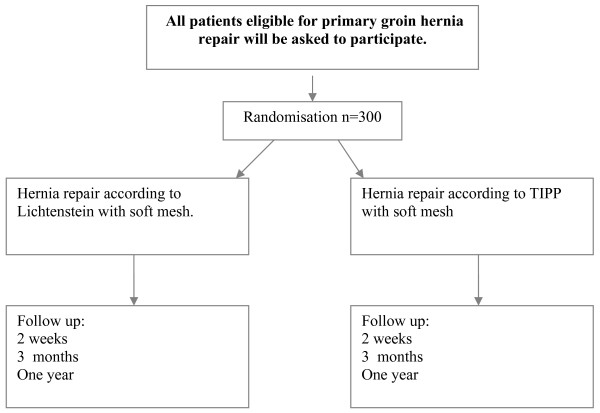
Methods: The TULIP is a double-blind randomised controlled trial in which 300 patients will be randomly allocated to anterior inguinal hernia repair according to Lichtenstein or the transinguinal preperitoneal technique with soft mesh. All unilateral primary inguinal hernia patients eligible for operation who meet inclusion criteria will be invited to participate in this trial. The primary endpoint will be direct postoperative- and chronic pain. Secondary endpoints are operation time, postoperative complications, hospital stay, costs, return to daily activities (e.g. work) and recurrence. Both groups will be evaluated.Success rate of hernia repair and complications will be measured as safeguard for quality.To demonstrate that inguinal hernia repair according to the transinguinal preperitoneal (TIPP) technique reduces postoperative pain to <10%, with alpha = 0,05 and power 80%, a total sample size of 300 patients was calculated.
Discussion: The TULIP trial is aimed to show a reduction in postoperative chronic pain after anterior hernia repair according to the transinguinal preperitoneal (TIPP) technique, compared to Lichtenstein.In our hypothesis the TIPP technique reduces chronic pain compared to Lichtenstein.
Trial registration: ISRCTN 93798494.
References
-
- Source. 2005. http://www.Prismant.nl
Publication types
MeSH terms
Associated data
LinkOut - more resources
Full Text Sources
