. 2009 Sep 25:9:207.
doi: 10.1186/1471-2180-9-207.

Identification of a bacteriocin and its cognate immunity factor expressed by Moraxella catarrhalis

Affiliations

Identification of a bacteriocin and its cognate immunity factor expressed by Moraxella catarrhalis

Ahmed S Attia et al. BMC Microbiol. .

Abstract

Background: Bacteriocins are antimicrobial proteins and peptides ribosomally synthesized by some bacteria which can effect both intraspecies and interspecies killing.

Results: Moraxella catarrhalis strain E22 containing plasmid pLQ510 was shown to inhibit the growth of M. catarrhalis strain O35E. Two genes (mcbA and mcbB) in pLQ510 encoded proteins predicted to be involved in the secretion of a bacteriocin. Immediately downstream from these two genes, a very short ORF (mcbC) encoded a protein which had some homology to double-glycine bacteriocins produced by other bacteria. A second very short ORF (mcbI) immediately downstream from mcbC encoded a protein which had no significant similarity to other proteins in the databases. Cloning and expression of the mcbI gene in M. catarrhalis O35E indicated that this gene encoded the cognate immunity factor. Reverse transcriptase-PCR was used to show that the mcbA, mcbB, mcbC, and mcbI ORFs were transcriptionally linked. This four-gene cluster was subsequently shown to be present in the chromosome of several M. catarrhalis strains including O12E. Inactivation of the mcbA, mcbB, or mcbC ORFs in M. catarrhalis O12E eliminated the ability of this strain to inhibit the growth of M. catarrhalis O35E. In co-culture experiments involving a M. catarrhalis strain containing the mcbABCI locus and one which lacked this locus, the former strain became the predominant member of the culture after overnight growth in broth.

Conclusion: This is the first description of a bacteriocin and its cognate immunity factor produced by M. catarrhalis. The killing activity of the McbC protein raises the possibility that it might serve to lyse other M. catarrhalis strains that lack the mcbABCI locus, thereby making their DNA available for lateral gene transfer.


Figures
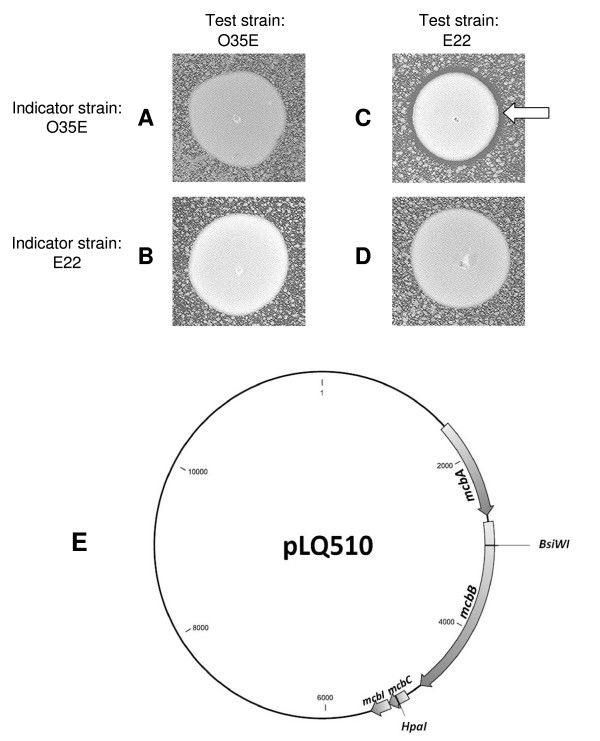
Figure 1
Figure 1
Killing of M. catarrhalis O35E by M. catarrhalis E22 carrying pLQ510. Test strains and indicator strains were grown on BHI agar plates as described in Materials and Methods. Panels: A, O35E test strain on O35E indicator; B, O35E test strain on E22 indicator; C, E22 test strain on O35E indicator; D, E22 test strain on E22 indicator. The white arrow in panel C indicates the zone of killing of the indicator strain by the test strain. Panel E, schematic of pLQ510 indicating the four ORFs located in the mcb locus. The nucleotide sequence of pLQ510 is available at GenBank under accession no. AF129811. The positions of the restriction sites used to insert kanamycin resistance cassettes in the mcbB and mcbC genes are indicated.
Figure 2
Figure 2
Putative bacteriocin proteins encoded by the mcb locus. (A) Amino acid sequence of the predicted McbC proteins encoded by the mcb locus in plasmid pLQ510, M. catarrhalis O12E, and M. catarrhalis V1120. Residues that differ among the proteins are underlined and bolded. (B) Alignment of the amino acid sequence of the putative leader of the M. catarrhalis O12E McbC protein with that of leader peptides of proven and hypothetical double-glycine peptides from other bacteria including CvaC [GenBank: CAA11514] and MchB [GenBank: CAD56170] of E. coli, NMB0091 [GenBank: NP_273152] of Neisseria meningitidis, XF1219 [GenBank:AAF84029] and XF1694 [GenBank: AF84503] of Xylella fastidiosa and LafX [GenBank: AAS08589] of Lactobacillus johnsonii. Highly conserved amino acids are shaded with dark grey. This latter figure is adapted from that published by Michiels et al [30].
Figure 3
Figure 3
Reverse transcriptase-PCR analysis of the mcbABCI locus in pLQ510. (A) Schematic drawing showing the three sets of oligonucleotide primers that collectively spanned the three intergenic regions. (B) RT-PCR analysis of possible transcriptional linkage among the ORFs in the mcbABCI locus in pLQ510. RT-PCR was carried out as described in Materials and Methods. Lanes 1, 4, and 7 contain PCR products derived from pLQ510 DNA. Lanes 2, 5, and 8 are RT-PCR negative controls in which M. catarrhalis E22 RNA was incubated in the absence of reverse transcriptase. Lanes 3, 6, and 9 show the products obtained when these same primer pairs were used in RT-PCR with RNA from M. catarrhalis E22. Size markers (in bp) are present on the left side of panel B.
Figure 4
Figure 4
Detection of bacteriocin production by wild-type M. catarrhalis strains. (A) Fifteen M. catarrhalis strains tested for bacteriocin production with strain O35E as the indicator strain. Thirteen of these strains were positive as shown here together with two negative strains (V1118 and O46E). (B) Agarose DNA gel electrophoretic analysis of PCR products obtained from four bacteriocin-positive strains (lane 1, ETSU-5; lane 2, FIN 2341; lane 3, O12E; lane 4, V1120) and 4 bacteriocin-negative strains (lane 6, FIN 2344; lane 7, O35E; lane 8, O46E; lane 9, V1118) with the oligonucleotide primers AA247 (binds within mcbA) and pLQ510-rp1 (binds within mcbC). Lane 5 contains a set of DNA size markers.
Figure 5
Figure 5
Analysis of mutant and recombinant M. catarrhalis strains. (A) Schematic showing the mcbABCI locus in the O12E chromosome and the position of the oligonucleotide primers used to construct the three different in-frame deletion mutations in this locus. The extent of the deletion in each ORF is indicated. (B) Bacteriocin production assay using O35E as the indicator strain together with the following test strains: panel 1, O12E; panel 2, O12EΔmcbA; panel 3, O12EΔmcbB; panel 4, O12EΔmcbC. Panel C, Use of recombinant M. catarrhalis strains to demonstrate that expression of McbI in O35E confers protection against killing by strain O12E. M. catarrhalis O12E was used as the test strain in a bacteriocin production assay with three different M. catarrhalis strains as the indicator. Panels: A, O35E wild-type; B, O35E(pWW115) [vector-only control]; C, O35E(pAA113) [expressing McbI].
Figure 6
Figure 6
Expression of the His-tagged mcbC gene product. Killing of strain O35E by (A) wild-type O12E, (B) O12E.mcbC::kan; (C) O12E.mcbC::kan(pWW115); (D) O12E.mcbC::kan(pAA111). (E) Western blot-based detection of His-tagged McbC protein purified from spent culture supernatant fluid from (lane 1) M. catarrhalis O12E.mcbC::kan(pAA111) and (lane 2) M. catarrhalis O12E.mcbC::kan(pWW115) (negative control). A His-tag specific antibody was used as the primary antibody for Western blot analysis. Molecular weight position markers (in kDa) are present on the left side of this panel.

References

    1. Catlin BW. Branhamella catarrhalis: an organism gaining respect as a pathogen. Clin Microbiol Rev. 1990;3:293–320. - PMC - PubMed
    1. Karalus R, Campagnari A. Moraxella catarrhalis: a review of an important human mucosal pathogen. Microbes Infect. 2000;2:547–559. doi: 10.1016/S1286-4579(00)00314-2. - DOI - PubMed
    1. Murphy TF. Bacterial otitis media: pathogenetic considerations. Pediatr Infect Dis J. 2000;19:S9–15. doi: 10.1097/00006454-200005001-00003. - DOI - PubMed
    1. Verduin CM, Hol C, Fleer A, van Dijk H, Van Belkum A. Moraxella catarrhalis: from emerging to established pathogen. Clin Microbiol Rev. 2002;15:125–144. doi: 10.1128/CMR.15.1.125-144.2002. - DOI - PMC - PubMed
    1. Wallace RJ Jr, Musher DM. In honor of Dr. Sarah Branham, a star is born. The realization of Branhamella catarrhalis as a respiratory pathogen. Chest. 1986;90:447–450. doi: 10.1378/chest.90.3.447. - DOI - PubMed

Publication types

LinkOut - more resources
