. 2009 Sep 25:9:240.
doi: 10.1186/1471-2148-9-240.

An EST screen from the annelid Pomatoceros lamarckii reveals patterns of gene loss and gain in animals

Affiliations

An EST screen from the annelid Pomatoceros lamarckii reveals patterns of gene loss and gain in animals

Tokiharu Takahashi et al. BMC Evol Biol. .

Abstract

Background: Since the drastic reorganisation of the phylogeny of the animal kingdom into three major clades of bilaterians; Ecdysozoa, Lophotrochozoa and Deuterostomia, it became glaringly obvious that the selection of model systems with extensive molecular resources was heavily biased towards only two of these three clades, namely the Ecdysozoa and Deuterostomia. Increasing efforts have been put towards redressing this imbalance in recent years, and one of the principal phyla in the vanguard of this endeavour is the Annelida.

Results: In the context of this effort we here report our characterisation of an Expressed Sequence Tag (EST) screen in the serpulid annelid, Pomatoceros lamarckii. We have sequenced over 5,000 ESTs which consolidate into over 2,000 sequences (clusters and singletons). These sequences are used to build phylogenetic trees to estimate relative branch lengths amongst different taxa and, by comparison to genomic data from other animals, patterns of gene retention and loss are deduced.

Conclusion: The molecular phylogenetic trees including the P. lamarckii sequences extend early observations that polychaetes tend to have relatively short branches in such trees, and hence are useful taxa with which to reconstruct gene family evolution. Also, with the availability of lophotrochozoan data such as that of P. lamarckii, it is now possible to make much more accurate reconstructions of the gene complement of the ancestor of the bilaterians than was previously possible from comparisons of ecdysozoan and deuterostome genomes to non-bilaterian outgroups. It is clear that the traditional molecular model systems for protostomes (e.g. Drosophila melanogaster and Caenorhabditis elegans), which are restricted to the Ecdysozoa, have undergone extensive gene loss during evolution. These ecdysozoan systems, in terms of gene content, are thus more derived from the bilaterian ancestral condition than lophotrochozoan systems like the polychaetes, and thus cannot be used as good, general representatives of protostome genomes. Currently sequenced insect and nematode genomes are less suitable models for deducing bilaterian ancestral states than lophotrochozoan genomes, despite the array of powerful genetic and mechanistic manipulation techniques in these ecdysozoans. A distinct category of genes that includes those present in non-bilaterians and lophotrochozoans, but which are absent from ecdysozoans and deuterostomes, highlights the need for further lophotrochozoan data to gain a more complete understanding of the gene complement of the bilaterian ancestor.


Figures
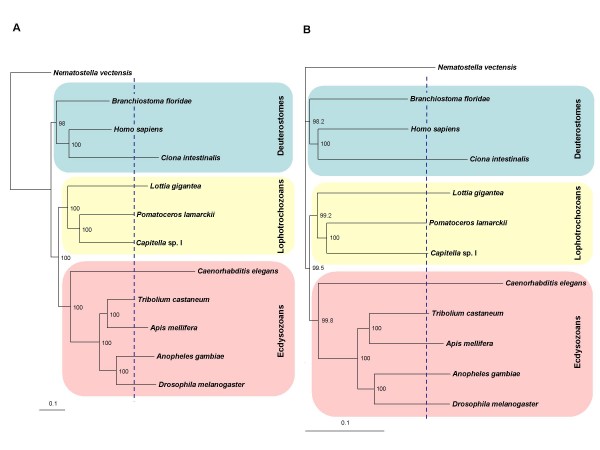
Figure 1
Figure 1
Phylogenetic trees of concatenated sequences from 11 representative taxa of bilaterian animals. (A and B) and the non-bilaterian N. vectensis as an outgroup (11716 amino acid sites from 59 orthologous genes). The blue vertical dotted line in each of the figures marks the tip of the Pomatoceros branch. Bootstrap percentages are indicated on each node. (A) Maximum likelihood tree. Likelihood: Loglk = -138,297.9751. (B) Neighbour-joining tree.
Figure 2
Figure 2
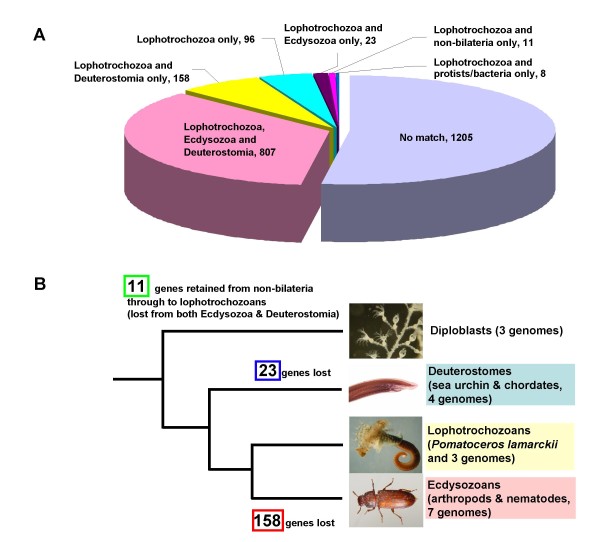
Summary of the gene conservation analysis. (A) Distribution of 2308 unique P. lamarckii ESTs. Genes were classified into groups based on their pattern of putative orthology with genes in other major metazoan groups. (B) Illustration of gene loss in the evolution of metazoan genomes in reference to P. lamarckii orthologues. Refer to Methods for further explanation of classification and gene loss characterization.
Figure 3
Figure 3
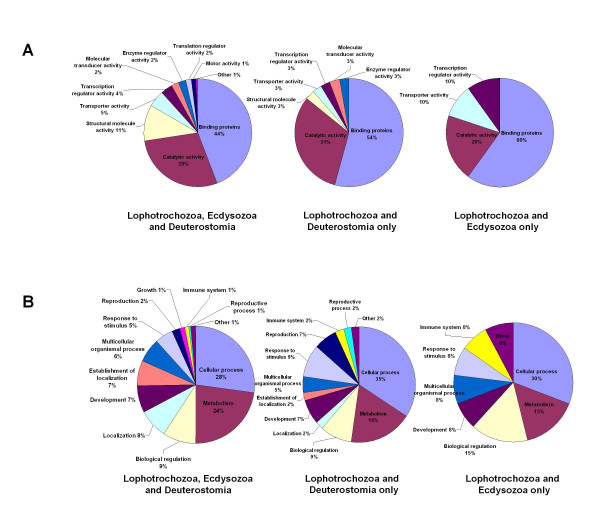
Comparison of GO annotations associated with EST datasets amongst three major animal groupings after conservation analysis. (A and B) GO classification according to major GO categories (level 2) by both molecular function (A) and biological process (B) for ESTs classified into three groups, 1) conserved within all three bilaterian clades (807 genes), 2) found only in the Lophotrochozoa and Deuterostomia (lost in the Ecdysozoa, 158 genes) and 3) found only in the Lophotrochozoa and Ecdysozoa (lost from, or never gained by the Deuterostomia, 23 genes).
Figure 4
Figure 4
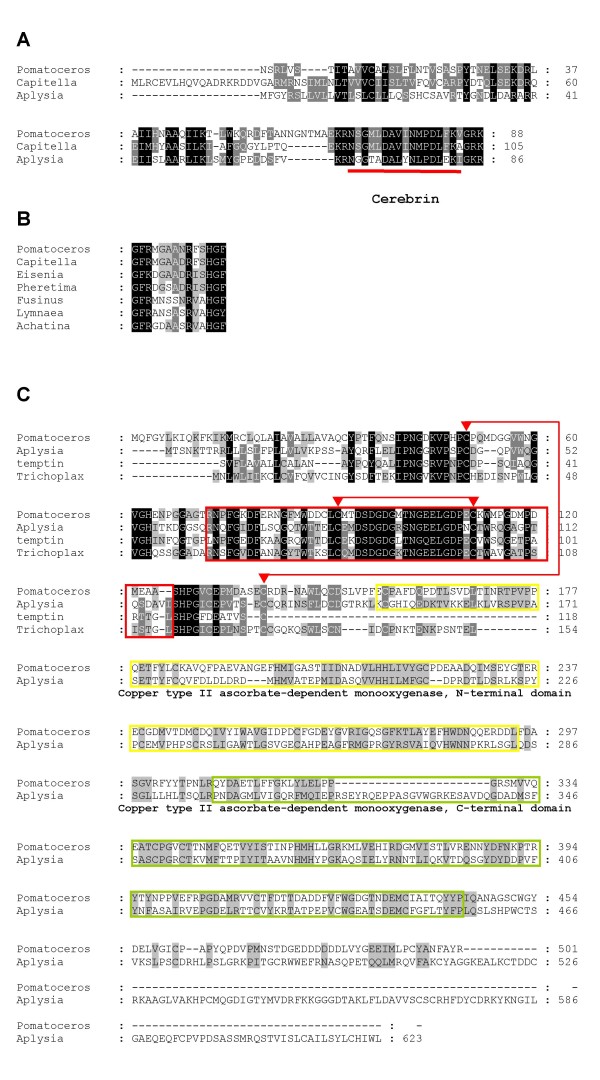
Amino acid alignments of the proteins with putative lophotrochozoan-specific functions. (A) Predicted proteins from Pomatoceros EST clone (pl_xlvo_42f05) and the Capitella genome are aligned with Aplysia cerebrin prohormone. The 17-residues of the cerebrin amidated peptide purified from Aplysia is underlined. (B) Alignment of tetradecapeptide sequences from 4 annelid and 3 mollusc species with 2 predicted sequences from a Pomatoceros EST (Contig 102) and the Capitella genome. (C) Comparison of the Pomatoceros protein predicted from EST clone (pl_xlvo_55b08) with Aplysia dopamine beta hydroxylase-like protein, Aplysia temptin protein and a hypothetical protein predicted from the Trichoplax genome. The central 1 region of temptin is boxed with red lines. Two disulfide bonds are marked with red lines and triangles. The conserved regions of mono-oxygenase are also boxed with yellow (N-terminal domain) and green (C-terminal) lines respectively.

References

    1. McDougall C, Chen WC, Shimeld SM, Ferrier DE. The development of the larval nervous system, musculature and ciliary bands of Pomatoceros lamarckii (Annelida): heterochrony in polychaetes. Front Zool. 2006;9:16. doi: 10.1186/1742-9994-3-16. - DOI - PMC - PubMed
    1. Dixon DR, Wilson JT, Pascoe PL, Parry JM. Anaphase aberrations in the embryos of the marine tubeworm Pomatoceros lamarckii (Polychaeta: Serpulidae): a new in vivo test assay for detecting aneugens and clastogens in the marine environment. Mutagenesis. 1999;9:375–383. doi: 10.1093/mutage/14.4.375. - DOI - PubMed
    1. Wilson JT, Dixon DR, Dixon LR. Numerical chromosomal aberrations in the early life-history stages of a marine tubeworm, Pomatoceros lamarckii (Polychaeta: Serpulidae) Aquat Toxicol. 2002;9:163–175. doi: 10.1016/S0166-445X(01)00249-1. - DOI - PubMed
    1. Aguinaldo AMA, Turbeville JM, Linford LS, Rivera MC, Garey JR, Raff RA, Lake JA. Evidence for a clade of nematodes, arthropods and other moulting animals. Nature. 1997;9:489–493. doi: 10.1038/387489a0. - DOI - PubMed
    1. Kortschak RD, Samuel G, Saint R, Miller DJ. EST analysis of the Cnidarian Acropora millepora reveals extensive gene loss and rapid sequence divergence in the model invertebrates. Current Biology. 2003;9:2190–2195. doi: 10.1016/j.cub.2003.11.030. - DOI - PubMed

Publication types