Review
. 2009 Dec;13(5-6):633-40.
doi: 10.1016/j.cbpa.2009.08.017. Epub 2009 Sep 24.

Recent progress and applications in glycosaminoglycan and heparin research

Affiliations
Review

Recent progress and applications in glycosaminoglycan and heparin research

Tatiana N Laremore et al. Curr Opin Chem Biol. 2009 Dec.

Abstract

Heparin, the focus of this review, is a crucially important anticoagulant drug produced from animal sources, which was contaminated last year leading to a number of adverse side effects, some resulting in death. Heparin is a highly acidic polysaccharide and a member of a family of biopolymers called glycosaminoglycans. The structure and activities of heparin are detailed along with recent advances in heparin structural analysis and biological evaluation. Current state-of-the-art chemical and chemoenzymatic synthesis of heparin and new approaches for its metabolic engineering are described. New technologies, including microarrays and digital microfluidics, are proposed for high-throughput synthesis and screening of heparin and for the fabrication of an artificial Golgi.


Figures
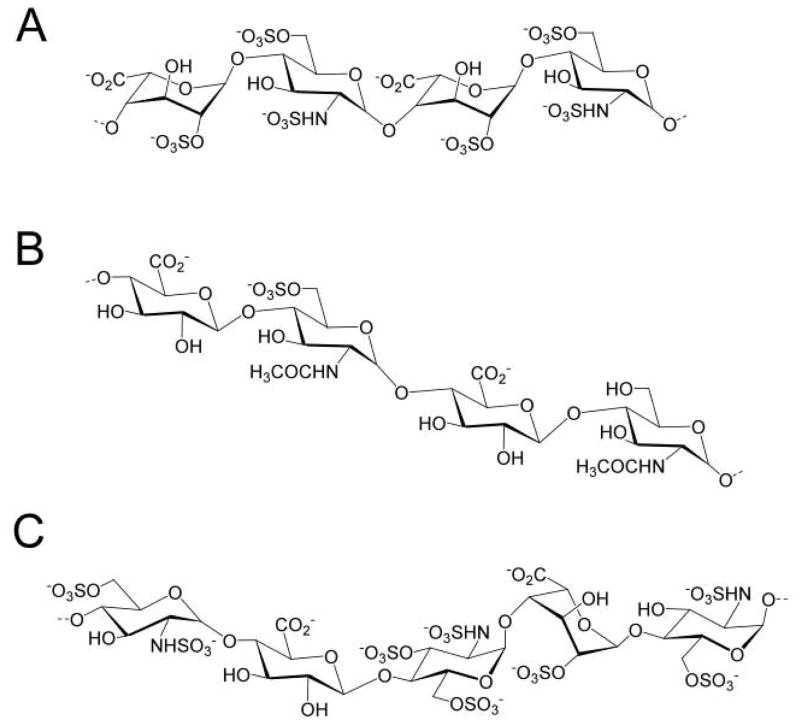
Figure 1
Figure 1
Heparin and HS. A. The prominent trisulfated disaccharide-repeating unit in heparin represents 80–90% of its structure. B. HS has a more variable structure and primarily consists of monosulfated and unsulfated disaccharide units. It has a domain structure in which the more highly sulfated repeating units are clustered. C. An AT-binding pentasaccharide site is shown. There is some variability both within this AT-binding site and in surrounding residues, but all contain the critical 3-O-sulfo group in the central saccharide residue. Both heparin and HS can contain this site or one of its structural variants.
Figure 2
Figure 2
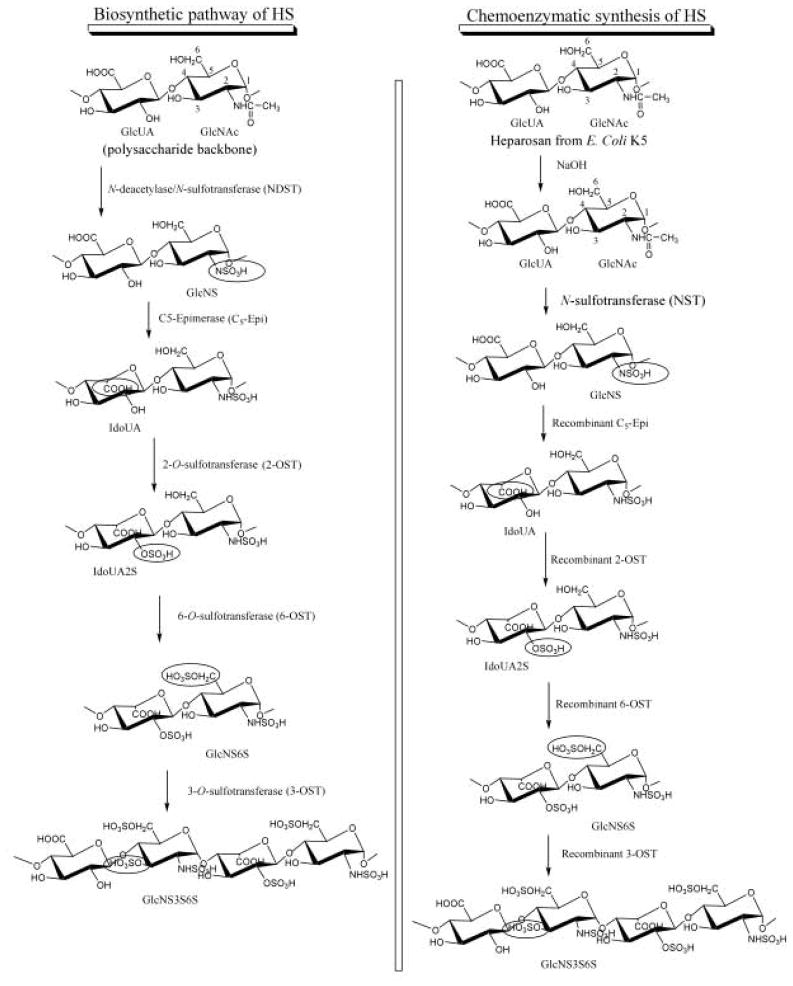
Biosynthetic pathway and chemoenzymatic synthesis of HS. The polysaccharide backbone synthesis is omitted for clarity. The recombinant biosynthetic HS modifying enzymes are obtained from bacterial expression. To improve cost-efficiency, a low-cost sulfo donor, p-nitrophenol sulfate is coupled with the 3′-phosphoadenosine-5′-phosphosulfate regeneration system for use with HS sulfotransferases
Figure 3
Figure 3
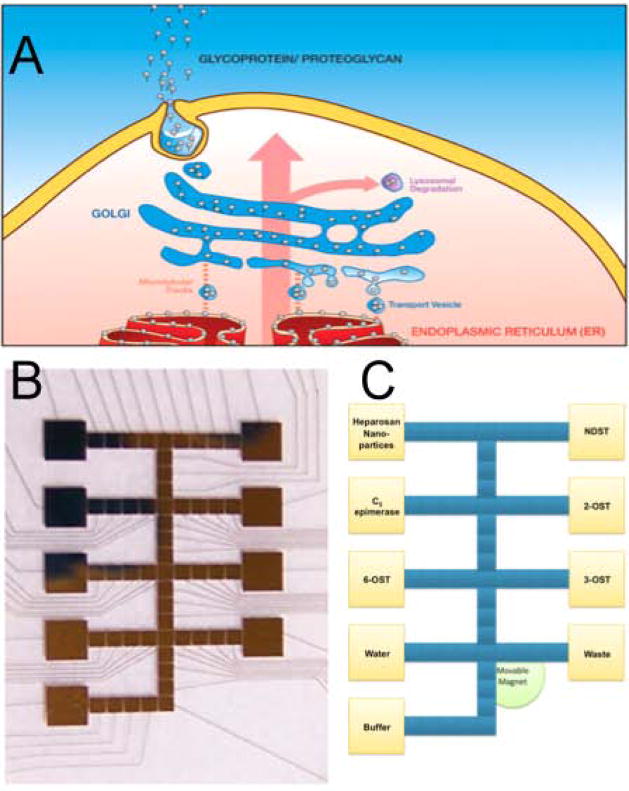
The Golgi and artificial Golgi. A. Cartoon of the Golgi: The direction of flow (pink arrow) in posttranslational modification is from the endoplasmic reticulum (red) to the cell membrane (yellow), where PGs and glycoproteins are released into the extracellular environment. B. The design of an artificial Golgi for the HS biosynthesis: Yellow squares are the reagent and enzyme reservoir electrodes, blue squares – electrodes for droplet movement, mixing, and sequestration. C. A fabricated artificial Golgi based on the design in panel B: Thin gold wires lead from square reservoir electrodes to pads connecting them to a power source.

References

    1. Linhardt RJ, Claude S. Hudson Award Address in Carbohydrate Chemistry. Heparin: Structure and Activity. J Med Chem. 2003;46:2551–2564. - PubMed
    1. Stringer SE, Gallagher JT. Heparan sulphate. Int J Biochem Cell Biol. 1997;29:709–714. - PubMed
    1. Bishop JR, Schuksz M, Esko JD. Heparan sulphate proteoglycans fine-tune mammalian physiology. Nature. 2007;446:1030–1037. - PubMed
    1. Capila I, Linhardt RJ. Heparin-protein interactions. Angew Chem Int Ed Engl. 2002;41:391–412. - PubMed
    1. Liu H, Zhang Z, Linhardt RJ. Lessons learned from the contamination of heparin. Nat Prod Rep. 2009;26:313–321. This review gives a detailed account of the heparin contamination crisis of 2008 and proposes both short-term and long-term solutions. - PMC - PubMed

Publication types