


Review
doi: 10.1016/j.drudis.2009.09.003.
Epub 2009 Sep 24.
Current applications and future potential for bioinorganic chemistry in the development of anticancer drugs
Affiliations
- PMID: 19782150
- PMCID: PMC2933823
- DOI: 10.1016/j.drudis.2009.09.003
Item in Clipboard
Review
Current applications and future potential for bioinorganic chemistry in the development of anticancer drugs
Drug Discov Today.
2009 Dec.
Abstract
This review illustrates notable recent progress in the field of medicinal bioinorganic chemistry as many new approaches to the design of innovative metal-based anticancer drugs are emerging. Current research addressing the problems associated with platinum drugs has focused on other metal-based therapeutics that have different modes of action and on prodrug and targeting strategies in an effort to diminish the side-effects of cisplatin chemotherapy.
Figures
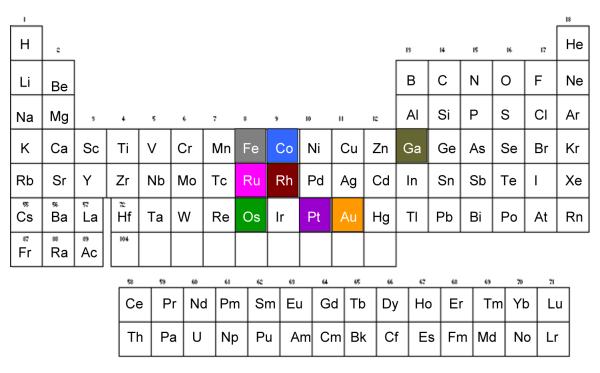
Periodic table with color coding for the metals discussed in this review
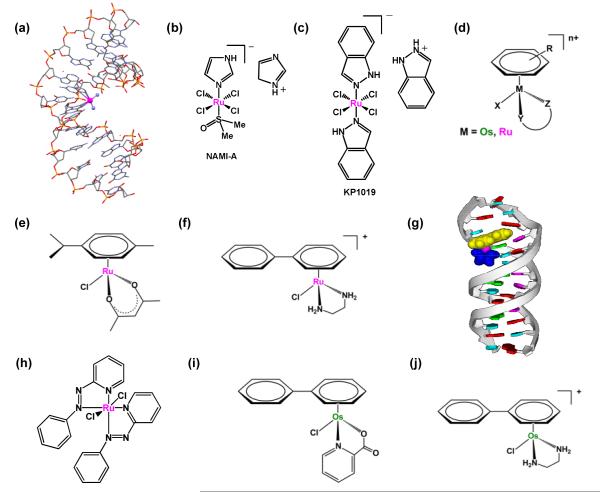
Examples of metal-based compounds that target DNA. (a) X-ray structure showing the kinking of DNA by cisplatin (pdb1aio) (b) NAMI-A. (c) KP1019. (d) General structure of organometallic ruthenium(II) and osmium(II) arene complexes. (e, f) Examples of cytotoxic RuII arene complexes. (g) model showing intercalation of a RuII arene complex into DNA. (h) [γ-Ru(azpy)2Cl2]. (i, j) Examples of cytotoxic OsII arene complexes.
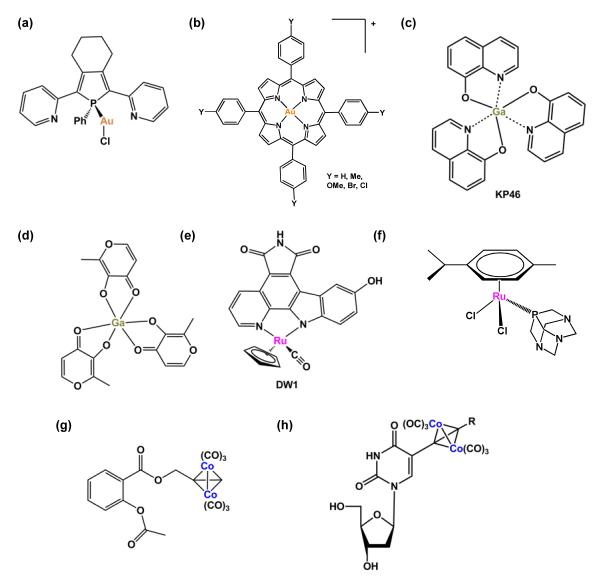
Examples of metal-based anticancer drugs that target proteins and enzymes. (a) Gold(I) phosphole complex. (b) Gold(III) meso-tetraarylporphyrins complexes. (c) KP46. (d) Gallium tris-maltolate. (e) DW1. (f) RuII arene complex containing a monodentate phosphaadamantane (pta) ligand. (g) Cobalt-alkyne analogue of the anti-inflammatory drug aspirin. (h) Hexacarbonyl dicobalt complex containing a nucleoside ligand.
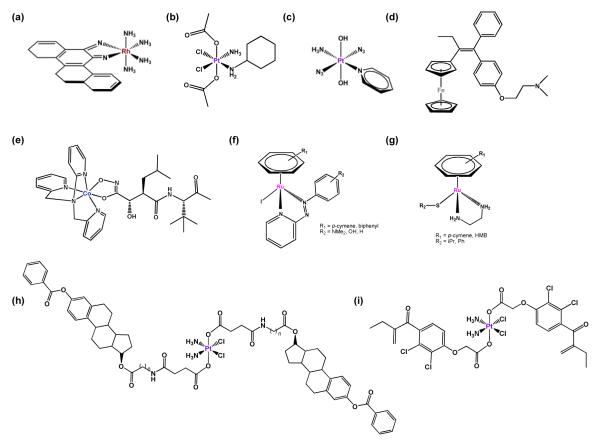
Prodrug strategies. (a) Example of a photoactivatable octahedral RhIII complex with an extended diimine ligand. (b) Satraplatin. (c) Example of a photoactivatable trans-azido platinum(IV) prodrug. (d) Ferrocifen. (e) Cobalt-marimastat bioconjugate. (f) RuII arene complexes containing iodo and phenylplazopyridine ligand. (g) RuII arene complexes containing a thiolate ligand. (h) Pt(IV)-estradiol bioconjugate. (i) Ethacraplatin.
References
-
- Hambley TW. Metal-Based Therapeutics. Science. 2007;318(5855):1392–1393. - PubMed
-
- Sadler PJ, et al. Metals in medicine. In: Bertini I, Gray HB, Stiefel EI, Selverstone VL, editors. Biological inorganic chemistry: structure and reactivity. University Science Books; U.S.: 2007. pp. 95–135.
-
- Sessler JL, et al. Medicinal inorganic chemistry. In: Sessler JL, Doctrow SR, McMurry T, Lippard SJ, editors. ACS Symp. Ser.; 903. CAPLUS; 2005. p. 453.
-
- Storr T, et al. Design of targeting ligands in medicinal inorganic chemistry. Chem. Soc. Rev. 2006;35(6):534–544. - PubMed
-
- Kelland L. The resurgence of platinum-based cancer chemotherapy. Nat. Rev. Cancer. 2007;7(8):573–584. - PubMed
Publication types
MeSH terms
Substances
Grants and funding
LinkOut - more resources
Full Text Sources
Other Literature Sources
