


The Quality of Dying and Death Questionnaire (QODD): empirical domains and theoretical perspectives
- PMID: 19782530
- PMCID: PMC2815047
- DOI: 10.1016/j.jpainsymman.2009.05.012
The Quality of Dying and Death Questionnaire (QODD): empirical domains and theoretical perspectives
Abstract
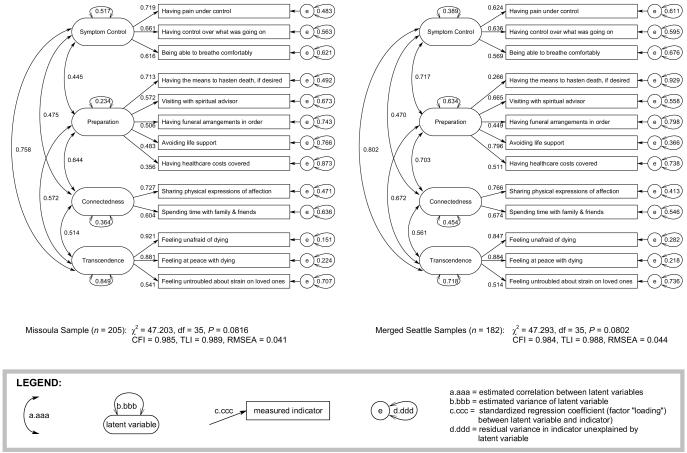
We used exploratory factor analysis within the confirmatory analysis framework, and data provided by family members and friends of 205 decedents in Missoula, Montana, to construct a model of latent-variable domains underlying the Quality of Dying and Death questionnaire (QODD). We then used data from 182 surrogate respondents, who were survivors of Seattle decedents, to verify the latent-variable structure. Results from the two samples suggested that survivors' retrospective ratings of 13 specific aspects of decedents' end-of-life experience served as indicators of four correlated, but distinct, latent-variable domains: Symptom Control, Preparation, Connectedness, and Transcendence. A model testing a unidimensional domain structure exhibited unsatisfactory fit to the data, implying that a single global quality measure of dying and death may provide insufficient evidence for guiding clinical practice, evaluating interventions to improve quality of care or assessing the status or trajectory of individual patients. In anticipation of possible future research tying the quality of dying and death to theoretical constructs, we linked the inferred domains to concepts from identity theory and existential psychology. We conclude that research based on the current version of the QODD might benefit from the use of composite measures representing the four identified domains, but that future expansion and modification of the questionnaire are in order.
Copyright 2010 U.S. Cancer Pain Relief Committee. Published by Elsevier Inc. All rights reserved.
Figures
References
-
- Steinhauser KE, Christakis NA, Clipp EC, et al. Factors considered important at the end of life by patients, family, physicians, and other care providers. JAMA. 2000;284:2476–2482. - PubMed
-
- Emanuel EJ, Emanuel LL. The promise of a good death. Lancet. 1998;351(Suppl 2):21–29. - PubMed
-
- Byock IR, Merriman MP. Measuring quality of life for patients with terminal illness: the Missoula-VITAS quality of life index. Palliat Med. 1998;12:231–244. - PubMed
-
- Singer PA, Martin DK, Kelner M. Quality end-of-life care: patients’ perspectives. JAMA. 1999;281:163–168. - PubMed
Publication types
MeSH terms
Grants and funding
LinkOut - more resources
Full Text Sources
Medical
