. 2009 Dec;145(2-3):47-56.
doi: 10.1016/j.bpc.2009.08.007. Epub 2009 Sep 1.

Quantitative assignment of reaction directionality in constraint-based models of metabolism: application to Escherichia coli

Affiliations

Quantitative assignment of reaction directionality in constraint-based models of metabolism: application to Escherichia coli

R M T Fleming et al. Biophys Chem. 2009 Dec.

Abstract

Constraint-based modeling is an approach for quantitative prediction of net reaction flux in genome-scale biochemical networks. In vivo, the second law of thermodynamics requires that net macroscopic flux be forward, when the transformed reaction Gibbs energy is negative. We calculate the latter by using (i) group contribution estimates of metabolite species Gibbs energy, combined with (ii) experimentally measured equilibrium constants. In an application to a genome-scale stoichiometric model of Escherichia coli metabolism, iAF1260, we demonstrate that quantitative prediction of reaction directionality is increased in scope and accuracy by integration of both data sources, transformed appropriately to in vivo pH, temperature and ionic strength. Comparison of quantitative versus qualitative assignment of reaction directionality in iAF1260, assuming an accommodating reactant concentration range of 0.02-20mM, revealed that quantitative assignment leads to a low false positive, but high false negative, prediction of effectively irreversible reactions. The latter is partly due to the uncertainty associated with group contribution estimates. We also uncovered evidence that the high intracellular concentration of glutamate in E. coli may be essential to direct otherwise thermodynamically unfavorable essential reactions, such as the leucine transaminase reaction, in an anabolic direction.


Figures
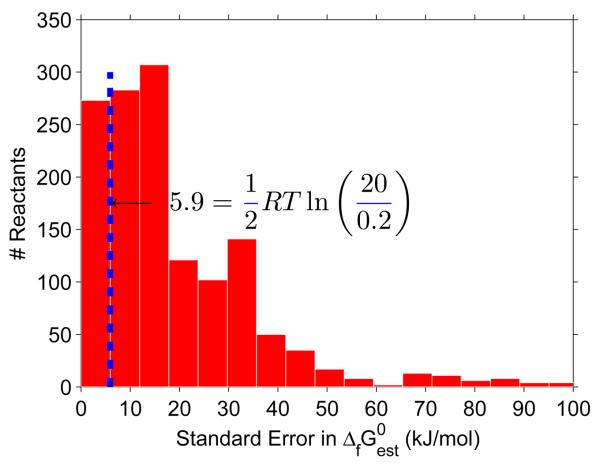
Figure 1
Figure 1. Uncertainty in reactant Gibbs energy
The majority of reactants in the E. coli iAF1260 model have a standard error in estimated standard Gibbs energy of formation which exceeds half the maximum error associated with assuming that reactant concentrations lie between 0.02 – 20 mM. This means that, for the majority of reactants, the uncertainty in reactant Gibbs energy is mostly from uncertainty in estimation of standard Gibbs energy, and not from uncertainty in concentration.
Figure 2
Figure 2. Non-predominant metabolite species
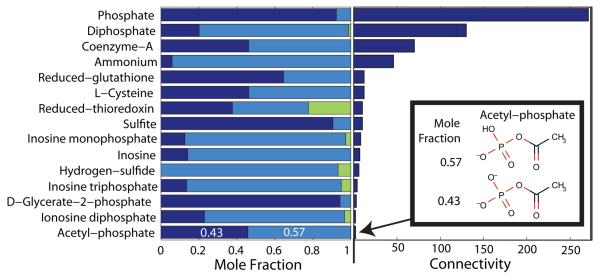
At typical in vivo conditions, a minority of cytoplasmic reactants in E. coli (15/138 with available data), have significant mole fractions (> 0.05) present as non-predominant metabolite species. The length within each bar (left), apportioned to each color equals the mole fraction of the reactant present as a particular metabolite species. A bar with three colors indicates a reactant simultaneously present as three different metabolite species differing only in their state of protonation. Accurate prediction of standard transformed Gibbs energy of formation is especially important for reactants, such as Co-enzyme-A, which is almost equally present in the two different metabolites species forms, and participates as a reactant in many reactions (connectivity bar to the right). Another example is acetyl-phosphate which is also almost equally distributed, as C2H3O5P2− and C2H4O5P (Inset). The mole fractions, corresponding to a pH 7.7 [43, 44], ionic strength 0.25 M and temperature 310.15 K, were calculated as described in Section 2.1.
Figure 3
Figure 3. The importance of a true Legendre Transform
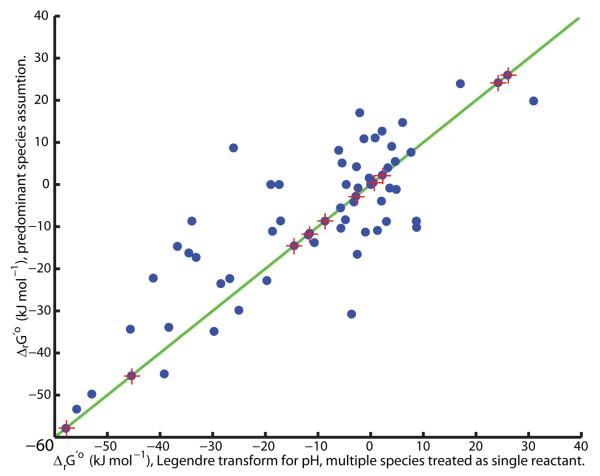
When cytoplasmic pH is held constant by buffering, a Legendre transform of metabolite species standard Gibbs energy of formation defines a standard transformed Gibbs energy of formation for each metabolite species. Reactant standard transformed Gibbs energy of formation, and therefore reaction standard transformed Gibbs energy, depends non-additively on the standard transformed metabolite species Gibbs energy of formation. Due to this non-additivity, when reactants are present as multiple species, differing in their state of protonation, it is erroneous to replace transformation of metabolite species standard Gibbs energy of formation, with adjustment to the hydrogen ion standard Gibbs energy of formation, when calculating reaction standard transformed Gibbs energy. The latter gives rise to an erroneous estimate of standard ‘transformed’ reaction Gibbs energy, as illustrated above for the reactions in the central metabolic E. coli model [61] at pH 7.7, zero ionic strength, atmospheric pressure and temperature 298.15K. The exception is when each reactant involved in a reaction is present as only one metabolite species. In this case both approaches agree (stars on the diagonal).
Figure 4
Figure 4. Qualitatively forward, quantitatively reverse reactions
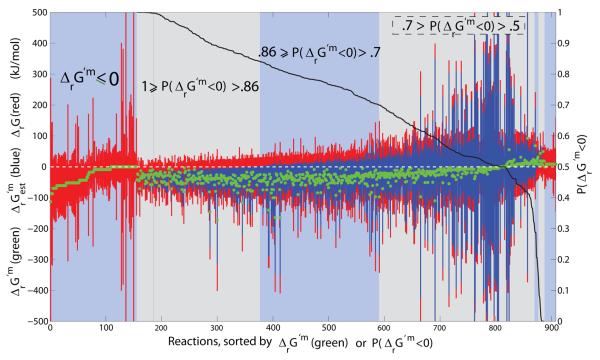
The reactions that are qualitatively assigned to be forward in iAF1260, yet quantitatively reversible, using at least one group contribution estimate of reactant standard transformed Gibbs energy of formation. The feasible range of ΔrG′ and ΔrGestm are given as red and blue bars respectively. Far left are transport reactions with negative or zero physiological standard transformed reaction Gibbs energy, ΔrG′m ≤ 0, but reversible depending on concentration of reactants. Reactions with uncertainty due to estimation of standard transformed reaction Gibbs energy are rank ordered by decreasing probability that physiological standard transformed reaction Gibbs energy is negative. In mathematical notation this probability is represented by the symbol PrG′m < 0), as defined in Eq. 3, and used in situabove to denote the intervals as follows: Reactions with PrG′m < 0) > 0.7 were assumed to be irreversible in the forward direction, and reactions with PrG′m < 0) < 0.3 or ΔrG′m > 0, were assumed to be irreversible in the reverse direction. See Figure 12 for a detailed illustration of the latter reactions. Reactions with 0.7 ≥ PrG′m < 0) > 0.3 were allowed to be quantitatively reversible in lieu of the large uncertainty in estimation of standard transformed reaction Gibbs energy.

References

    1. Palsson BØ. Systems Biology: Properties of Reconstructed Networks. Cambridge University Press; Cambridge: 2006.
    1. Thiele I, Palsson BØ. A protocol for generating a high-quality genome-scale metabolic reconstruction. Nat Protoc. 2009 accepted. - PMC - PubMed
    1. Pál C, Papp B, Lercher MJ, Csermely P, Oliver SG, Hurst LD. Chance and necessity in the evolution of minimal metabolic networks. Nature. 2006;440(7084):667–670. - PubMed
    1. Mahadevan R, Schilling CH. The effects of alternate optimal solutions in constraint-based genome-scale metabolic models. Metab Eng. 2003;5(4):264–276. - PubMed
    1. Burgard AP, Nikolaev EV, Schilling CH, Maranas CD. Flux coupling analysis of genome-scale metabolic network reconstructions. Genome Res. 2004;14(2):301–312. - PMC - PubMed

Publication types

LinkOut - more resources