


Review
doi: 10.1177/0022034509343143.
Sensitivity of salivary glands to radiation: from animal models to therapies
Affiliations
- PMID: 19783796
- PMCID: PMC2882712
- DOI: 10.1177/0022034509343143
Item in Clipboard
Review
Sensitivity of salivary glands to radiation: from animal models to therapies
J Dent Res.
2009 Oct.
Abstract
Radiation therapy for head and neck cancer causes significant secondary side-effects in normal salivary glands, resulting in diminished quality of life for these individuals. Salivary glands are exquisitely sensitive to radiation and display acute and chronic responses to radiotherapy. This review will discuss clinical implications of radiosensitivity in normal salivary glands, compare animal models used to investigate radiation-induced salivary gland damage, address therapeutic advances, and project future directions in the field.
Figures
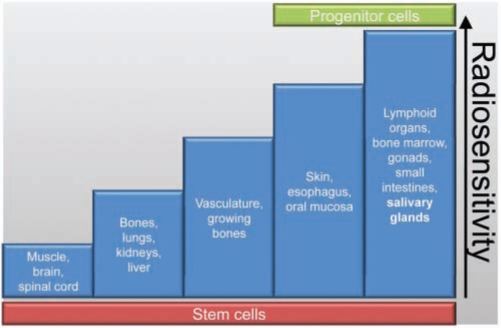
Radiosensitivity of various tissues. Radiosensitivity of different tissues classified by early cell death and proposed distribution of stem and progenitor cells. Modified from Rubin and Casarett, 1968 (with permission).
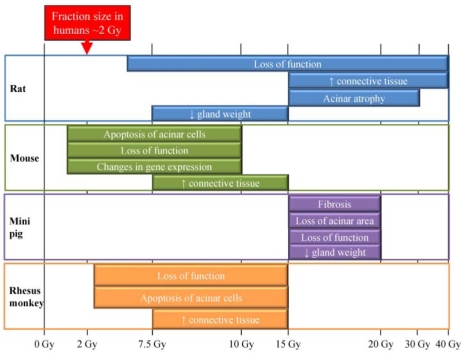
Comparison of radiation responses in animal models following a single dose. The typical fraction size (~ 2 Gy) in affected individuals is provided at the top as a reference for the other models. Physiological, molecular, and histological changes are graphed relative to the single radiation dose evaluated in the rat, mouse, miniature pig, and rhesus monkey models (Stephens et al., 1986a,b, 1991; Vissink et al., 1990; Nagler, 1998; Nagler et al., 1998; Paardekooper et al., 1998; Bralic et al., 2005; Konings et al., 2005a, 2006; Li et al., 2005; Humphries et al., 2006; Limesand et al., 2006; Muhvic-Urek et al., 2006;Takakura et al., 2007; Avila et al., 2009).
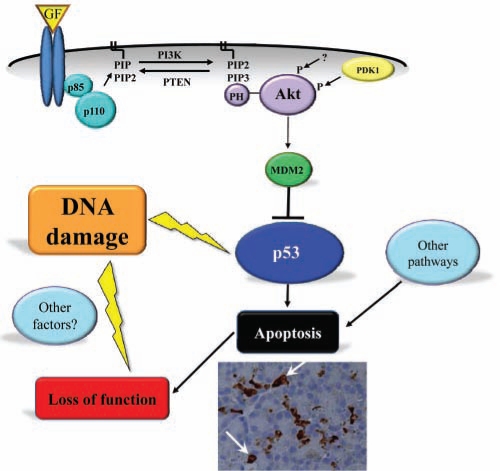
Putative signaling pathway involved in radiation-induced salivary gland dysfunction. In general, activation of Akt occurs through the binding of growth factors (GF) to their specific receptor (reviewed in (Manning and Cantley, 2007) and, in salivary acinar cells, requires the activation of PI-3 kinase (combined p85 and p110 subunits) (Limesand et al., 2003a). An important molecule that regulates the DNA damage response is p53, and negative regulation of p53 protein levels by Akt is mediated via activation of the Murine Double Minute Clone 2 (MDM2). p53 activation following radiation leads to apoptosis of salivary acinar cells (arrows mark activated caspase-3-positive cells) and subsequent loss of function. It is probable that other pathways (right-side icon) regulating the apoptotic response, discussed in the section “Other Pathways Involved in Radiation Damage”, could play a role in radiation-induced salivary gland dysfunction. In addition, other factors (left-side icon), such as autophagy, necrosis, senescence, etc., could be involved in DNA damage, leading to loss of function.
References
-
- Anne PR. (2002). Phase II trial of subcutaneous amifostine in patients undergoing radiation therapy for head and neck cancer. Semin Oncol 29(6 Suppl 19):80-83; erratum in Semin Oncol 30:417, 2003 - PubMed
-
- Bao S, Wu Q, McLendon RE, Hao Y, Shi Q, Hjelmeland AB, et al. (2006). Glioma stem cells promote radioresistance by preferential activation of the DNA damage response. Nature 444:756-760 - PubMed
-
- Baum BJ, Zheng C, Cotrim AP, Goldsmith CM, Atkinson JC, Brahim JS, et al. (2006). Transfer of the AQP1 cDNA for the correction of radiation-induced salivary hypofunction. Biochim Biophys Acta 1758:1071-1077 - PubMed
-
- Braam PM, Terhaard CH, Roesink JM, Raaijmakers CP. (2006). Intensity-modulated radiotherapy significantly reduces xerostomia compared with conventional radiotherapy. Int J Radiat Oncol Biol Phys 66:975-980 - PubMed
Publication types
MeSH terms
Substances
Grants and funding
LinkOut - more resources
Full Text Sources
Other Literature Sources
Medical
