Review
. 2009 Aug 24;14(9):3115-31.
doi: 10.3390/molecules14093115.

Solid state polyselenides and polytellurides: a large variety of Se-Se and Te-Te interactions

Affiliations
Review

Solid state polyselenides and polytellurides: a large variety of Se-Se and Te-Te interactions

Christian Graf et al. Molecules. .

Abstract

A large variety of different interactions between the chalcogen atoms, Q, occur in the solid state structures of polyselenides and polytellurides, including both molecular and infinite units. The simplest motifs are classical Q(2)(2-) dumbbells and nonlinear Q(n)(2-) chains (n = 3, 4, 5, ..), e.g. found in alkali metal polychalcogenides. In addition, nonclassical so-called hypervalent motifs exist in the form of linear Q(3)(4-) units or within larger units such as Q(4)(4-) and Q(5)(4-). Infinitely extended Q units include zigzag, cis/trans and linear chains, as well as planar and slightly puckered layers. Several of those are susceptible to Peierls distortions, leading to the formation of both commensurate and incommensurate superstructures and anomalies in transport properties, including metal-nonmetal transitions.


Figures
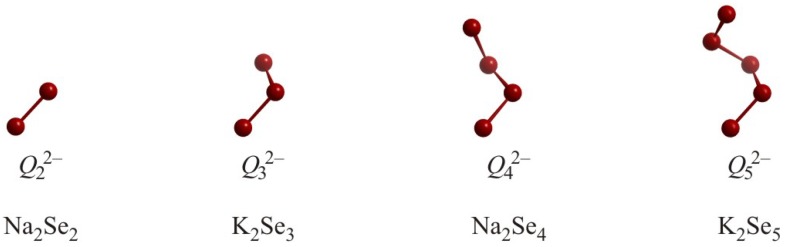
Figure 1
Figure 1
From left to right: Oligomeric Qn2– motifs in Na2Se2, K2Se3, Na2Se4, and K2Se5.
Figure 2
Figure 2
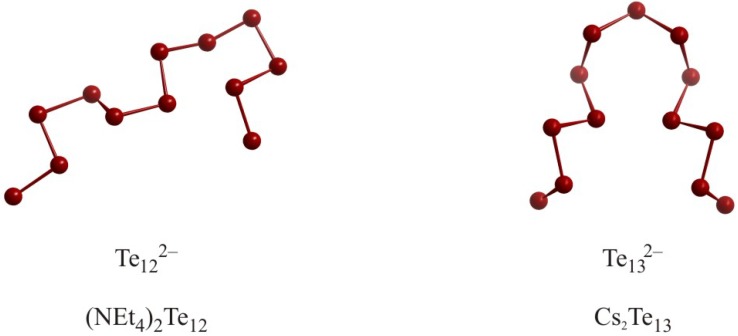
Oligomeric Ten2– motifs in (NEt4)2Te12 (left) and Cs2Te13 (right).
Figure 3
Figure 3
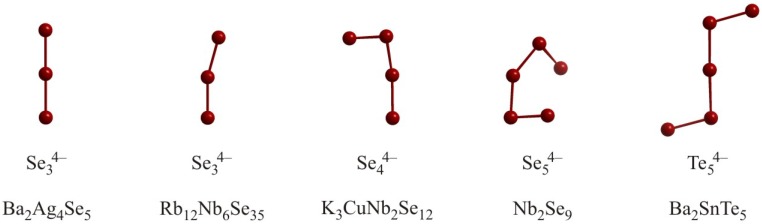
From left to right: Se34– (D∞h), Se34– (C2v), Se44–, cis-Se54– and trans-Te54–.
Figure 4
Figure 4
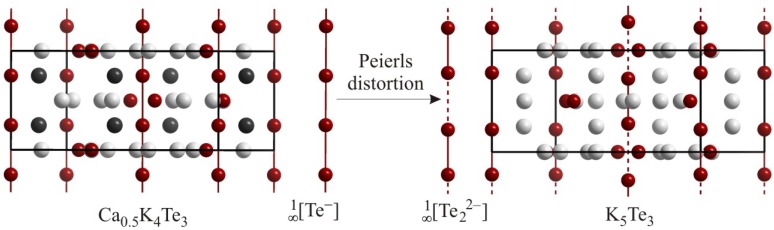
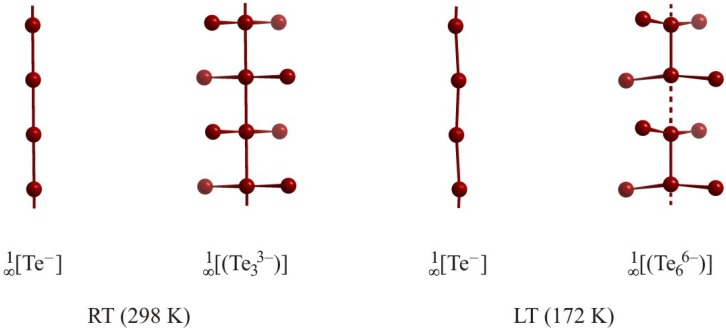
Infinite Te1– chains in Ca0.5K4Te3 (left) and K5Te3 (right).
Figure 5
Figure 5
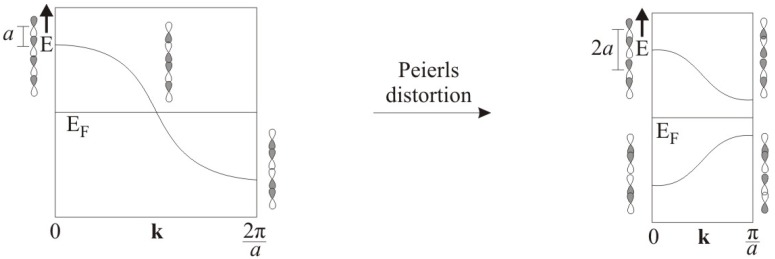
Peierls distortion of a linear [1 Te] chain.
Figure 6
Figure 6
Various Te atom chains of TlTe.
Figure 7
Figure 7
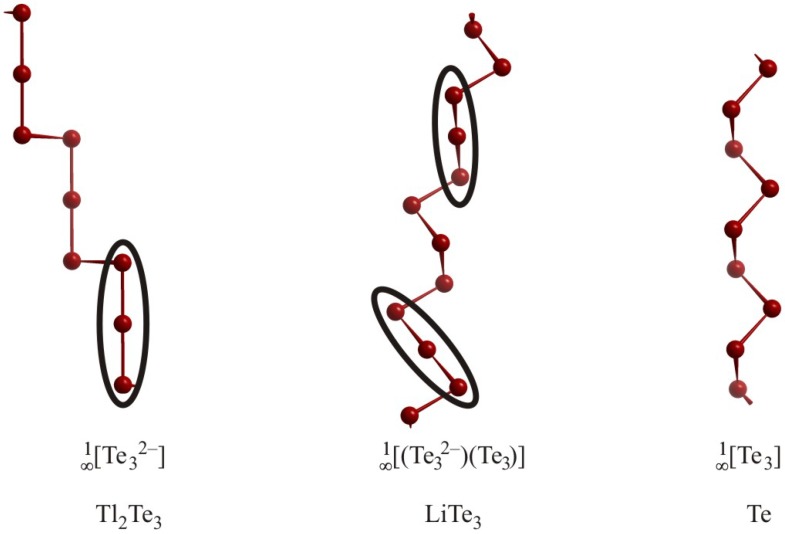
Infinite Te atom chains with different VEC(Te) in Tl2Te3 (left), LiTe3 (center) and Te (right).
Figure 8
Figure 8
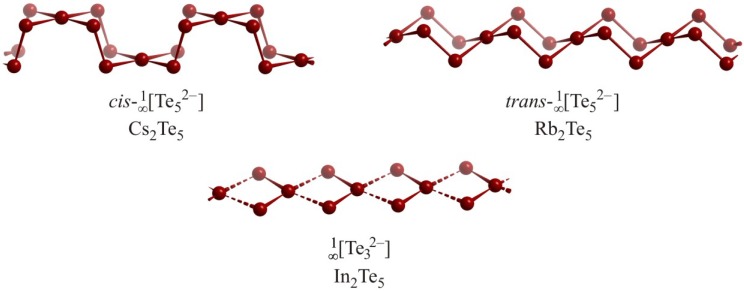
Infinite Te ribbons with different modifications in Cs2Te5 (top left), Rb2Te5 (top right) and In2Te5 (bottom center).
Figure 9
Figure 9
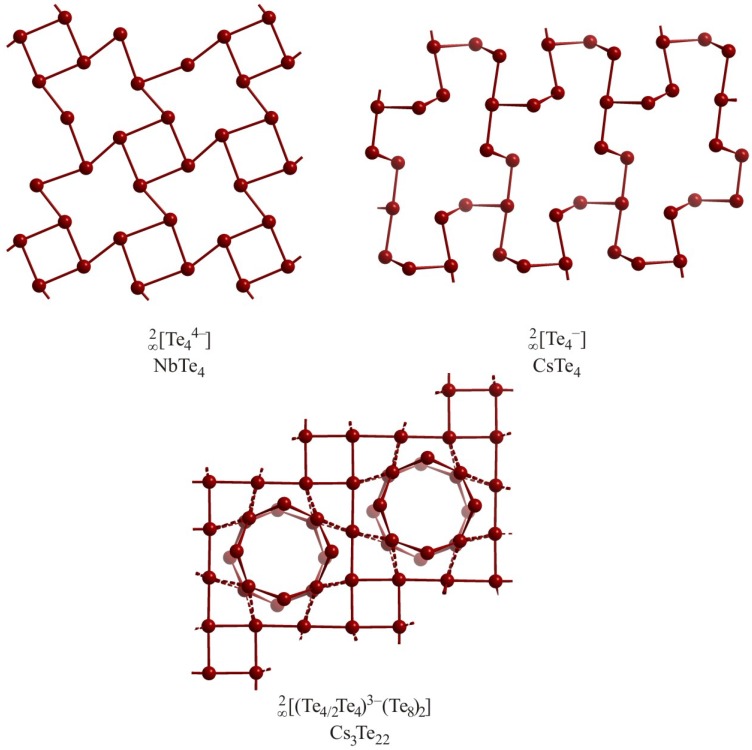
Different T nets in NbTe4 (top left), CsTe4 (top right) and Cs3Te22 (bottom center).
Figure 10
Figure 10
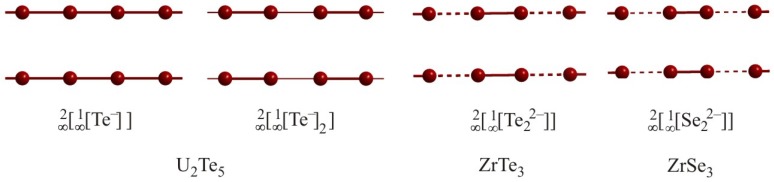
Planar layers of linear chains in U2Te5 (left), ZrTe3 (center) and ZrSe3 (right).
Figure 11
Figure 11
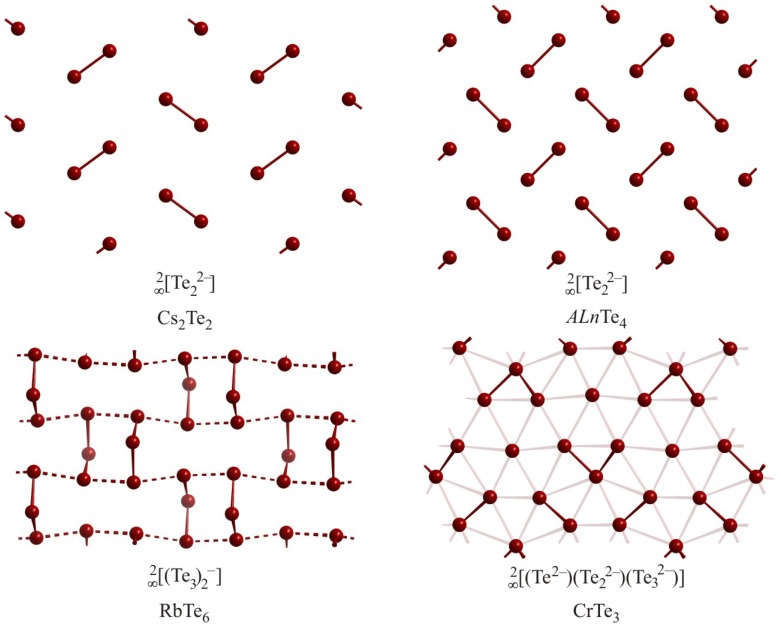
Layers of oligomeric Te atom fragments in Cs2Te2 (top left), ALnTe4 (top right), RbTe6 (bottom left), and CrTe3 (bottom right).
Figure 12
Figure 12
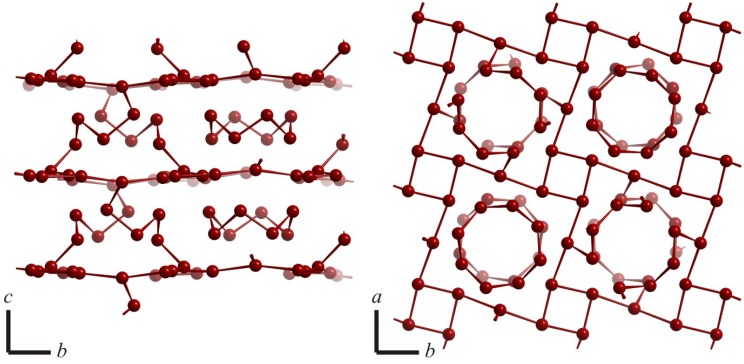
Three-dimensional network of Te atoms in Cs4Te28.

References

    1. Kosbar L.L., Murray C.E., Copel M., Afzali A., Mitzi D.B. High-mobility ultrathin semiconducting films prepared by spin coating. Nature. 2004;428:299–303. - PubMed
    1. Lange S., Nilges T. Ag10Te4Br3: A new silver(I) (poly)chalcogenide halide solid electrolyte. Chem. Mater. 2006;18:2538–2544. doi: 10.1021/cm060226m. - DOI
    1. Zheng N., Bu X., Feng P. Synthetic design of crystalline inorganic chalcogenides exhibiting fast-ion conductivity. Nature. 2003;426:428–432. doi: 10.1038/nature02159. - DOI - PubMed
    1. Tarascon J.-M., Armand M. Issues and challenges facing rechargeable lithium batteries. Nature. 2001;414:359–367. doi: 10.1038/35104644. - DOI - PubMed
    1. Atwood G. Phase-change materials for electronic memories. Science. 2008;321:210–211. doi: 10.1126/science.1160231. - DOI - PubMed

Publication types

MeSH terms

LinkOut - more resources