


doi: 10.1146/annurev.fluid.40.111406.102126.
Hemodynamics of Cerebral Aneurysms
Affiliations
- PMID: 19784385
- PMCID: PMC2750901
- DOI: 10.1146/annurev.fluid.40.111406.102126
Item in Clipboard
Hemodynamics of Cerebral Aneurysms
Annu Rev Fluid Mech.
.
Abstract
The initiation and progression of cerebral aneurysms are degenerative processes of the arterial wall driven by a complex interaction of biological and hemodynamic factors. Endothelial cells on the artery wall respond physiologically to blood-flow patterns. In normal conditions, these responses are associated with nonpathological tissue remodeling and adaptation. The combination of abnormal blood patterns and genetics predisposition could lead to the pathological formation of aneurysms. Here, we review recent progress on the basic mechanisms of aneurysm formation and evolution, with a focus on the role of hemodynamic patterns.
Figures

Mathematical model of blood flows.

Computational model of the hemodynamics in the circle of Willis of a normal subject. (a) Original medical image and (b) corresponding vascular model. (c) The complex swirling flows and (d) nonuniform wall shear stress (WSS) distribution (with red representing the highest WSS) along the major cerebral vessels.

Intra-aneurysmal flow patterns, ranging from simple patterns with a single recirculation region (top left) to complex patterns with several vortical structures that can be stable, moving, or intermittent during the cardiac cycle.

(a) Aneurysms with concentrated inflow jet and regions of locally elevated wall shear stress (WSS) (top panels) and with diffuse inflow jet and WSS uniformly lower than the parent artery (bottom panels). (b) Aneurysms with large (top panels) and small (bottom panels) impingement regions compared to the aneurysm size.
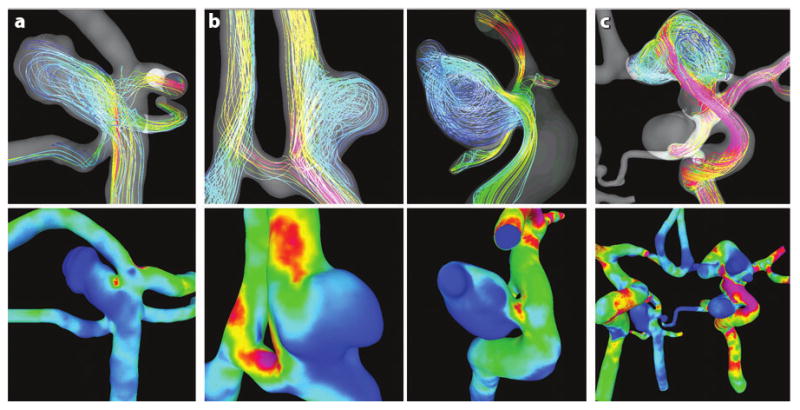
Flow patterns (top panels) and wall shear stress distribution (bottom panels) of aneurysms with inflow regions located at the distal (a), side (b), and proximal (c) portions of the neck.

Aneurysms with flow-impingement regions located at the neck (a), body (b) and dome (c) of the aneurysm. Flow patterns are shown in the top panels, and wall shear stress distribution is shown in the bottom panels.
References
-
- Alastruey J, Parker KH, Peiro J, Byrd SM, Sherwin SJ. Modelling the circle of Willis to assess the effects of anatomical variations and occlusions on cerebral flows. J Biomech. 2007;40:1794–805. - PubMed
-
- Alnaes MS, Isaksen J, Mardal KE, Rommer B, Morgan MK, Ingebritsen T. Computation of hemodynamics in the circle of Willis. Stroke. 2007;38:2500–5. - PubMed
-
- Basombrio F, Dari E, Buscaglia GC, Feijoo RA. Numerical experiments in complex haemodynamics flows: non-Newtonian effects. Presented at XI ENIEF; Bariloche, Argentina. 2000.
-
- Black SPW, German WL. Observation on the relationship between the volume and the size of the orifice of experimental aneurysms. J Neurosurg. 1960;17:984–90. - PubMed
Grants and funding
LinkOut - more resources
Full Text Sources