


Disparities in physicians' interpretations of heart disease symptoms by patient gender: results of a video vignette factorial experiment
- PMID: 19785567
- PMCID: PMC2825679
- DOI: 10.1089/jwh.2008.1007
Disparities in physicians' interpretations of heart disease symptoms by patient gender: results of a video vignette factorial experiment
Abstract
Background: Previous studies have documented the underdiagnosis of coronary heart disease (CHD) in women, but less is known about which alternate diagnoses take precedence and whether additional patient factors modify possible gender bias.
Objective: To measure gender variation in clinical decision making, including (1) the number, types, and certainty levels of diagnoses considered and (2) how diagnoses vary according to patient characteristics, when patients have identical symptoms of CHD.
Methods: This was a factorial experiment presenting videotaped CHD symptoms, systematically altering patient gender, age, socioeconomic status (SES) and race, and physician gender and level of experience. The primary end point was physicians' most certain diagnosis.
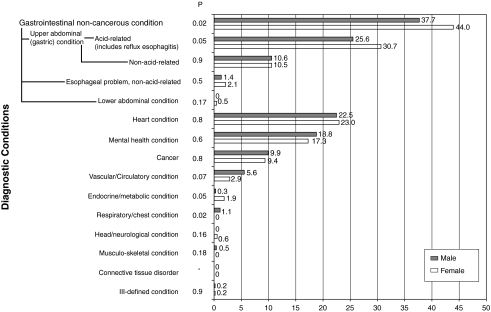
Results: Physicians (n = 128) mentioned five diagnoses on average, most commonly heart, gastrointestinal, and mental health conditions. Physicians were significantly less certain of the underlying cause of symptoms among female patients regardless of age (p = 0.006), but only among middle-aged women were they significantly less certain of the CHD diagnosis (p < 0.001). Among middle-aged women, 31.3% received a mental health condition as the most certain diagnosis, compared with 15.6% of their male counterparts (p = 0.03). An interaction effect showed that females with high SES were most likely to receive a mental health diagnosis as the most certain (p = 0.006).
Conclusions: Middle-aged female patients were diagnosed with the least confidence, whether for CHD or non-CHD conditions, indicating that their gender and age combination misled physicians, particularly toward mental health alternative diagnoses. Physicians should be aware of the potential for psychological symptoms to erroneously take a central role in the diagnosis of younger women.
Figures
References
-
- Institute of Medicine. Unequal treatment: Confronting racial and ethnic disparities in healthcare. Washington, DC: National Academies Press; 2003. - PubMed
-
- Wallen J. Waitzkin H. Stoeckle JD. Physician stereotypes about female health and illness: A study of patient's sex and the informative process during medical interviews. Women Health. 1979;4:135–146. - PubMed
-
- Verbrugge LM. How physicians treat mentally distressed men and women. Soc Sci Med. 1984;18:1–9. - PubMed
-
- McKinlay JB. Crawford SL. McKinlay SM. Sellers DE. On the reported gender difference in coronary heart disease: An illustration of the social construction of epidemiologic rates. In: Czajkowski SM, editor; Hill DR, editor; Clarkson TB, editor. Women Behavior and Cardiovascular Disease. Vol. 6. Bethesda, MD: NIH Publication; 1994. pp. 223–252.94-3309
Publication types
MeSH terms
Grants and funding
LinkOut - more resources
Full Text Sources
Medical
