. 2009 Nov;158(5):1366-74.
doi: 10.1111/j.1476-5381.2009.00407.x. Epub 2009 Sep 28.

Long-term blockade of L/N-type Ca(2+) channels by cilnidipine ameliorates repolarization abnormality of the canine hypertrophied heart

Affiliations

Long-term blockade of L/N-type Ca(2+) channels by cilnidipine ameliorates repolarization abnormality of the canine hypertrophied heart

A Takahara et al. Br J Pharmacol. 2009 Nov.

Abstract

Background and purpose: The heart of the canine model of chronic atrioventricular block is known to have a ventricular electrical remodelling, which mimics the pathophysiology of long QT syndrome. Using this model, we explored a new pharmacological therapeutic strategy for the prevention of cardiac sudden death.

Experimental approach: The L-type Ca(2+) channel blocker amlodipine (2.5 mg.day(-1)), L/N-type Ca(2+) channel blocker cilnidipine (5 mg.day(-1)), or the angiotensin II receptor blocker candesartan (12 mg.day(-1)) was administered orally to the dogs with chronic atrioventricular block for 4 weeks. Electropharmacological assessments with the monophasic action potential (MAP) recordings and blood sample analyses were performed before and 4 weeks after the start of drug administration.

Key results: Amlodipine and cilnidipine decreased the blood pressure, while candesartan hardly affected it. The QT interval, MAP duration and beat-to-beat variability of the ventricular repolarization period were shortened only in the cilnidipine group, but such effects were not observed in the amlodipine or candesartan group. Plasma concentrations of adrenaline, angiotensin II and aldosterone decreased in the cilnidipine group. In contrast, plasma concentrations of angiotensin II and aldosterone were elevated in the amlodipine group, whereas in the candesartan group an increase in plasma levels of angiotensin II and a decrease in noradrenaline and adrenaline concentrations were observed.

Conclusions and implications: Long-term blockade of L/N-type Ca(2+) channels ameliorated the ventricular electrical remodelling in the hypertrophied heart which causes the prolongation of the QT interval. This could provide a novel therapeutic strategy for the treatment of cardiovascular diseases.


Figures
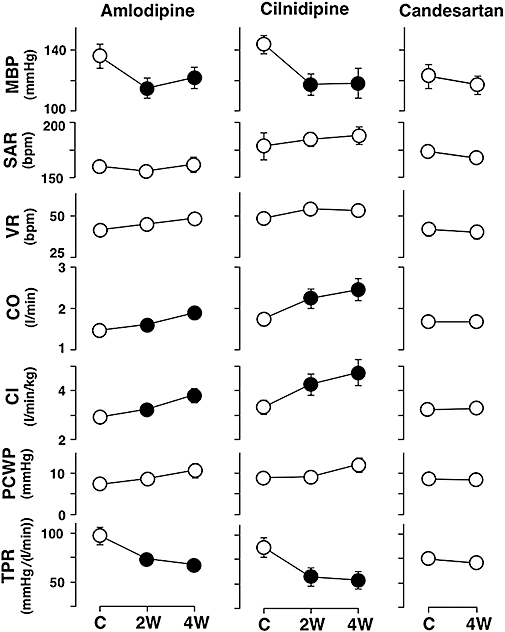
Figure 1
Figure 1
Cardiovascular effects of amlodipine, cilnidipine and candesartan in the canine model of chronic atrioventricular block. Cardiovascular variables in the amlodipine (n= 8) and cilnidipine (n= 7) groups were obtained at pre-drug control (C) and 2 weeks (2W) and 4 weeks (4W) after the start of drug administration, whereas those in the candesartan group (n= 7) were obtained at pre-drug control and 4 weeks after the start of drug administration. Data are presented as the mean ± SEM. Solid symbols represent the significant differences from each pre-drug control (C) value, P < 0.05. MBP, mean blood pressure; SAR, sinoatrial rate; VR, ventricular rate; CO, cardiac output; CI, cardiac index; PCWP, pulmonary capillary wedge pressure; TPR, total peripheral vascular resistance.
Figure 2
Figure 2
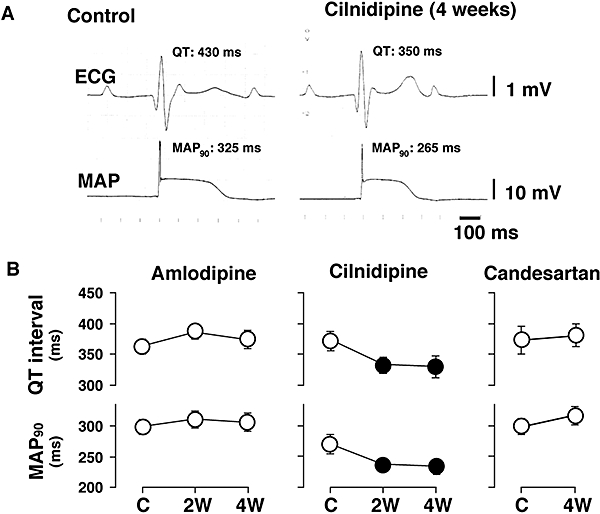
Effects of the different drugs on the electrocardiogram (ECG) and monophasic action potential (MAP) signal during idioventricular rhythm. (A) Typical tracings of effects of cilnidipine on ECG and MAP signal. (B) Effects of amlodipine (n= 8), cilnidipine (n= 7) and candesartan (n= 7) on the QT interval and MAP duration. These parameters were obtained at pre-drug control (C) and 2 weeks (2W) and 4 weeks (4W) after the start of drug administration. Data are presented as the mean ± SEM. Solid symbols represent the significant differences from each pre-drug control (C) value, P < 0.05.
Figure 3
Figure 3
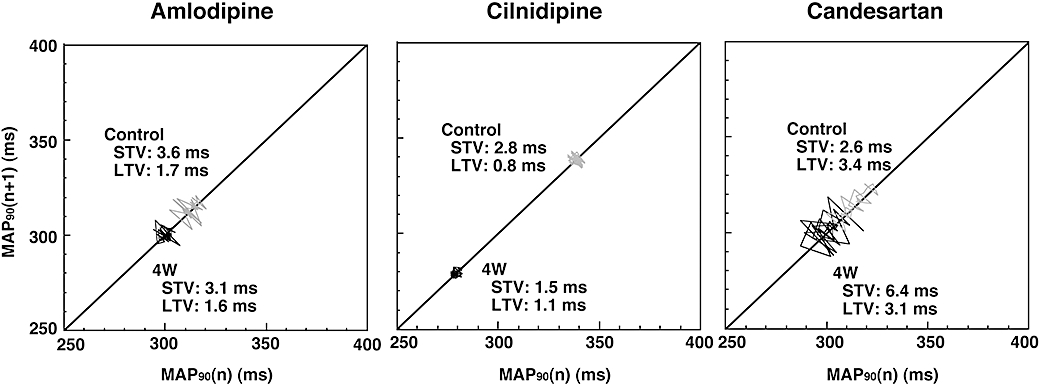
Effects of amlodipine, cilnidipine and candesartan on the Poincaré plots of the duration of the monophasic action potential (MAP90) in the canine model of chronic atrioventricular block. Thirty-one beats were plotted for each of two analysis time points; before (Control) and 4 weeks after the drug administration (4W). STV, short-term variability; LTV, long-term variability.
Figure 4
Figure 4
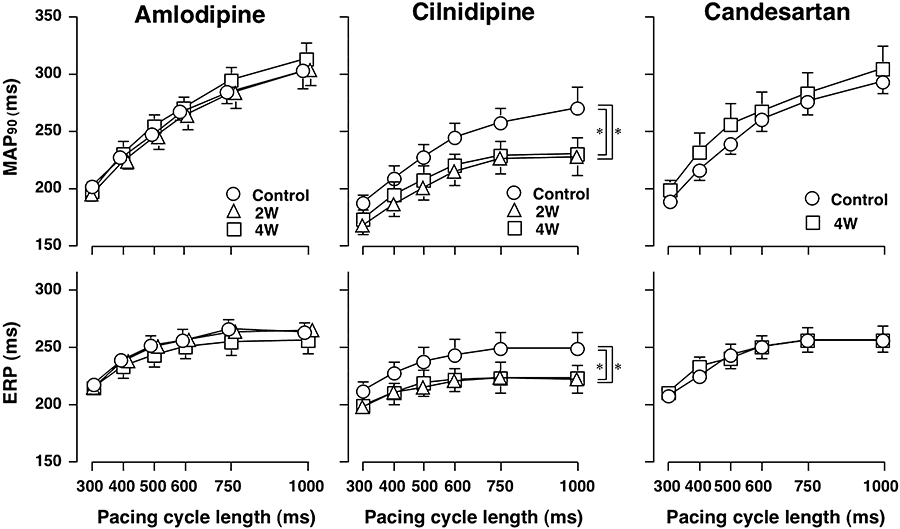
Electrophysiological effects of amlodipine, cilnidipine and candesartan on the ventricular repolarization phase of the canine model of chronic atrioventricular block. MAP duration (MAP90) and effective refractory period (ERP) of various basic pacing cycle length of 300, 400, 500, 600, 750 and 1000 ms in the amlodipine (n= 8) and cilnidipine (n= 7) groups were obtained at pre-drug control (C) and 2 weeks (2W) and 4 weeks (4W) after the start of drug administration, whereas those in the candesartan group (n= 7) were obtained at pre-drug control and 4 weeks after the start of drug administration. Data are presented as the mean ± SEM. *P < 0.05 compared with corresponding pre-drug control value (C).
Figure 5
Figure 5
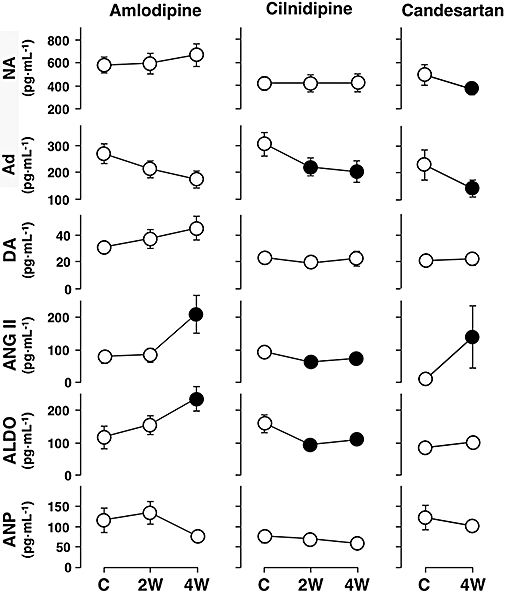
Effects of amlodipine, cilnidipine and candesartan on neurohormones in the canine model of chronic atrioventricular block. Plasma concentrations of each neurohumoral factor in the amlodipine (n= 8) and cilnidipine (n= 7) groups were obtained at pre-drug control (C) and 2 weeks (2W) and 4 weeks (4W) after the start of drug administration, whereas those in the candesartan group (n= 7) were obtained at pre-drug control and 4 weeks after the start of drug administration. Data are presented as the mean ± SEM. Solid symbols represent significant differences from each pre-drug control (C) value, P < 0.05. NA, noradrenaline; Ad, adrenaline; DA, dopamine; ANG II, angiotensin II; ALDO, aldosterone; ANP, atrial natriuretic peptide.

References

    1. Alexander SPH, Mathie A, Peters JA. Guide to Receptors and Channels (GRAC), 3rd ed. Br J Pharmacol. 2008;153(Suppl 2):S1, S209. - PMC - PubMed
    1. Antzelevitch C. Ionic, molecular, and cellular bases of QT-interval prolongation and torsade de pointes. Europace. 2007;9(Suppl 4):iv4–15. - PMC - PubMed
    1. Antzelevitch C, Belardinelli L, Zygmunt AC, Burashnikov A, Di Diego JM, Fish JM, et al. Electrophysiological effects of ranolazine, a novel antianginal agent with antiarrhythmic properties. Circulation. 2004;110:904–910. - PMC - PubMed
    1. Aritomi S, Nogi Y, Koganei H, Mitsui A, Konda T, Yoshimura M. The role of N-type calcium channels in regulating aldosterone secretion in H295R human adrenocortical cells. J Am Soc Nephrol. 2007;18:155A.
    1. Bénitah JP, Perrier E, Gómez AM, Vassort G. Effects of aldosterone on transient outward K+ current density in rat ventricular myocytes. J Physiol. 2001;537:151–160. - PMC - PubMed

Publication types

MeSH terms