. 2009 Oct;158(4):1153-64.
doi: 10.1111/j.1476-5381.2009.00383.x. Epub 2009 Sep 28.

Interaction of nilotinib, dasatinib and bosutinib with ABCB1 and ABCG2: implications for altered anti-cancer effects and pharmacological properties

Affiliations

Interaction of nilotinib, dasatinib and bosutinib with ABCB1 and ABCG2: implications for altered anti-cancer effects and pharmacological properties

C Hegedus et al. Br J Pharmacol. 2009 Oct.

Abstract

Background and purpose: ABC multidrug transporters (MDR-ABC proteins) cause multiple drug resistance in cancer and may be involved in the decreased anti-cancer efficiency and modified pharmacological properties of novel specifically targeted agents. It has been documented that ABCB1 and ABCG2 interact with several first-generation, small-molecule, tyrosine kinase inhibitors (TKIs), including the Bcr-Abl fusion kinase inhibitor imatinib, used for the treatment of chronic myeloid leukaemia. Here, we have investigated the specific interaction of these transporters with nilotinib, dasatinib and bosutinib, three clinically used, second-generation inhibitors of the Bcr-Abl tyrosine kinase activity.

Experimental approach: MDR-ABC transporter function was screened in both membrane- and cell-based (K562 cells) systems. Cytotoxicity measurements in Bcr-Abl-positive model cells were coupled with direct determination of intracellular TKI concentrations by high-pressure liquid chromatography-mass spectrometry and analysis of the pattern of Bcr-Abl phosphorylation. Transporter function in membranes was assessed by ATPase activity.

Key results: Nilotinib and dasatinib were high-affinity substrates of ABCG2, and this protein mediated an effective resistance in cancer cells against these compounds. Nilotinib and dasatinib also interacted with ABCB1, but this transporter provided resistance only against dasatinib. Neither ABCB1 nor ABCG2 induced resistance to bosutinib. At relatively higher concentrations, however, each TKI inhibited both transporters.

Conclusions and implications: A combination of in vitro assays may provide valuable preclinical information for the applicability of novel targeted anti-cancer TKIs, even in multidrug-resistant cancer. The pattern of MDR-ABC transporter-TKI interactions may also help to understand the general pharmacokinetics and toxicities of new TKIs.


Figures
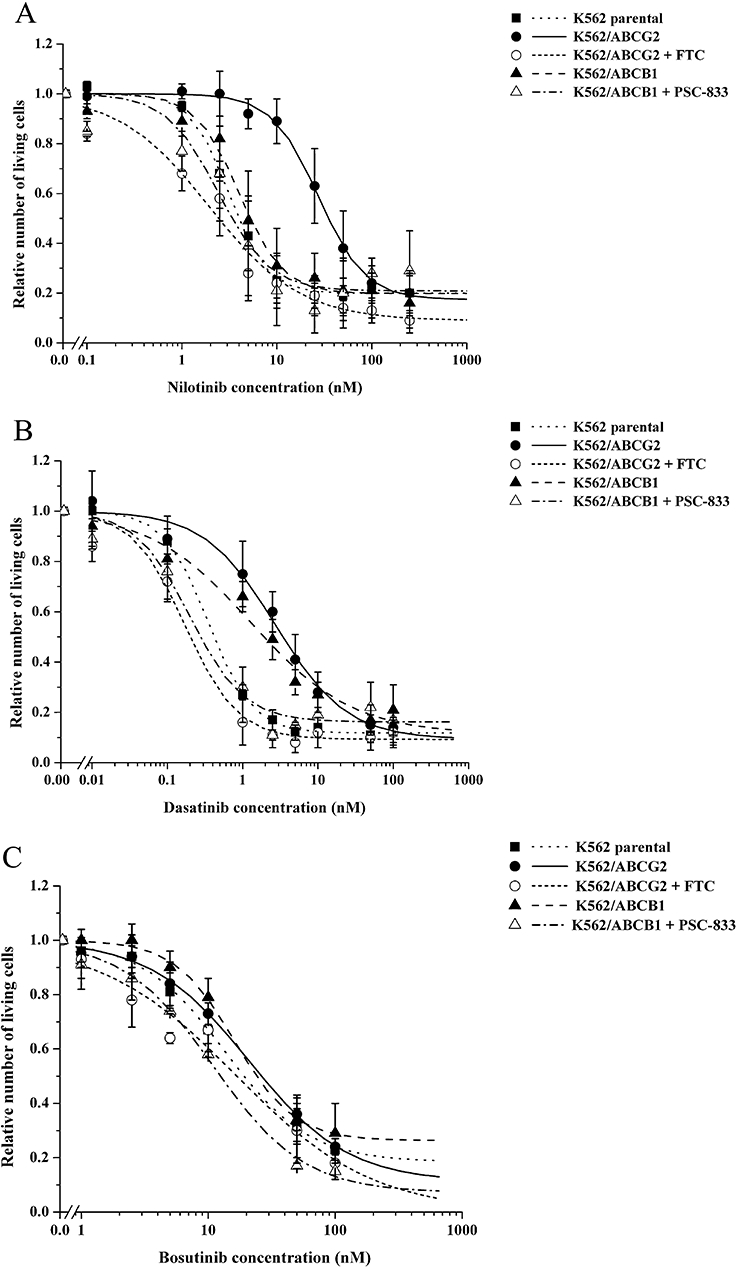
Figure 1
Figure 1
Cytotoxic effect of nilotinib, dasatinib and bosutinib in parental K562, K562/ABCB1 and K562/ABCG2 cells. Parental K562, K562/ABCB1 and K562/ABCG2 cells were incubated with increasing concentration of nilotinib (A), dasatinib (B) or bosutinib (C) in the presence or in the absence of the specific multidrug resistance ATP-binding cassette inhibitors 1 µM PSC-833 or 5 µM fumitremorgin C (FTC) for 48 h. Cells were then harvested, stained with TOPRO-3 and counted by flow cytometry. The number of living cells relative to those measured in vehicle-treated control samples was plotted against the log of tyrosine kinase inhibitor (TKI) concentrations, and exponential fit was applied. Data represent the mean of at least three independent experiments each in duplicate; bars represent SD.
Figure 2
Figure 2
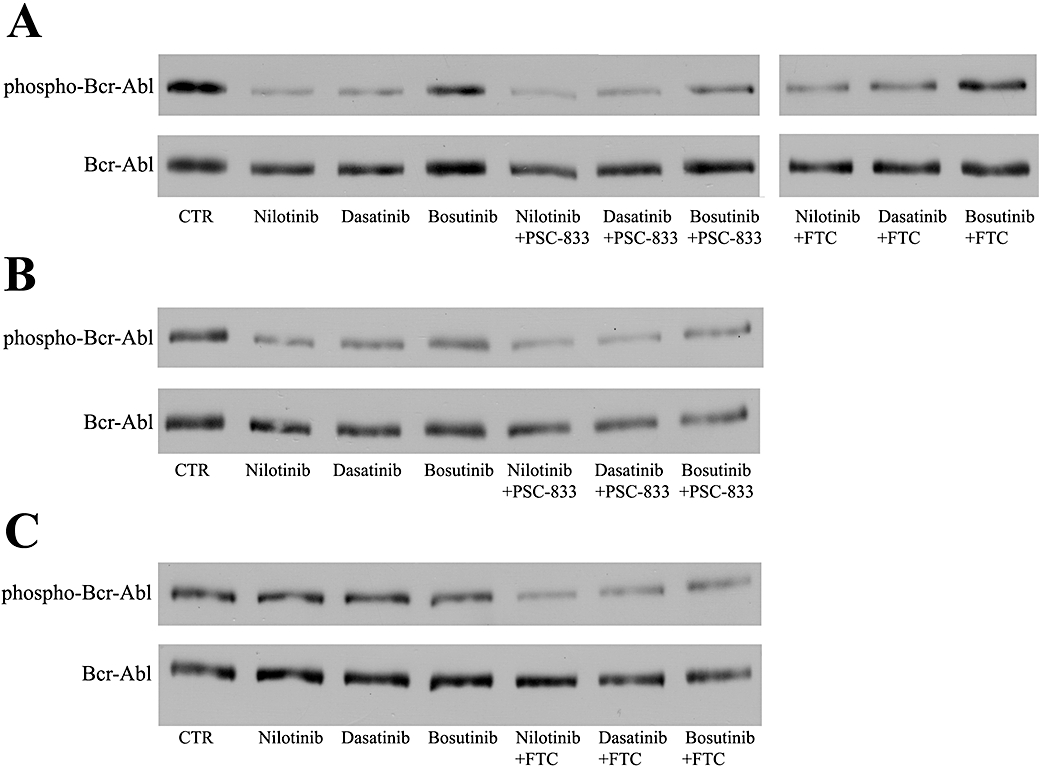
Bcr-Abl phosphorylation pattern in tyrosine kinase inhibitor-treated parental K562, K562/ABCB1 and K562/ABCG2 cells. Parental K562 (A), K562/ABCB1 (B) and K562/ABCG2 (C) cells were exposed to 25 nM nilotinib, 2.5 nM dasatinib or 25 nM bosutinib in the presence or in the absence of the specific multidrug resistance ATP-binding cassette inhibitors PSC-833 (1 µM) or fumitremorgin C (FTC) (5 µM) for 24 h. Bcr-Abl phosphorylation status in 40 µg protein of cell lysates was probed by Western blot analysis using the p-Bcr (Tyr177) antibody. Total amount of the Bcr-Abl protein (210 kDa) was estimated by c-Abl staining. The figure shows the result of one of two independent experiments.
Figure 3
Figure 3
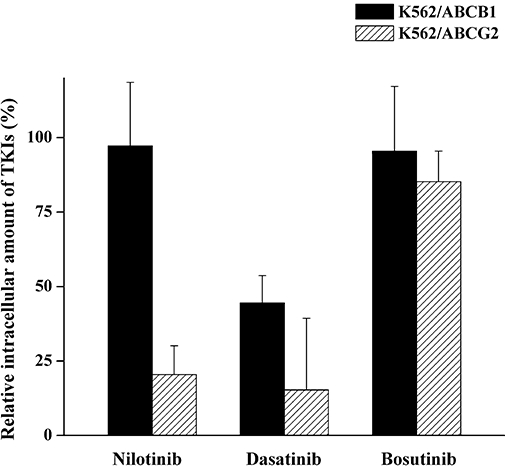
Effect of ABCB1 and ABCG2 on the intracellular accumulation of nilotinib, dasatinib and bosutinib. Parental K562, K562/ABCB1 and K562/ABCG2 cells were incubated with 25 nM nilotinib, 5 nM dasatinib or 10 nM bosutinib at 37°C for 60 min. Following precipitation of cells with acetonitrile containing 30 nM imatinib as an internal standard, the amount of intracellularly accumulated tyrosine kinase inhibitors (TKIs) was determined by high-pressure liquid chromatography-mass spectrometry. The figure shows the amount of nilotinib, dasatinib and bosutinib measured in K562/ABCB1 and K562/ABCG2 cells relative to those detected in parental K562 cells (100%). Columns represent the mean of at least two independent experiments, each in duplicate; bars represent SD.
Figure 4
Figure 4
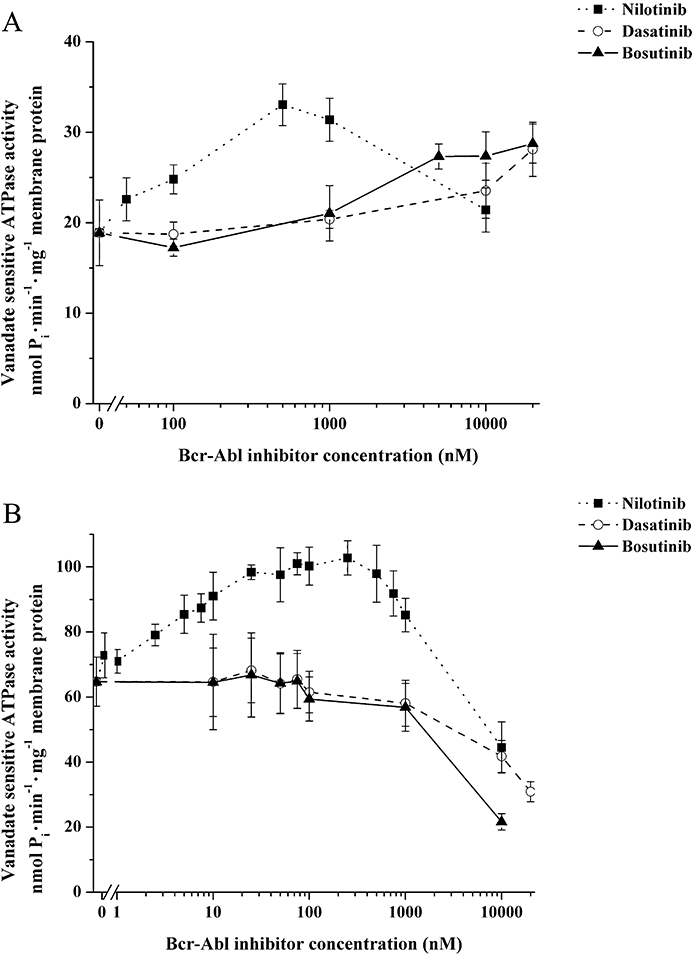
Modulatory effect of nilotinib, dasatinib and bosutinib on the ATPase activity of ABCB1 and ABCG2. The modulatory effects of tyrosine kinase inhibitors on the vanadate-sensitive ATPase activity (nmol Pi·min−1·mg−1 membrane protein) of human ABCB1 (A) and human wild-type ABCG2 (B) were tested using 10 µg insect Spodoptera frugiperda (Sf9) ovarian cell membranes expressing the respective multidrug resistance ATP-binding cassette transporter. For ABCG2 ATPase activity measurements, cholesterol-loaded Sf9 membrane vesicles were used. Expressed in Sf9 membranes, both transporters exhibit a relatively high basal ATPase activity. Full ABCB1 and ABCG2 transporter function in the membrane vesicles was tested by maximal ATPase stimulation with verapamil (50 µM) and prazosin (50 µM) or quercetin (1 µM) respectively (data not shown). Data represent the mean of at least three independent experiments each in duplicate; bars represent SD.
Figure 5
Figure 5
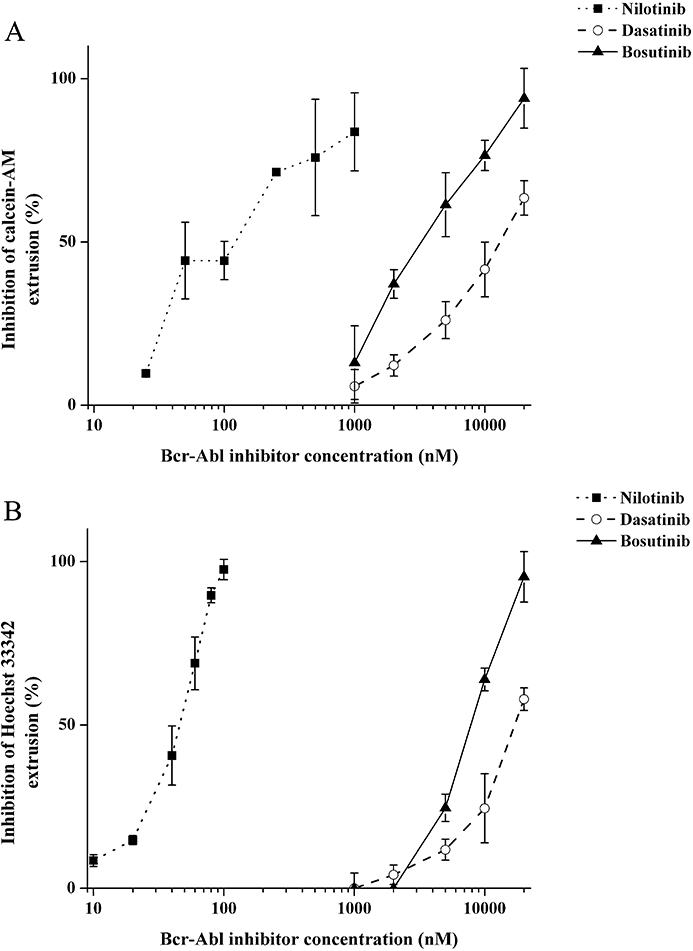
Inhibition of transporter-dependent fluorescent reporter dye extrusion from K562/ABCB1 and K562/ABCG2 cells by nilotinib, dasatinib and bosutinib. Concentration-dependent inhibitory potential of tyrosine kinase inhibitors (TKIs) on the ABCB1-dependent extrusion of calcein-AM (A) and ABCG2-dependent extrusion of Hoechst 33342 (B) was tested using K562/ABCB1 and K562/ABCG2 intact cells respectively. Cellular fluorescence was measured by using a spectrofluorometer, and TKI-mediated relative inhibition of dye extrusion was calculated as described in Methods. Data represent the mean of at least three independent experiments; bars represent SD.

References

    1. Brendel C, Scharenberg C, Dohse M, Robey RW, Bates SE, Shukla S, et al. Imatinib mesylate and nilotinib (AMN107) exhibit high-affinity interaction with ABCG2 on primitive hematopoietic stem cells. Leukemia. 2007;21:1267–1275. - PubMed
    1. Brozik A, Casey NP, Hegedus C, Bors A, Kozma A, Andrikovics H, et al. Reduction of Bcr-Abl function leads to erythroid differentiation of K562 cells via downregulation of ERK. Ann N Y Acad Sci. 2006;1090:344–354. - PubMed
    1. Burger H, van Tol H, Boersma AW, Brok M, Wiemer EA, Stoter G, et al. Imatinib mesylate (STI571) is a substrate for the breast cancer resistance protein (BCRP)/ABCG2 drug pump. Blood. 2004;104:2940–2942. - PubMed
    1. Dean M, Fojo T, Bates S. Tumour stem cells and drug resistance. Nat Rev Cancer. 2005;5:275–284. - PubMed
    1. Deguchi Y, Kimura S, Ashihara E, Niwa T, Hodohara K, Fujiyama Y, et al. Comparison of imatinib, dasatinib, nilotinib and INNO-406 in imatinib-resistant cell lines. Leuk Res. 2008;32:980–983. - PubMed

Publication types

MeSH terms

Substances