. 2009 Sep 28:10:93.
doi: 10.1186/1471-2199-10-93.

Evaluation of putative reference genes for gene expression normalization in soybean by quantitative real-time RT-PCR

Affiliations

Evaluation of putative reference genes for gene expression normalization in soybean by quantitative real-time RT-PCR

Ruibo Hu et al. BMC Mol Biol. .

Abstract

Background: Real-time quantitative reverse transcription PCR (RT-qPCR) data needs to be normalized for its proper interpretation. Housekeeping genes are routinely employed for this purpose, but their expression level cannot be assumed to remain constant under all possible experimental conditions. Thus, a systematic validation of reference genes is required to ensure proper normalization. For soybean, only a small number of validated reference genes are available to date.

Results: A systematic comparison of 14 potential reference genes for soybean is presented. These included seven commonly used (ACT2, ACT11, TUB4, TUA5, CYP, UBQ10, EF1b) and seven new candidates (SKIP16, MTP, PEPKR1, HDC, TIP41, UKN1, UKN2). Expression stability was examined by RT-qPCR across 116 biological samples, representing tissues at various developmental stages, varied photoperiodic treatments, and a range of soybean cultivars. Expression of all 14 genes was variable to some extent, but that of SKIP16, UKN1 and UKN2 was overall the most stable. A combination of ACT11, UKN1 and UKN2 would be appropriate as a reference panel for normalizing gene expression data among different tissues, whereas the combination SKIP16, UKN1 and MTP was most suitable for developmental stages. ACT11, TUA5 and TIP41 were the most stably expressed when the photoperiod was altered, and TIP41, UKN1 and UKN2 when the light quality was changed. For six different cultivars in long day (LD) and short day (SD), their expression stability did not vary significantly with ACT11, UKN2 and TUB4 being the most stable genes. The relative gene expression level of GmFTL3, an ortholog of Arabidopsis FT (FLOWERING LOCUS T) was detected to validate the reference genes selected in this study.

Conclusion: None of the candidate reference genes was uniformly expressed across all experimental conditions, and the most suitable reference genes are conditional-, tissue-specific-, developmental-, and cultivar-dependent. Most of the new reference genes performed better than the conventional housekeeping genes. These results should guide the selection of reference genes for gene expression studies in soybean.


Figures
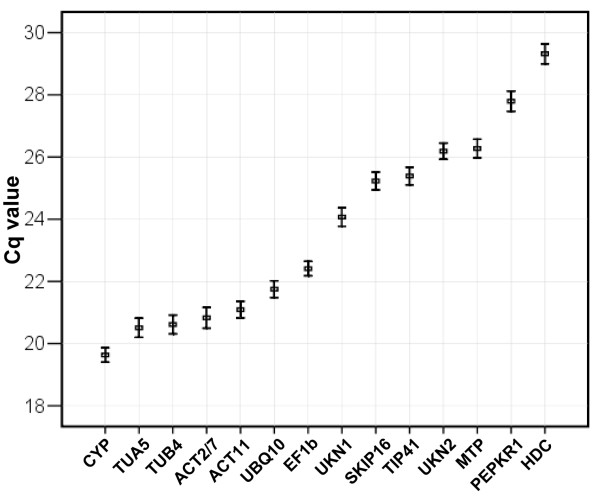
Figure 1
Figure 1
Expression levels of the candidate reference genes across experimental samples. Values are given in the form of RT-qPCR quantification cycle numbers (Cq values). The boxes represent mean Cq values, the bars standard deviations.
Figure 2
Figure 2
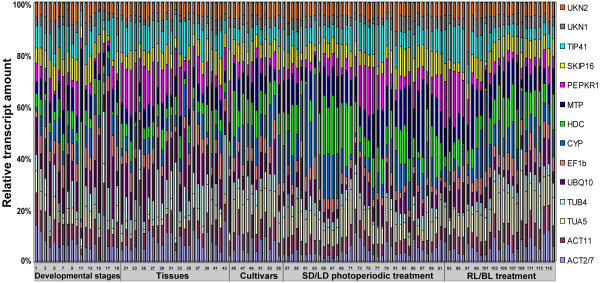
Distribution of relative transcript quantities of the reference genes across all samples. Transcript quantities are represented as percentages of the aggregated 14-transcript pool for each sample. 1-20: across various developmental stages; 21-44: across different tissues; 45-56: across cultivars; 57-92: response to short day (SD) and long day (LD) photoperiods; 93-116: response to exposure to red (RL) and blue (BL) light. Detailed sample information given in Additional file 5.
Figure 3
Figure 3
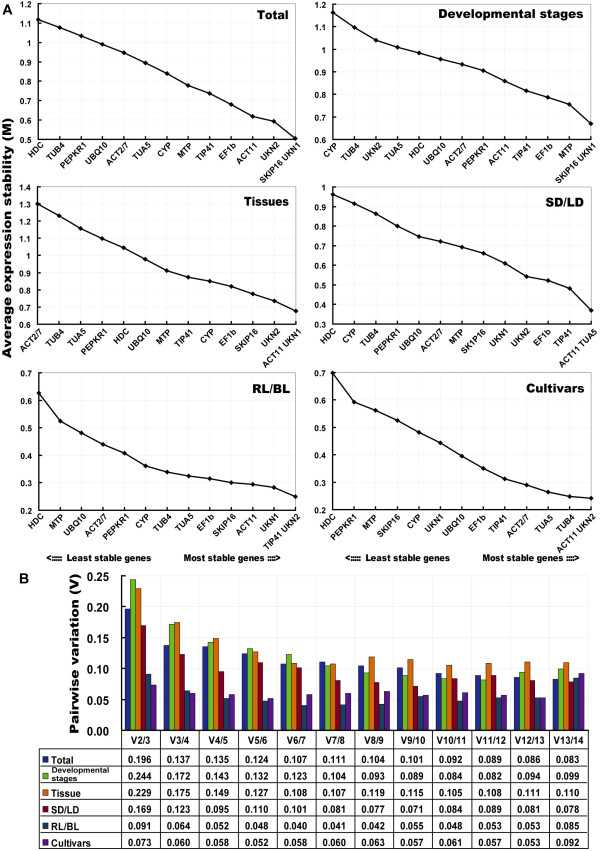
Gene expression stability and pairwise variation of the candidate genes as predicted by geNorm. A. Mean expression stability (M) following stepwise exclusion of the least stable gene across all treatment groups. The least stable genes are on the left, and the most stable on the right. B. The optimal number of reference genes required for effective normalization. The pairwise variation (Vn/Vn+1) was analyzed between the normalization factors NFn and NFn+1 by geNorm program to determine the optimal number of reference genes required for RT-qPCR data normalization.
Figure 4
Figure 4
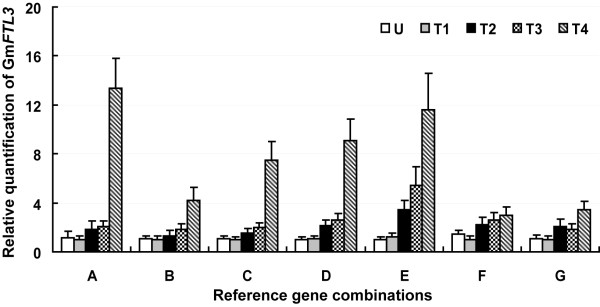
Relative quantification of GmFTL3 expression using validated reference genes for normalization. A: SKIP16; B: UKN1; C: SKIP16 and UKN1; D: SKIP16, UKN1 and MTP; E: SKIP16, UKN1, MTP and EF1b; F: CYP; G: TUB4. The results are represented as a mean fold change in relative expression compared to the first sampling stage (U). cDNA samples taken from the same set used for gene expression stability analysis: U, T1, T2, T3 and T4 indicate, respectively, the aerial part of plants collected at the full expansion of the unifoliolate, the first trifoliolate, the second trifoliolate, the third trifoliolate and the fourth trifoliolate leaf.

References

    1. Bustin SA. Quantification of mRNA using real-time reverse transcription PCR (RT-PCR): trends and problems. J Mol Endocrinol. 2002;29:23–39. doi: 10.1677/jme.0.0290023. - DOI - PubMed
    1. Bustin SA, Benes V, Nolan T, Pfaffl MW. Quantitative real-time RT-PCR--a perspective. J Mol Endocrinol. 2005;34:597–601. doi: 10.1677/jme.1.01755. - DOI - PubMed
    1. Gachon C, Mingam A, Charrier B. Real-time PCR: what relevance to plant studies? J Exp Bot. 2004;55:1445–1454. doi: 10.1093/jxb/erh181. - DOI - PubMed
    1. Walker NJ. Tech. Sight. A technique whose time has come. Science. 2002;296:557–559. doi: 10.1126/science.296.5567.557. - DOI - PubMed
    1. Huggett J, Dheda K, Bustin S, Zumla A. Real-time RT-PCR normalisation; strategies and considerations. Genes Immun. 2005;6:279–284. doi: 10.1038/sj.gene.6364190. - DOI - PubMed

Publication types

MeSH terms