


Window screening, ceilings and closed eaves as sustainable ways to control malaria in Dar es Salaam, Tanzania
- PMID: 19785779
- PMCID: PMC2760565
- DOI: 10.1186/1475-2875-8-221
Window screening, ceilings and closed eaves as sustainable ways to control malaria in Dar es Salaam, Tanzania
Abstract
Background: Malaria transmission in Africa occurs predominantly inside houses where the primary vectors prefer to feed. Human preference and investment in blocking of specific entry points for mosquitoes into houses was evaluated and compared with known entry point preferences of the mosquitoes themselves.
Methods: Cross-sectional household surveys were conducted in urban Dar es Salaam, Tanzania to estimate usage levels of available options for house proofing against mosquito entry, namely window screens, ceilings and blocking of eaves. These surveys also enabled evaluation of household expenditure on screens and ceilings and the motivation behind their installation.
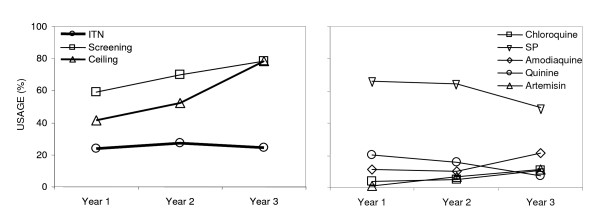
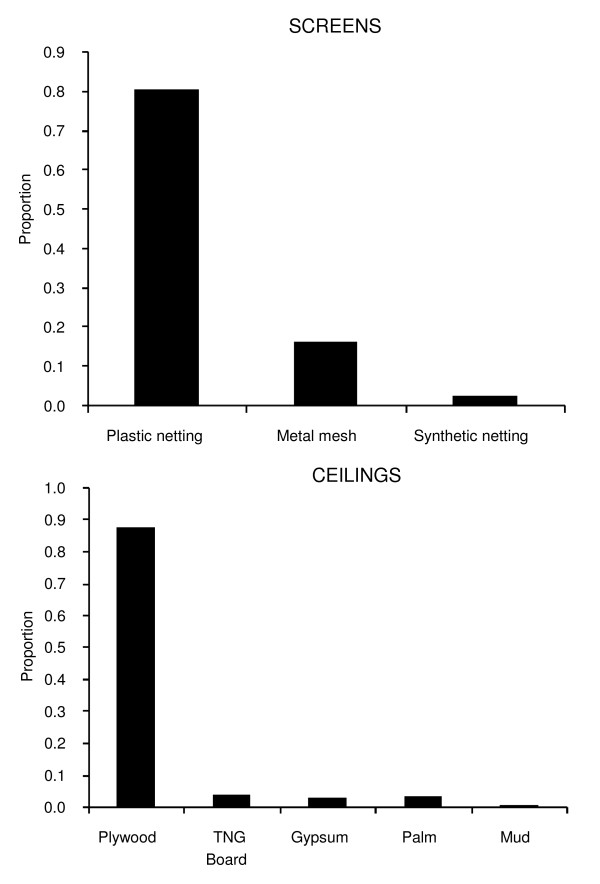
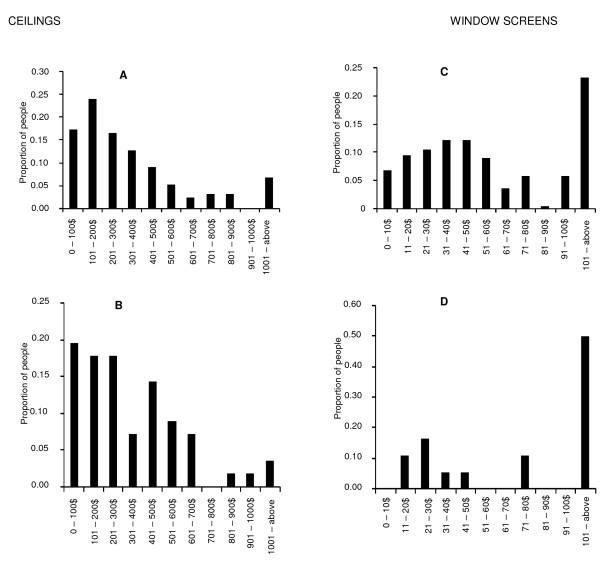
Results: Over three quarters (82.8%) of the 579 houses surveyed in Dar es Salaam had window screens, while almost half (48.9%) had ceilings. Prevention of mosquito entry was cited as a reason for installation of window screens and ceilings by 91.4% (394/431) and 55.7% (127/228) of respondents, respectively, but prevention of malaria was rarely cited (4.3%, 22/508). The median cost of window screens was between US $ 21-30 while that of ceilings was between US $301-400. The market value of insecticide-treated nets, window screening and ceilings currently in use in the city was estimated as 2, 5 and 42 million US$. More than three quarters of the respondents that lacked them said it was too expensive to install ceilings (82.2%) or window screens (75.5%).
Conclusion: High coverage and spending on screens and ceilings implies that these techniques are highly acceptable and excellent uptake can be achieved in urban settings like Dar es Salaam. Effective models for promotion and subsidization should be developed and evaluated, particularly for installation of ceilings that prevent entry via the eaves, which are the most important entry point for mosquitoes that cause malaria, a variety of neglected tropical diseases and the nuisance which motivates uptake.
Figures
References
Publication types
MeSH terms
Grants and funding
LinkOut - more resources
Full Text Sources
Medical
