. 2009 Nov;37(21):7239-57.
doi: 10.1093/nar/gkp668.

A search for small noncoding RNAs in Staphylococcus aureus reveals a conserved sequence motif for regulation

Affiliations

A search for small noncoding RNAs in Staphylococcus aureus reveals a conserved sequence motif for regulation

Thomas Geissmann et al. Nucleic Acids Res. 2009 Nov.

Abstract

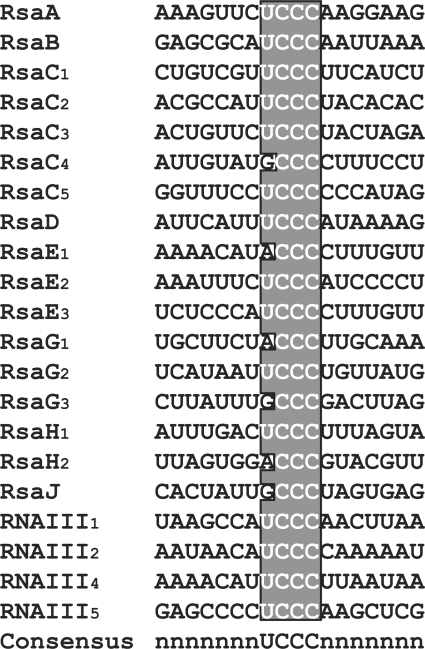
Bioinformatic analysis of the intergenic regions of Staphylococcus aureus predicted multiple regulatory regions. From this analysis, we characterized 11 novel noncoding RNAs (RsaA-K) that are expressed in several S. aureus strains under different experimental conditions. Many of them accumulate in the late-exponential phase of growth. All ncRNAs are stable and their expression is Hfq-independent. The transcription of several of them is regulated by the alternative sigma B factor (RsaA, D and F) while the expression of RsaE is agrA-dependent. Six of these ncRNAs are specific to S. aureus, four are conserved in other Staphylococci, and RsaE is also present in Bacillaceae. Transcriptomic and proteomic analysis indicated that RsaE regulates the synthesis of proteins involved in various metabolic pathways. Phylogenetic analysis combined with RNA structure probing, searches for RsaE-mRNA base pairing, and toeprinting assays indicate that a conserved and unpaired UCCC sequence motif of RsaE binds to target mRNAs and prevents the formation of the ribosomal initiation complex. This study unexpectedly shows that most of the novel ncRNAs carry the conserved C-rich motif, suggesting that they are members of a class of ncRNAs that target mRNAs by a shared mechanism.


Figures
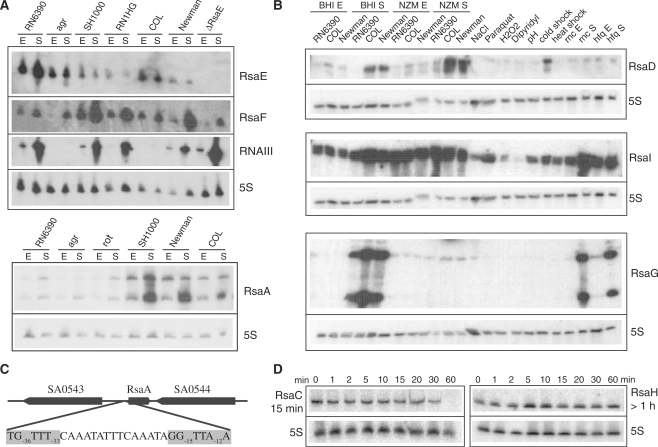
Figure 1.
Figure 1.
The expression of Rsa RNAs as monitored under various stresses, culture conditions, and in various S. aureus strains. (A) Northern blot analysis of RsaE, RsaF and RsaA in different S. aureus strains: RN6390 (ΔrbsU, σB−), RN6911 (Δagr, σB−), SH1000, RN1HG, COL and Newman (σB+). The strains LUG1430 (ΔrnaE) and LUG1160 (Δrot) are isogenic to RN6390. Total RNAs were prepared from cells grown in BHI medium and stopped at the exponential (E) or stationary (S) phases of growth. Staphylococcus aureus RNAIII was used as positive control, and 5S rRNA was probed as a quality RNA control. (B) Northern blot analysis of RsaD, RsaI and RsaG in various S. aureus strains (RN6390, COL, Newman, LUG774 (RN6390-Δrnc) and LUG911 (RN6390-Δhfq)) grown in BHI or NZM at exponential (E) and stationary (S) phases of growth. The COL strain was grown under various stress conditions: osmotic stress (NaCl), oxidative stress (H2O2, paraquat), iron chelating agent (dipyridyl), acidic pH, cold shock (25°C) and heat shock (42°C). (C) Genomic organization of the rsaE gene with the σB-binding site; the consensus sequence is highlighted. (D) Northern blot analysis of the half-lives of RsaC and RsaH. The cells were treated with rifampicin and total RNAs were extracted after 1, 2, 5, 10, 20, 30 and 60 min at 37°C in BHI. 5S rRNA was probed to quantify the yield of RNA in each lane.
Figure 2.
Figure 2.
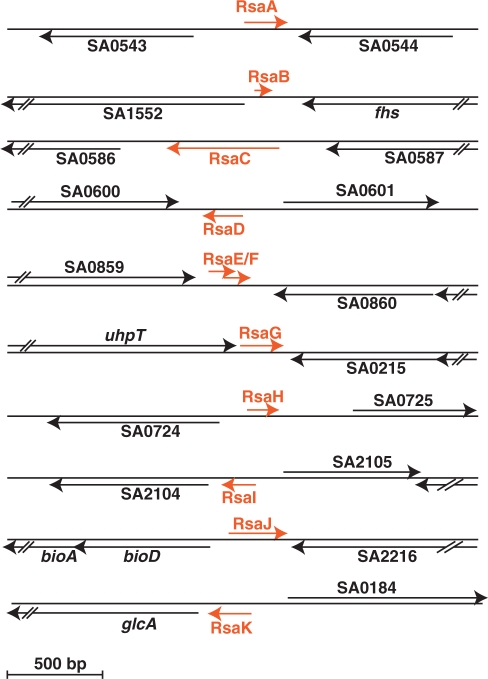
Genomic organization of rsa genes in the S. aureus N315 strain. Red arrows denote the rsa transcripts and their orientations, and the blacks arrows are for the flanking open reading frames (ORFs). The genes are represented to scale. The sizes of the rsa genes were determined based on the experimental determination of the 5′ start by RACE mapping and primer extension, estimates from denaturing gel electrophoresis, and the presence of transcription terminator. For RsaJ, the transcription start site was not determined and the length is estimated. RsaB and RsaF do not contain transcription terminator at their 3′-ends. In Table 1, the exact genomic location of rsa genes is given.
Figure 3.
Figure 3.
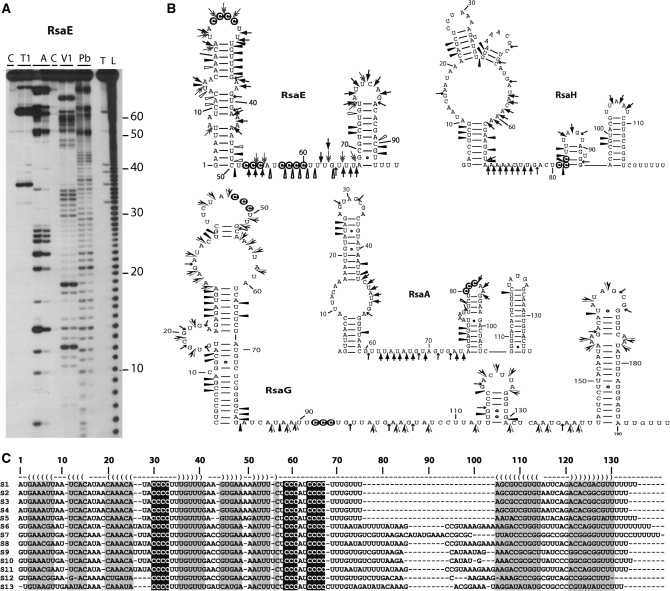
Secondary structures of various Rsa RNAs. (A) Gel fractionation of enzymatic cleavages and lead-induced cleavages of 5′-end-labeled RsaE: lanes T1: RNase T1, 0.01 and 0.02 U for 10 min at 20°C; lanes A: RNase A, 0.01 µg/ml and 0.001 µg/ml for 10 min at 20°C; lanes V1: RNase V1, 0.05 and 0.1 U for 5 min at 20°C; lanes Pb: lead-induced cleavage, 12.5 and 25 mM for 5 min at 20°C; lane T: RNase T1 under denaturing conditions; lane L: alkaline ladder; lane C: Incubation control. Bars denote the main reactivity changes induced by complex formation. (B) Probing data represented on the secondary structures of RsaE, RsaH, RsaA and RsaG RNAs. Enzymatic cleavages are as follows: RNase T1 (formula image), RNase A (formula image), RNase T2 (formula image), Lead-cleavages (formula image) and RNase V1: (formula image) moderate and (formula image) strong cleavages. The cytosines of the C-rich motif are encircled in black. (C) Sequence and structure alignment of RsaE coming from various Staphylococci and Bacillaceae: S1, S. aureus; S2, S. epidermidis; S3, S. saprophyticus; S4, S. haemolyticus; S5, Macrococcus caseolyticus; S6, B. anthracis; S7, B. amyloliquefaciens; S8, B. cereus; S9, B. licheniformis; S10, B. subtilis; S11, B. thuringiensis; S12, Geobacillus thermodenitrificans; S13, Oceanobacillus iheyensis. The helices are shown in grey. The C-rich conserved residues are highlighted in black. The alignment was done with the PARADISE platform (https://simtk.org/home/paradise).
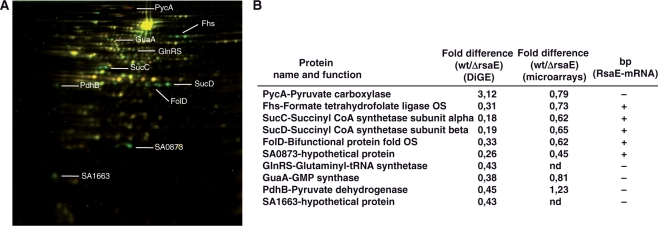
Figure 4.
Figure 4.
RsaE regulates the synthesis of several metabolic enzymes. (A) 2D fluorescence difference gel electrophoresis (DiGE) performed on the RN6390 and ΔrsaE strains. Total protein extracts were prepared from cultures stopped at the stationary phase of growth and labeled with different cyanine-dyes. Yellow spots represent unchanged proteins; green spots, protein synthesis repressed in the strain expressing RsaE; red spots, protein synthesis increased in the strain expressing RsaE. The proteins were identified by mass spectroscopy analysis. (B) Summary of the DiGE analysis, and comparative analysis with the microarray data. Ratios correspond to the quantification obtained for RN6390 versus the ΔrsaE strain (data from four different experiments). (bp) for base pairing between RsaE and mRNA targets: (+) potential bp, (−) no bp.
Figure 5.
Figure 5.
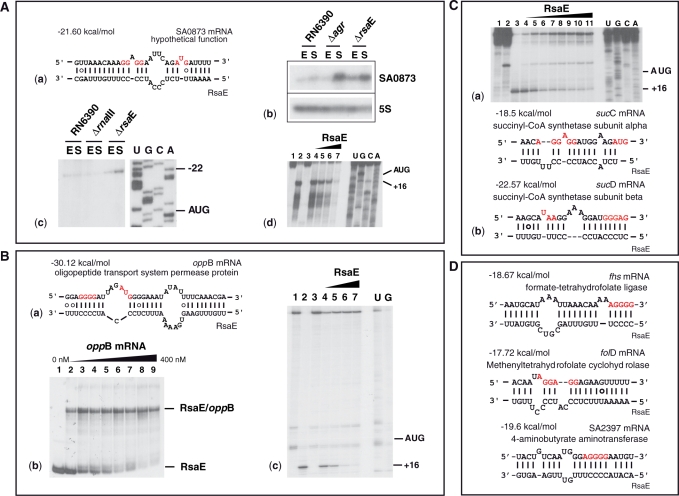
RsaE regulates gene expression by direct interaction with target mRNAs. (A) RsaE binds to the RBS of SA0873 mRNA: (a) Base pairings predicted between SA0873 and RsaE. The Shine‐Dalgarno sequence (SD) and the initiation codon AUG are shown in red. (b) Northern analysis of SA0873 mRNA prepared from various S. aureus strains (RN6390, RN6911-Δagr and RN6390-ΔrsaE). The 5S rRNA was probed as an internal control. (c) The 5′ start of the SA0873 mRNA was determined by primer extension with reverse transcriptase. The mRNA was only observed in the ΔrsaE strain. Lanes U, G, C and A: sequencing ladders. (d) RsaE binding to SA0873 mRNA prevents the formation of the ribosomal initiation complex. Lanes 1 and 3: Incubation controls of mRNA alone and with RsaE, respectively; lane 2: formation of the ternary complex formed from the S. aureus 30S subunit, the initiator tRNA, and the mRNA; lanes 4–7: Formation of the ternary ribosomal mRNA‐30S‐tRNA complex in the presence of increasing RsaE concentrations of 50, 100, 150 and 200 nM, respectively. (B) RsaE binds to oppB mRNA and prevents the ribosome binding: (a) Base pairings between oppB and RsaE. Same legend as above. (b) Band shift experiment showing a stable RsaE-oppB mRNA complex. Lane 1, incubation control of RsaE alone; lanes 2–9, complex formation between 5′-end-labeled RsaE with increasing oppB mRNA concentrations of 10, 50, 100, 150, 200, 250, 300 and 400 nM, respectively. (c) RsaE binds to oppB mRNA and prevents the formation of the 30S initiation complex. Same legend as above. (C) The RsaE-sucD mRNA complex prevents the formation of the ribosomal initiation complex. (a) Toeprinting assays: lanes 1, 2, incubation controls on the mRNA alone and with 200 nM of RsaE; lane 3, ternary mRNA‐30S‐tRNA complex; lanes 4–11, ternary complex with increasing RsaE concentrations 50, 100, 200, 300, 400, 500, 600 and 800 nM, respectively. (b) RsaE-sucC/D mRNA base pairing interaction. The hybrid formed between RsaE and sucD mRNA includes the stop codon of the upstream sucC mRNA. (D) Predicted base pairing interactions between RsaE and other mRNAs repressed by RsaE.
Figure 6.
Figure 6.
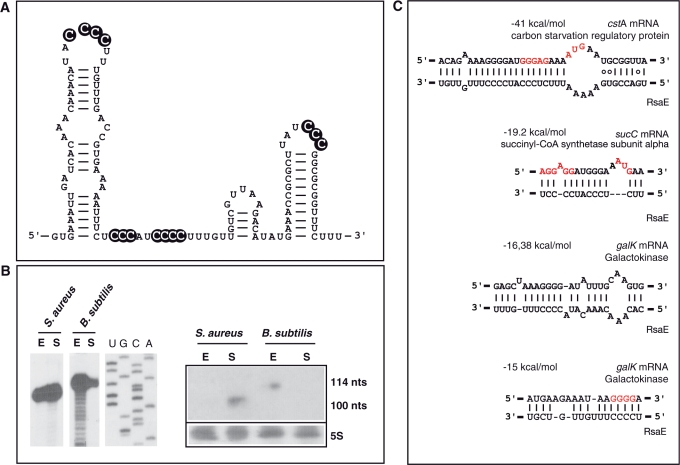
RsaE ortholog is expressed in B. subtilis. (A) Secondary structure of B. subtilis RsaE derived from the structural alignment shown in Figure 2. The C-rich conserved boxes are shown in black. (B) Expression of B. subtilis RsaE: (left) Primer extension was used to map the 5′ start of S. aureus and B. subtilis RsaE. The coordinates of the RNA are 1232743–1232852 corresponding to Bacillus subtilis subsp. subtilis strain 168 (NC_000964.2). The RNA has been referred in GenBank with the accession number GQ403626. Lanes U, G, C and A: sequencing ladders. (Right) Northern experiment performed on S. aureus and B. subtilis RsaE. Both experiments were carried out on total RNA extracts prepared at the exponential (E) and stationary (S) phases. (C) Potential base pairings between B. subtilis RsaE and mRNAs encoding proteins involved in carbohydrate metabolism and sugar utilization. The Shine‐Dalgarno (SD) sequence is in red.
Figure 7.
Figure 7.
The C-rich box conserved motif in S. aureus regulatory RNAs. The alignment of the C-rich sequence motif in S. aureus RNAIII (9) and Rsa RNAs was done with the help of the PARADISE platform (https://simtk.org/home/paradise).

References

    1. Waters LS, Storz G. Regulatory RNAs in bacteria. Cell. 2009;136:615–628. - PMC - PubMed
    1. Vogel J, Wagner EGH. Target identification of small noncoding RNAs in bacteria. Curr. Opin. Microbiol. 2007;10:262–270. - PubMed
    1. Toledo-Arana A, Repoila F, Cossart P. Small noncoding RNAs controlling pathogenesis. Curr. Opin. Microbiol. 2007;10:182–188. - PubMed
    1. Vogel J. A rough guide to the non-coding RNA world of Salmonella. Mol. Microbiol. 2009;71:1–11. - PubMed
    1. Taubes G. The bacteria fight back. Science. 2008;321:356–361. - PubMed

Publication types