Autophagy promotes synapse development in Drosophila
- PMID: 19786572
- PMCID: PMC2762098
- DOI: 10.1083/jcb.200907109
Autophagy promotes synapse development in Drosophila
Abstract
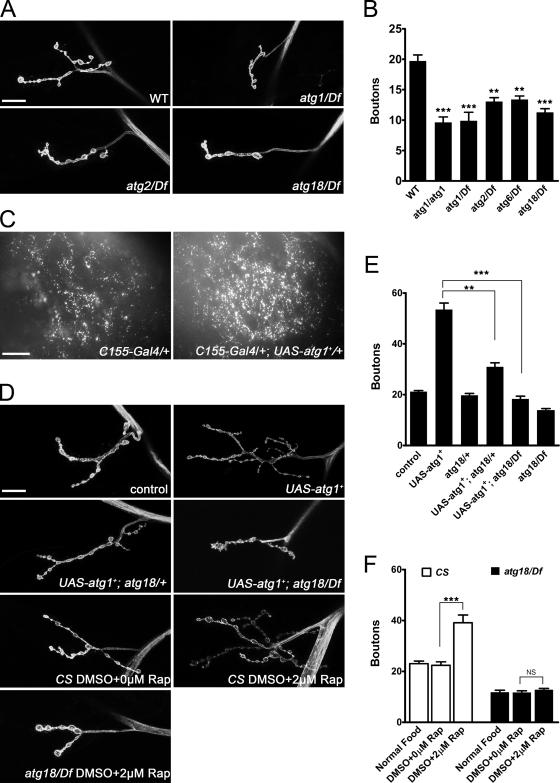
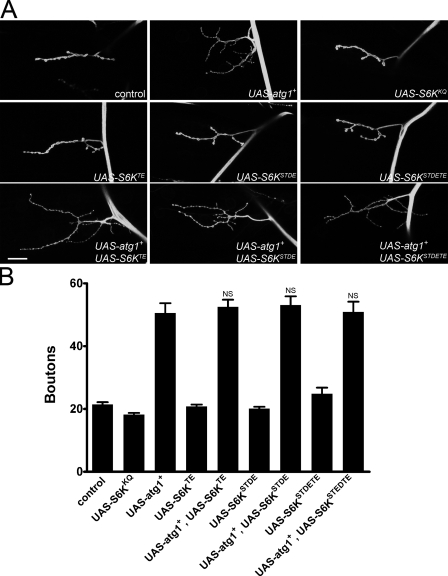
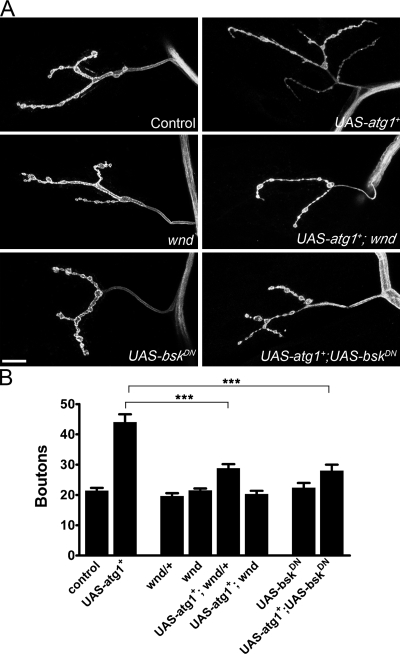
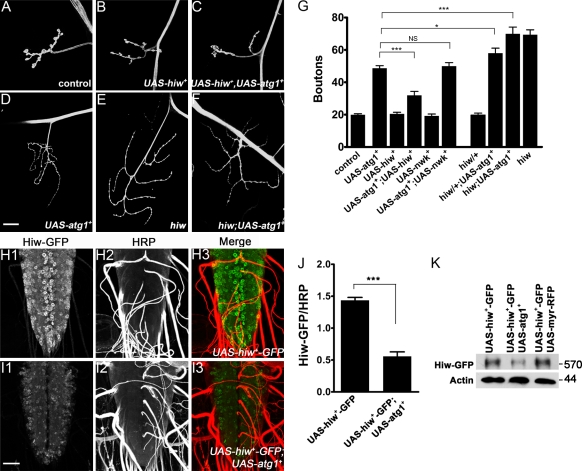
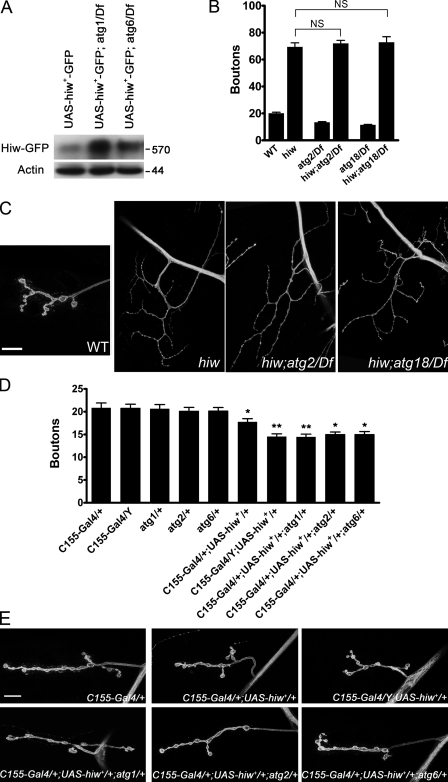
Autophagy, a lysosome-dependent degradation mechanism, mediates many biological processes, including cellular stress responses and neuroprotection. In this study, we demonstrate that autophagy positively regulates development of the Drosophila melanogaster larval neuromuscular junction (NMJ). Autophagy induces an NMJ overgrowth phenotype closely resembling that of highwire (hiw), an E3 ubiquitin ligase mutant. Moreover, like hiw, autophagy-induced NMJ overgrowth is suppressed by wallenda (wnd) and by a dominant-negative c-Jun NH(2)-terminal kinase (bsk(DN)). We show that autophagy promotes NMJ growth by reducing Hiw levels. Thus, autophagy and the ubiquitin-proteasome system converge in regulating synaptic development. Because autophagy is triggered in response to many environmental cues, our findings suggest that it is perfectly positioned to link environmental conditions with synaptic growth and plasticity.
Figures
References
-
- Aberle H., Haghighi A.P., Fetter R.D., McCabe B.D., Magalhães T.R., Goodman C.S. 2002. wishful thinking encodes a BMP type II receptor that regulates synaptic growth in Drosophila.Neuron. 33:545–558 doi:10.1016/S0896-6273(02)00589-5 - DOI - PubMed
-
- Barcelo H., Stewart M.J. 2002. Altering Drosophila S6 kinase activity is consistent with a role for S6 kinase in growth.Genesis. 34:83–85 doi:10.1002/gene.10132 - DOI - PubMed
-
- Berry D.L., Baehrecke E.H. 2007. Growth arrest and autophagy are required for salivary gland cell degradation in Drosophila.Cell. 131:1137–1148 doi:10.1016/j.cell.2007.10.048 - DOI - PMC - PubMed
-
- Collins C.A., DiAntonio A. 2007. Synaptic development: insights from Drosophila.Curr. Opin. Neurobiol. 17:35–42 doi:10.1016/j.conb.2007.01.001 - DOI - PubMed
-
- Collins C.A., Wairkar Y.P., Johnson S.L., DiAntonio A. 2006. Highwire restrains synaptic growth by attenuating a MAP kinase signal.Neuron. 51:57–69 doi:10.1016/j.neuron.2006.05.026 - DOI - PubMed
Publication types
MeSH terms
Substances
Grants and funding
LinkOut - more resources
Full Text Sources
Molecular Biology Databases
Miscellaneous