. 2009 Sep;7(9):e1000204.
doi: 10.1371/journal.pbio.1000204. Epub 2009 Sep 29.

The mechanochemistry of endocytosis

Affiliations

The mechanochemistry of endocytosis

Jian Liu et al. PLoS Biol. 2009 Sep.

Abstract

Endocytic vesicle formation is a complex process that couples sequential protein recruitment and lipid modifications with dramatic shape transformations of the plasma membrane. Although individual molecular players have been studied intensively, how they all fit into a coherent picture of endocytosis remains unclear. That is, how the proper temporal and spatial coordination of endocytic events is achieved and what drives vesicle scission are not known. Drawing upon detailed knowledge from experiments in yeast, we develop the first integrated mechanochemical model that quantitatively recapitulates the temporal and spatial progression of endocytic events leading to vesicle scission. The central idea is that membrane curvature is coupled to the accompanying biochemical reactions. This coupling ensures that the process is robust and culminates in an interfacial force that pinches off the vesicle. Calculated phase diagrams reproduce endocytic mutant phenotypes observed in experiments and predict unique testable endocytic phenotypes in yeast and mammalian cells. The combination of experiments and theory in this work suggest a unified mechanism for endocytic vesicle formation across eukaryotes.


Conflict of interest statement

The authors have declared that no competing interests exist.

Figures
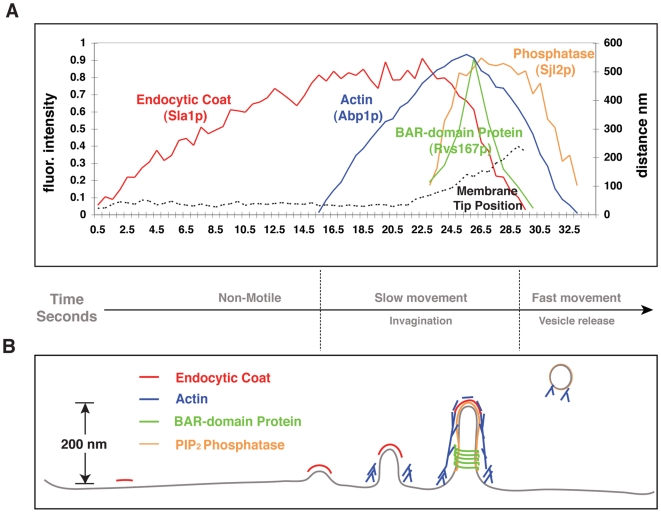
Figure 1
Figure 1. Endocytic dynamics in budding yeast.
(A) Timelines for endocytic protein recruitment as determined by multicolor fluorescence microscopy analysis. Sla1p, which is an endocytic adaptor protein, represents the endocytic coat. Abp1p is an actin-binding protein and faithfully reports on actin dynamics. Sjl2p is the yeast synaptojanin that hydrolyzes PIP2. PIP2 represents the lipid module and is believed to be the recruitment signal for many endocytic proteins. Rvs167p, yeast Amphiphysin, contains a BAR domain capable of sensing/binding curved membranes and deforming membranes. (Sla1 and Abp1 data are from , Sjl2 data are from , Rvs167 data are determined in this work from six individual patches in cells expressing Rvs167-GFP and aligned to the relative timing of Sjl2 appearance.) (B) Spatial profiles of endocytic membrane and the key endocytic proteins as revealed by EM .
Figure 2
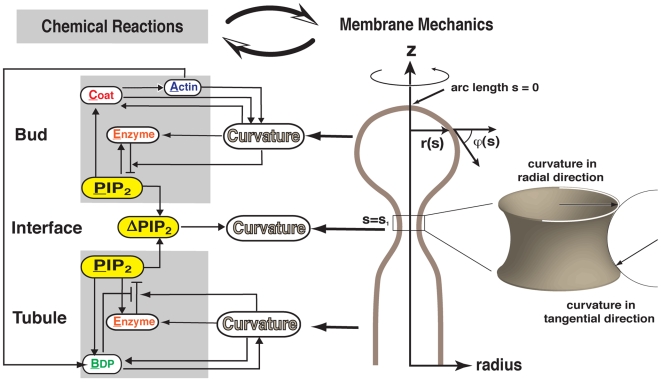
Figure 2. Mechanochemical feedback mechanism for endocytosis in budding yeast.
The thin arrows represent activation effects, and the bar ends represent inhibition effects. The local spatial coordinate along the membrane surface is the arc length s with unit length 1 nm. The bud region is defined by the arc length 0≤ss 1, the lipid phase boundary is at s = s 1, and the tubule region starts from s = s 1+1, where s 1 is chosen to be 100. We assume that membrane shape is cylindrically symmetric. ϕ(s) is the membrane tangential angle and r(s) is the radius of the tubule. The mean curvature, Ω(s), is the average of the curvatures in the radial and tangential directions; it measures the overall extent of the PIP2 head group exposure.
Figure 3
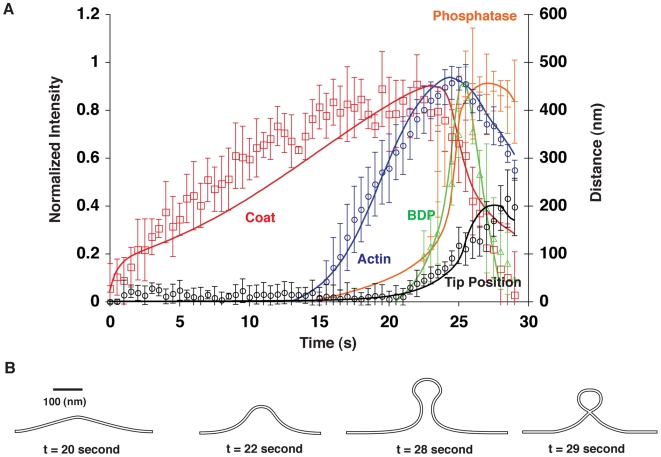
Figure 3. Fitting of the results calculated from the model to experimental results.
(A) Timelines of functional modules during endocytosis in budding yeast (continuous lines represent calculated values, and the discontinuous lines are experimental measurements—same as Figure 1A—with standard deviation). In the model, the instantaneous total levels for the individual modules (except for actin) at the endocytic site were obtained by summing their local levels over their respective locations on the membrane surface. The instantaneous total level of actin was obtained by summing over the entire bud region the product of the local actin level and its distance from cell cortex (proportional to the length of the actin filaments). To obtain the intensity plot for each of the modules, we normalized the curve for its total levels over time in accordance to its respective peak value. We then scaled the resulting curve by setting its peak value to be the same as that of the peak intensity measured experimentally. We thus can compare the computed time-lapse curve for each module to those from experimental observations. (B) Calculated endocytic membrane shape changes. The calculation of membrane shape was carried out in 3-D. Membrane shape is shown in 2-D for clarity. The parameters in the model used for curve fitting are listed in Table 1 in Protocol S1. If not stated otherwise, the parameters are fixed throughout this paper.
Figure 4
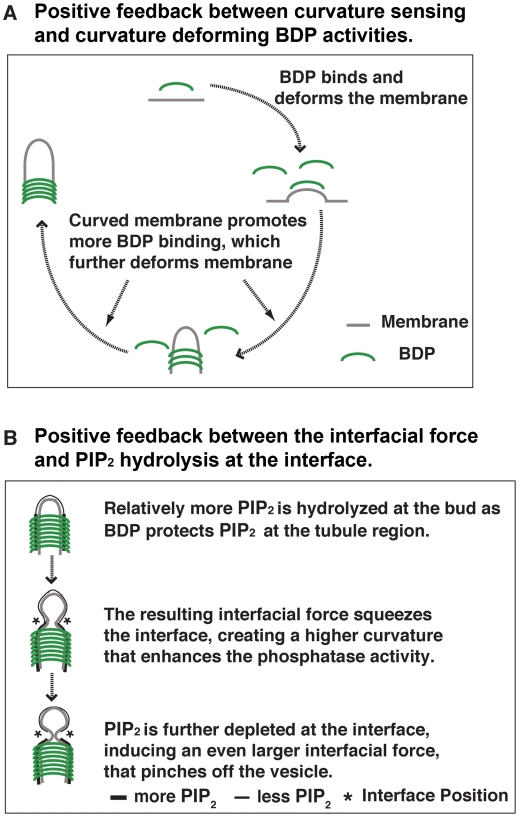
Figure 4. Two positive mechanochemical feedback loops between membrane shape changes and local chemical reactions.
(A) Membrane tubulation by BDPs. (B) Development of interfacial forces that drive vesicle scission.
Figure 5
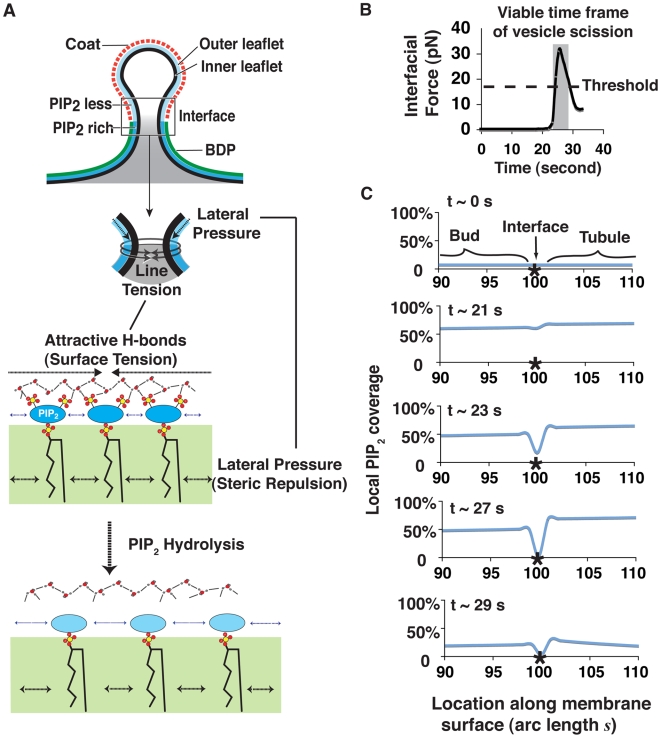
Figure 5. Development of the interfacial force during endocytosis.
(A) Schematics of interfacial forces that consist of two components. The first is the line tension. Because less PIP2 is hydrolyzed on the tubule, a higher hydrogen bond density is created adjacent to the bud. The imbalance in electrostatic attraction from hydrogen bonds between the two adjacent regions (bud and tubule) results in a line tension encircling the neck. The second force is the lateral pressure in the cytoplasmic leaflet of the bud membrane. The average area per PIP2 in the membrane is determined by the force balance between steric repulsion (i.e., arising from both the hydrocarbon chain and the polar head groups) and attractive electrostatic interactions (e.g., hydrogen bonds). The net effect of PIP2 hydrolysis is to decrease the electrostatic attraction more than the steric repulsion, causing the PIP2 leaflet to expand ,. The osmotic pressure in the cell inhibits the expansion in the normal direction, and so the cytoplasmic leaflet expands tangentially. (B) The calculated time course of the interfacial force. The threshold value for the interfacial force was determined by a force-balance calculation similar to . (C) The computed time course for PIP2 levels around the lipid phase boundary (at the arc length s = 100).
Figure 6
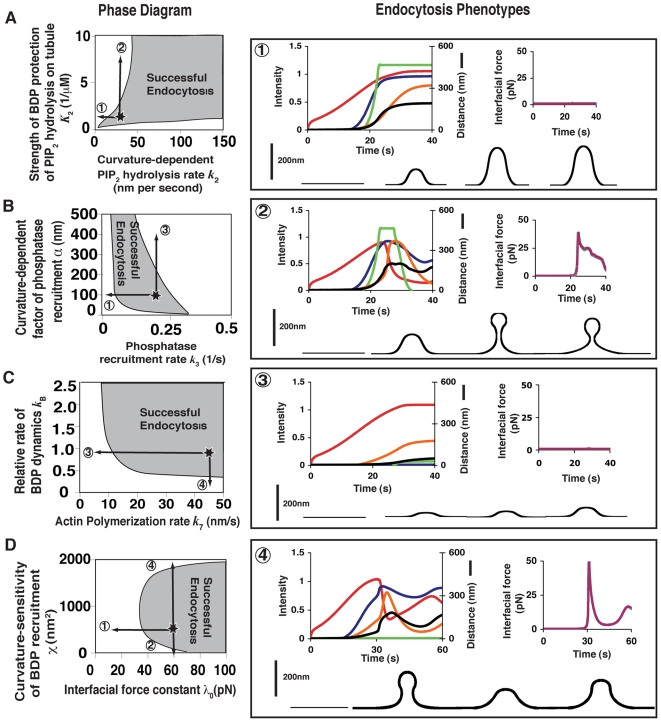
Figure 6. Phase diagrams for endocytic dynamics.
The shaded areas represent the parameter regions for successful endocytosis; the star in each phase diagram represents the parameter set used in the fitting plot in Figure 3. (A) Strength of BDP PIP2 protection: K 2 versus curvature-dependent PIP2 hydrolysis rate k 2; (B) Curvature-dependent factor for phosphatase recruitment rate, α versus phosphatase recruitment rate k 3; (C) Relative rate of BDP dynamics versus actin polymerization rate k 7; (D) Curvature-dependent factor of BDP recruitment rate χ versus interfacial force constant λ 0. Each phenotype is characterized by: (a) time-lapse plot for the coat proteins (red), actin (blue), BDP (green), phosphatase (orange), and the membrane tip position (black); (b) the time course for interfacial force development (purple); (c) the time course for membrane shape change (black). The intensity of each functional module in the phenotype plots is normalized relative to the corresponding wild-type normalized intensity shown in Figure 3, thus representing the relative abundance. Phenotype 1: Without PIP2 hydrolysis [k2 reduces from 20 (nm) per second to 0]. Phenotype 2: Increased protection strength of PIP2 hydrolysis at the tubule region [formula image increases from formula image to formula image]. Phenotype 3: Increased phosphatase recruitment rate [α increases from 100 nm to 500 nm]. Phenotype 4: BDP recruitment does not occur.
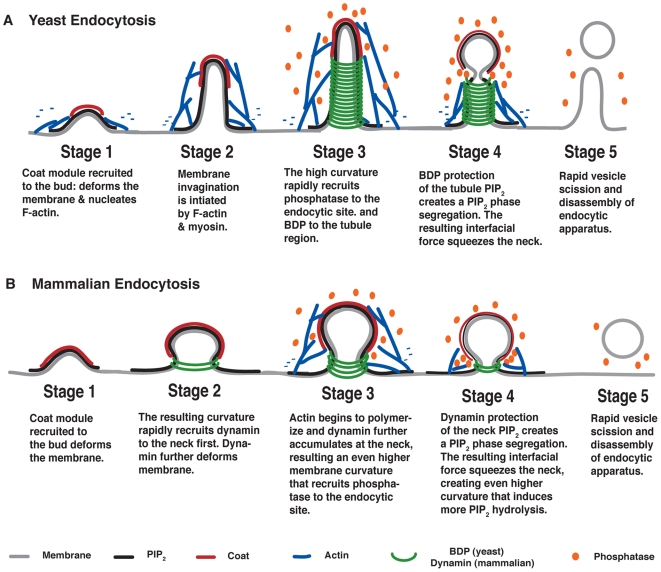
Figure 7
Figure 7. Schematics comparing endocytosis in yeast and mammalian cells.
(A) Model for yeast endocytosis. (B) Model for mammalian endocytosis (see text).

Comment in

  • Wrapping our heads around endocytosis.
    Sedwick C. Sedwick C. PLoS Biol. 2009 Sep 29;7(9):e1000207. doi: 10.1371/journal.pbio.1000207. PLoS Biol. 2009. PMID: 20076755 Free PMC article. No abstract available.

References

    1. Conner S. D, Schmid S. L. Regulated portals of entry into the cell. Nature. 2003;422:37–44. - PubMed
    1. Merrifield C. J. Seeing is believing: imaging actin dynamics at single sites of endocytosis. Trends Cell Biol. 2004;14:352–358. - PubMed
    1. Jonsdottir G. A, Li R. Dynamics of yeast myosin I: evidence for a possible role in scission of endocytic vesicles. Curr Biol. 2004;14:1604–1609. - PubMed
    1. Galletta B. J, Chuang D. Y, Cooper J. A. Distinct roles for Arp2/3 regulators in actin assembly and endocytosis. PLoS Biology. 2008;6:e1. doi: 10.1371/journal.pbio.0060001. - DOI - PMC - PubMed
    1. Zoncu R, Perera R. M, Sebastian R, Nakatsu F, Chen H, et al. Loss of endocytic clathrin-coated pits upon acute depletion of phosphatidylinositol 4,5-bisphosphate. Proc Natl Acad Sci U S A. 2007;104:3793–3798. - PMC - PubMed

Publication types

MeSH terms