


A novel animal model of Borrelia recurrentis louse-borne relapsing fever borreliosis using immunodeficient mice
- PMID: 19787030
- PMCID: PMC2742892
- DOI: 10.1371/journal.pntd.0000522
A novel animal model of Borrelia recurrentis louse-borne relapsing fever borreliosis using immunodeficient mice
Abstract
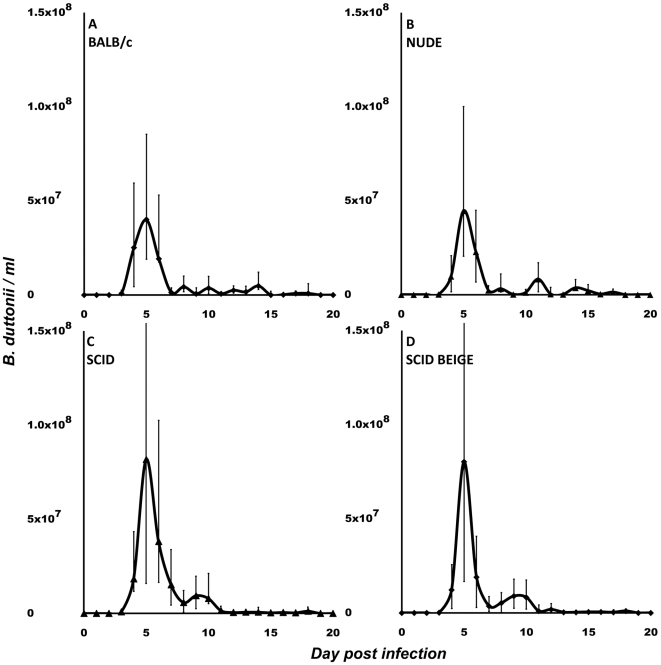
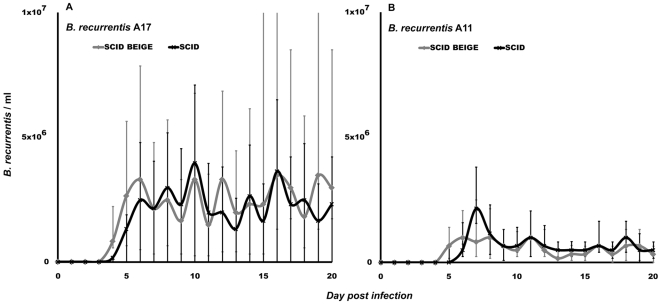
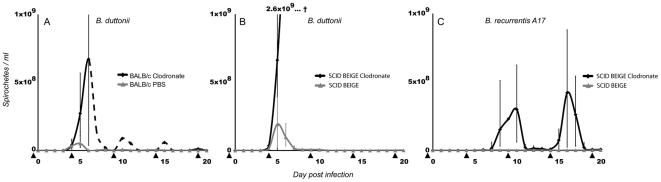
Louse-borne relapsing fever (LBRF) borreliosis is caused by Borrelia recurrentis, and it is a deadly although treatable disease that is endemic in the Horn of Africa but has epidemic potential. Research on LBRF has been severely hampered because successful infection with B. recurrentis has been achieved only in primates (i.e., not in other laboratory or domestic animals). Here, we present the first non-primate animal model of LBRF, using SCID (-B, -T cells) and SCID BEIGE (-B, -T, -NK cells) immunocompromised mice. These animals were infected with B. recurrentis A11 or A17, or with B. duttonii 1120K3 as controls. B. recurrentis caused a relatively mild but persistent infection in SCID and SCID BEIGE mice, but did not proliferate in NUDE (-T) and BALB/c (wild-type) mice. B. duttonii was infectious but not lethal in all animals. These findings demonstrate that the immune response can limit relapsing fever even in the absence of humoral defense mechanisms. To study the significance of phagocytic cells in this context, we induced systemic depletion of such cells in the experimental mice by injecting them with clodronate liposomes, which resulted in uncontrolled B. duttonii growth and a one-hundred-fold increase in B. recurrentis titers in blood. This observation highlights the role of macrophages and other phagocytes in controlling relapsing fever infection. B. recurrentis evolved from B. duttonii to become a primate-specific pathogen that has lost the ability to infect immunocompetent rodents, probably through genetic degeneration. Here, we describe a novel animal model of B. recurrentis based on B- and T-cell-deficient mice, which we believe will be very valuable in future research on LBRF. Our study also reveals the importance of B-cells and phagocytes in controlling relapsing fever infection.
Conflict of interest statement
The authors have declared that no competing interests exist.
Figures
References
-
- Bryceson AD, Parry EH, Perine PL, Warrell DA, Vukotich D, et al. Louse-borne relapsing fever. Q J Med. 1970;39:129–170. - PubMed
-
- Felsenfeld O. Borrelia: Strains, Vectors, Human and Animal Borreliosis. St Louis, MO: Green; 1971. 1971.
-
- Ramos JM, Malmierca E, Reyes F, Tesfamariam A. Louse-borne relapsing fever in Ethiopian children: experience of a rural hospital. Trop Doct. 2009;39:34–36. - PubMed
-
- Abdalla RE. Some studies on relapsing fever in the Sudan. J Trop Med Hyg. 1969;72:125–128. - PubMed
-
- de Jong J, Wilkinson RJ, Schaeffers P, Sondorp HE, Davidson RN. Louse-borne relapsing fever in southern Sudan. Trans R Soc Trop Med Hyg. 1995;89:621. - PubMed
LinkOut - more resources
Full Text Sources
