


Editorial
doi: 10.1002/hep.23212.
Fructose takes a toll
- PMID: 19787819
- PMCID: PMC4259103
- DOI: 10.1002/hep.23212
Item in Clipboard
Editorial
Fructose takes a toll
Hepatology.
2009 Oct.
No abstract available
Figures
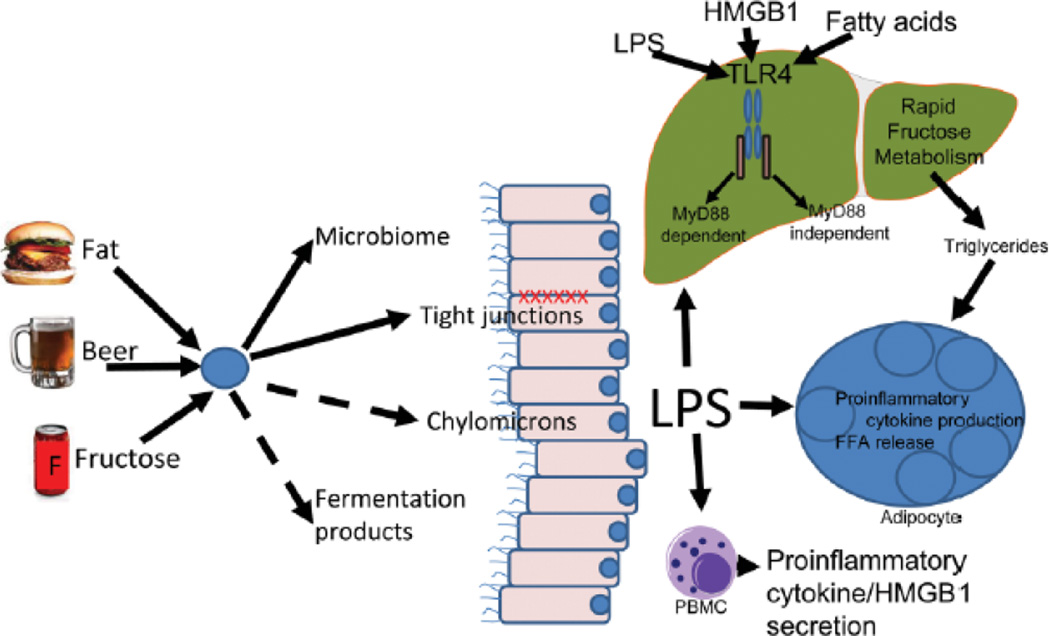
A high fructose diet induces changes similar to those seen in models of chronic alcohol intake and high fat diets, including increase gut permeability, endotoxemia, increased hepatic TNF production and hepatic steatosis. As shown in the figure, changes in the microbiome and altered tight junctions (solid arrows) result in increased LPS reaching the liver; LPS transfer via chylomicrons and fermentation products may also play a role (broken arrows). LPS has multiple effects including stimulation of TLR4 through both the MyD88 dependent (fructose induced liver injury) and independent pathways (alcohol-induced liver injury) as well as through stimulation of an inflammatory response that results in elevation in levels of FFA. These inflammatory products including FFA and HMGB1 (released by cell necrosis or by activation of Kupffer cells) are also known to stimulate TLR4. Loss of TLR4 function results in blockage or attenuation of the metabolic derangements in all 3 models, suggesting TLR4 signaling pathways play an important role in each of these forms of fatty liver. Abbreviations: FFA, free fatty acid; HMGB1, high mobility group box 1; LPS, lipopolysaccharide; MyD88, myeloid differentiation protein 88; PBMC, peripheral blood mononuclear cell; TLR4, Toll-like receptor 4.
Comment in
-
Therapeutic interventions for fructose-induced fatty liver disease are premature.Hepatology. 2010 Oct;52(4):1526. doi: 10.1002/hep.23776. Hepatology. 2010. PMID: 20672384 No abstract available.
Comment on
-
Toll-like receptor 4 is involved in the development of fructose-induced hepatic steatosis in mice.Hepatology. 2009 Oct;50(4):1094-104. doi: 10.1002/hep.23122. Hepatology. 2009. PMID: 19637282
References
-
- Havel PJ. Dietary fructose: implications for dysregulation of energy homeostasis and lipid/carbohydrate metabolism. Nutr Rev. 2005;63:133–157. - PubMed
-
- Thuy S, et al. Nonalcoholic fatty liver disease in humans is associated with increased plasma endotoxin and plasminogen activator inhibitor 1 concentrations and with fructose intake. J Nutr. 2008;138(8):1452–1455. - PubMed
Publication types
MeSH terms
Substances
Grants and funding
LinkOut - more resources
Full Text Sources
Medical