. 2009 Oct 1;15(19):6167-76.
doi: 10.1158/1078-0432.CCR-09-0645. Epub 2009 Sep 29.

Lymph node-targeted immunotherapy mediates potent immunity resulting in regression of isolated or metastatic human papillomavirus-transformed tumors

Affiliations

Lymph node-targeted immunotherapy mediates potent immunity resulting in regression of isolated or metastatic human papillomavirus-transformed tumors

Kent A Smith et al. Clin Cancer Res. .

Abstract

Purpose: The goal of this study was to investigate the therapeutic potential of a novel immunotherapy strategy resulting in immunity to localized or metastatic human papillomavirus 16-transformed murine tumors.

Experimental design: Animals bearing E7-expressing tumors were coimmunized by lymph node injection with E7 49-57 antigen and TLR3-ligand (synthetic dsRNA). Immune responses were measured by flow cytometry and antitumor efficacy was evaluated by tumor size and survival. In situ cytotoxicity assays and identification of tumor-infiltrating lymphocytes and T regulatory cells were used to assess the mechanisms of treatment resistance in bulky disease. Chemotherapy with cyclophosphamide was explored to augment immunotherapy in late-stage disease.

Results: In therapeutic and prophylactic settings, immunization resulted in a considerable expansion of E7 49-57 antigen-specific T lymphocytes in the range of 1/10 CD8(+) T cells. The resulting immunity was effective in suppressing disease progression and mortality in a pulmonary metastatic disease model. Therapeutic immunization resulted in control of isolated tumors up to a certain volume, and correlated with antitumor immune responses measured in blood. In situ analysis showed that within bulky tumors, T-cell function was affected by negative regulatory mechanisms linked to an increase in T regulatory cells and could be overcome by cyclophosphamide treatment in conjunction with immunization.

Conclusions: This study highlights a novel cancer immunotherapy platform with potential for translatability to the clinic and suggests its potential usefulness for controlling metastatic disease, solid tumors of limited size, or larger tumors when combined with cytotoxic agents that reduce the number of tumor-infiltrating T regulatory cells.


Figures
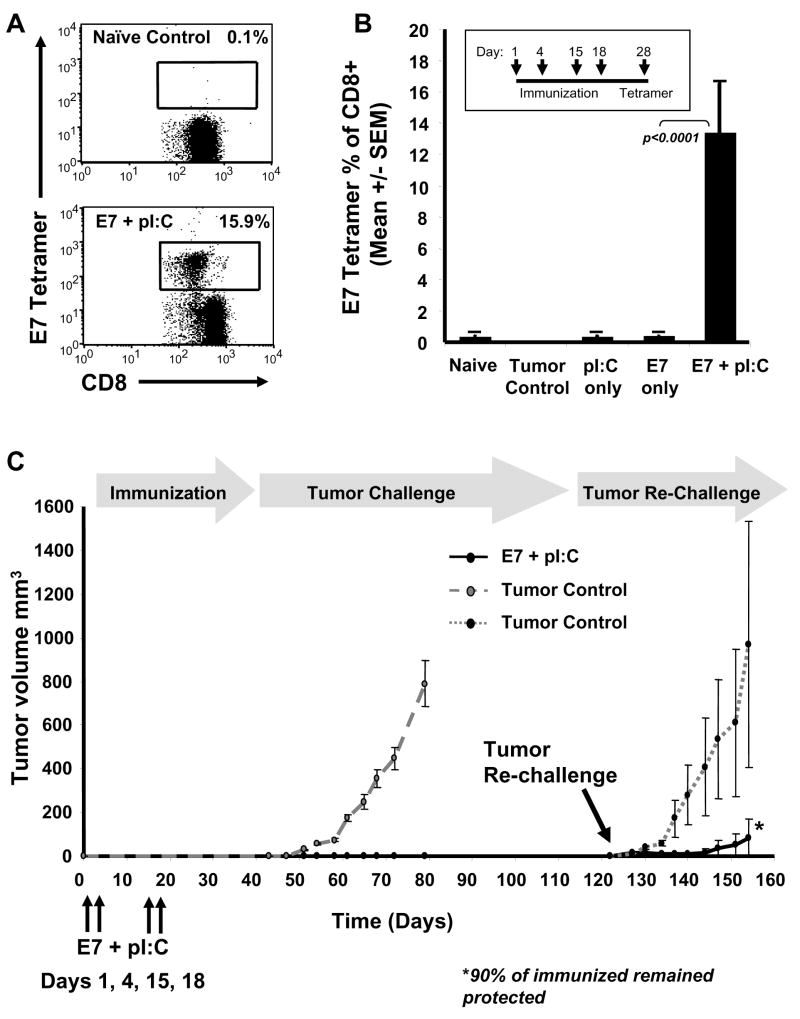
Fig. 1
Fig. 1
Intra-lymph node immunization with E7 peptide and pI:C elicits robust immunity protective against tumor challenge. Flow cytometry dot plots (A) comparing the tetramer response from an immunized (E7 + pI:C) and naïve control mouse representative of data shown in (B). The results are expressed as the frequency of E7 tetramer+ CD8+ T cells relative to the total CD8+ T cell population measured in peripheral blood 10 days after the completion of the immunization protocol. Intra-lymphatic vaccination with E7 49-57 HPV antigen and pI:C resulted in substantial E7-specific CD8+ T cell responses, whereas pI:C or E7 49-57 peptide alone had no significant impact on immune response when compared to tumor control or naïve mice (B). The mean E7 tetramer response +/- SEM for each group is shown (n=10). HPV 16 E7 49-57 antigen-specific immune response correlated with tumor protection (C). Immunization of mice with E7 49-57 peptide and pI:C (n=20) resulted in complete protection from subcutaneous challenge with 105 HPV transformed C3.43 tumor cells as compared to tumor control mice (n=20) and 90% protection following a tumor re-challenge compared to second group of tumor control mice (n=3).
Fig. 2
Fig. 2
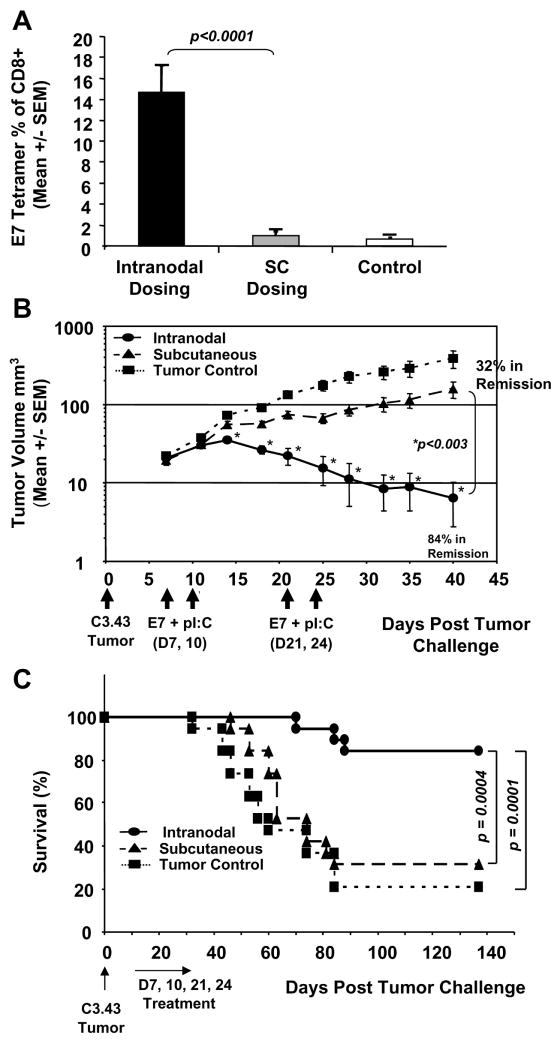
Intra-lymph node immunization with E7 peptide and pI:C mediates immunological regression of solid tumor. In a therapeutic model of HPV 16, the anti-tumor efficacy of intranodal versus subcutaneous (SC) dosing was compared. C57BL/6 mice were challenged SC with 105 C3.43 HPV tumor cells on day 0 and then immunized with a mixture of E7 49-57 peptide and pI:C in each bilateral inguinal lymph node (n=19) or an equivalent amount of vaccine SC (n=19) on day 7, 10, 21, and 24. The immune response was measured by E7 49-57 tetramer staining on day 31 from peripheral blood (A) and tumor size for each group was calculated and compared to untreated tumor challenged control (n=19) mice (B). Lymph node immunized mice generated statistically significant E7 49-57 specific immune responses with an average of 14.5% tetramer positive CD8+ T cells (A) compared to SC dosed mice (p < 0.0001). In addition, tumors in mice immunized in the lymph node began to regress on day 15 resulting in 84% of animals in remission at day 40 (B). This response was significantly superior to animals dosed SC (p < 0.003) whose tumor progression was only delayed compared to tumor controls but resulted in 32% of animals in disease remission. Untreated tumor control mice displayed background levels of E7 tetramer staining (A) and their tumors progressed exponentially without regression as expected (B). Log-rank statistical tests confirmed that survival in the E7 + pI:C group was significantly prolonged when compared to animals immunized SC (p = 0.0004) or when compared to tumor controls (p = 0.0001) (C).
Fig. 3
Fig. 3
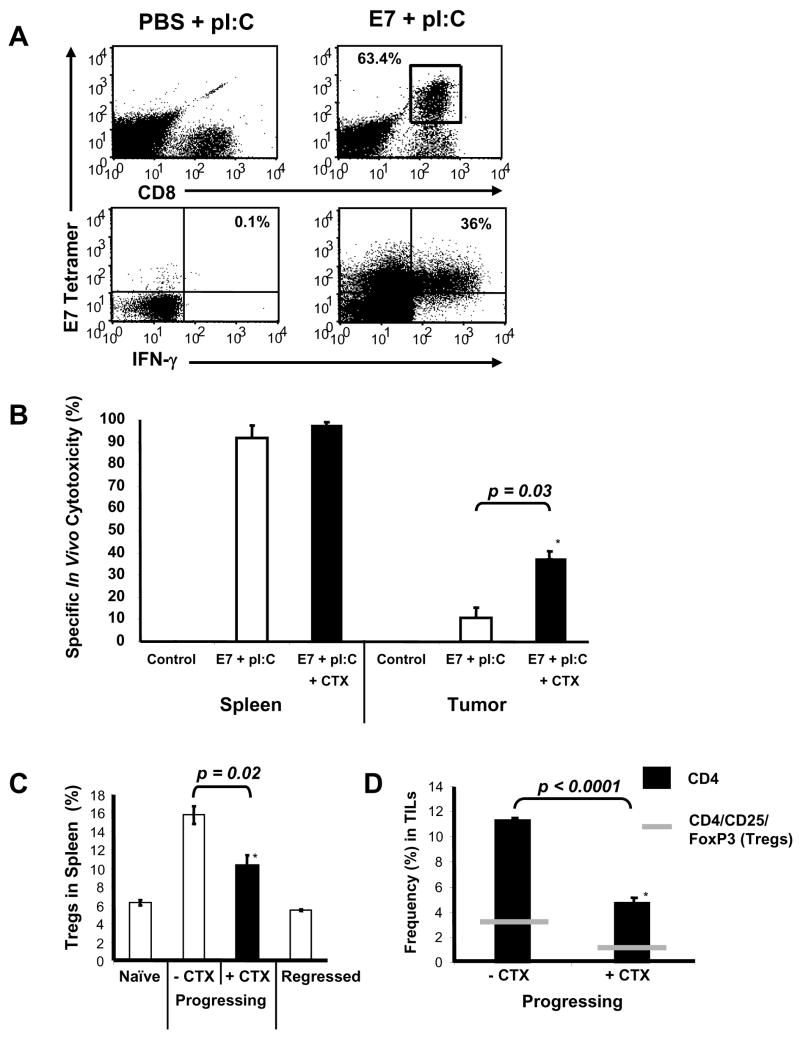
CD4+/CD25+/FoxP3HI Tregs impair in situ function of TILs in advanced tumors and are reduced following CTX treatment. Mice were inoculated with 105 HPV-16 transformed C3.43 tumor cells on day 0 and immunized with E7 49-57 HPV peptide and pI:C in bilateral inguinal lymph nodes on day 20, 24, 34, and 38 (n=3). Immunization control mice received PBS + pI:C in bilateral inguinal lymph nodes on day 20, 24, 34, and 38 (n=3). (A) Flow cytometry dot plots comparing the frequency (top panel) and the functional ability to produce IFN-γ (bottom panel) of E7 49-57 antigen-specific TILs from representative E7 + pI:C immunized or tumor control (PBS + pI:C) mice. (B) Impaired in situ function of TILs measured by in vivo cytotoxicity assay. E7 + pI:C immunized mice with progressing tumors cleared greater than 90% of HPV 16 E7 49-57 labelled target cells in spleen whereas TILs from the same mice had little cytotoxic effect on target cells within established tumors. CTX treatment (100 mg/kg, IP) in a second group of E7 + pI:C immunized mice (n=3) with progressive disease resulted in enhanced killing of specific target cells in tumors (p = 0.03) and had no adverse effect on target cell lysis in spleen. (C) Immunized mice bearing HPV-16 transformed tumors (n=3) displayed approximately three fold higher numbers of CD4+/CD25+/FoxP3+ Tregs in spleen compared to naïve mice (n=3) or immunized mice whose tumors completely regressed (n=3). The level of CD4+/CD25+/FoxP3+ Tregs could be reduced in the spleen (C, n=3) and the levels of CD4+ and CD4+/CD25+/FoxP3+ cells could be reduced in tumor (D) of mice with progressive disease by a single intraperitoneal injection of 100 mg/kg CTX (n=3 mice / group).
Fig. 4
Fig. 4
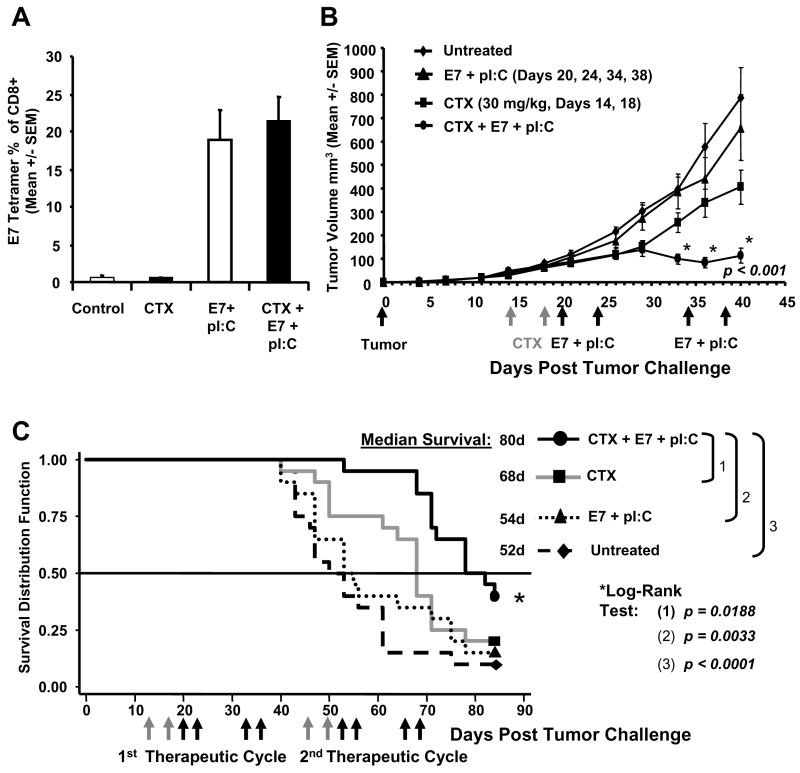
Adjunctive therapy with CTX enables immunotherapy in a more advanced disease setting. Mice were inoculated with 105 HPV-16 transformed C3.43 tumor cells on day 0, treated with CTX on Day 14 and 18 (n=20), immunized with E7 49-57 HPV peptide and pI:C in bilateral inguinal lymph nodes on day 20, 24, 34, and 38 (n=20), or treated with CTX then E7 + pI:C immunotherapy (n=20). Immune response (A) and tumor progression (B) was compared to untreated tumor control mice (n=20). The immune response following immunotherapy was measured by E7 49-57 tetramer staining on day 45 from peripheral blood. The immunized only group (E7 + pI:C) displayed HPV specific immune responses in the range of 20% with no observed inhibition of immune response in animals treated with CTX + E7 + pI:C which generated a similar tetramer response. The naïve control (n=5) and CTX control groups generated background levels of tetramer staining (A). CTX + E7 + pI:C induced significant tumor regression (p < 0.001) compared to E7 + pI:C immunotherapy alone, CTX alone, and untreated tumor controls (B). Evaluation of adjunctive therapy on animal survival (C). A second therapeutic cycle was administered with animals receiving CTX on day 46 and 50 (n=20), lymph node immunization with E7 + pI:C on day 52, 56, 65, and 69 (n=20), or treated with CTX + E7 + pI:C (n=20). Grey arrows indicate CTX treatment and black arrows indicate immunization days. Log-Rank statistical tests confirmed that survival in the CTX + E7 + pI:C group was significantly longer than survival in the control group (p < 0.0001, n=20), the CTX only group (p = 0.0188) and the E7 + pI:C immunotherapy only group (p = 0.0033).
Fig. 5
Fig. 5
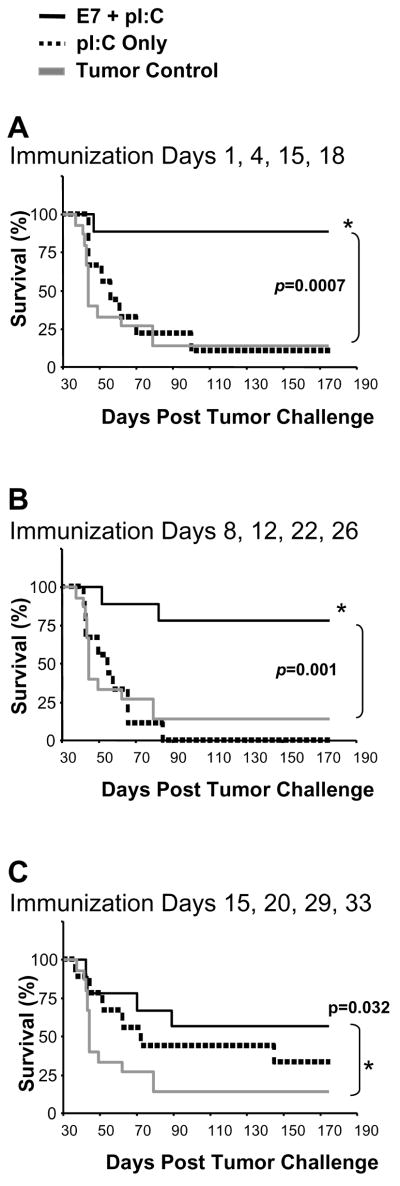
Control of pulmonary metastases by intra-lymph node immunization with E7 peptide and pI:C. Mice were injected intravenously with 5 × 10⁵ C3.43 tumor cells and then immunized with one of the following intranodal E7 + pI:C vaccine time courses: day 1, 4, 15, and 20 (A); day 8, 12, 22, and 26 (B); or day 15, 20, 29, and 33 (C). Survival curves for each group (A, B, C) are shown and the outcome for E7 + pI:C immunized mice (n = 9) was compared to pI:C only (n = 9) and untreated tumor control mice (n=9). Log-Rank statistical tests confirmed that survival in the E7 + pI:C group for each vaccine time course (A, B and C) was significantly longer than survival in the tumor control group (p = to 0.0007, 0.001, and 0.032 respectively) and the pI:C only group when immunization began on day 1 (A, p = 0.006) and day 8 (B, p = 0.004) but not day 15 (C, p = 0.06).

References

    1. zur Hausen H. Papillomaviruses and cancer: from basic studies to clinical application. Nat Rev Cancer. 2002;2:342–50. - PubMed
    1. Hung C, Ma B, Monie A, Tsen S, Wu T. Therapeutic human papillomavirus vaccines: current clinical trials and future directions. Expert Opin Biol Ther. 2008;8:421–39. - PMC - PubMed
    1. Parkin DM, Bray F, Ferlay J, Pisani P. Estimating the world cancer burden: Globocan 2000. Int J Cancer. 2001;94:153–6. - PubMed
    1. Bosch FX, Manos MM, Munoz N, et al. Prevalence of human papillomavirus in cervical cancer: a worldwide perspective. International biological study on cervical cancer (IBSCC) Study Group. J Natl Cancer Inst. 1995;87:796–802. - PubMed
    1. Koutsky LA, Ault KA, Wheeler CM, et al. A controlled trial of a human papillomavirus type 16 vaccine. N Engl J Med. 2002;347:1645–51. - PubMed

Publication types

MeSH terms