Clinical Trial
. 2009 Oct 1;15(19):6267-76.
doi: 10.1158/1078-0432.CCR-09-1254. Epub 2009 Sep 29.

Dendritic cell vaccination combined with CTLA4 blockade in patients with metastatic melanoma

Affiliations
Clinical Trial

Dendritic cell vaccination combined with CTLA4 blockade in patients with metastatic melanoma

Antoni Ribas et al. Clin Cancer Res. .

Abstract

Purpose: Tumor antigen-loaded dendritic cells (DC) are believed to activate antitumor immunity by stimulating T cells, and CTL-associated antigen 4 (CTLA4)-blocking antibodies should release a key negative regulatory pathway on T cells. The combination was tested in a phase I clinical trial in patients with advanced melanoma.

Experimental design: Autologous DC were pulsed with MART-1(26-35) peptide and administered with a dose escalation of the CTLA4-blocking antibody tremelimumab. Sixteen patients were accrued to five dose levels. Primary end points were safety and immune effects; clinical efficacy was a secondary end point.

Results: Dose-limiting toxicities of grade 3 diarrhea and grade 2 hypophysitis developed in two of three patients receiving tremelimumab at 10 mg/kg monthly. Four patients had an objective tumor response, two partial responses and two complete responses, all melanoma free between 2 and 4 years after study initiation. There was no difference in immune monitoring results between patients with an objective tumor response and those without a response. Exploratory gene expression analysis suggested that immune-related gene signatures, in particular for B-cell function, may be important in predicting response.

Conclusion: The combination of MART-1 peptide-pulsed DC and tremelimumab results in objective and durable tumor responses at the higher range of the expected response rate with either agent alone.


Conflict of interest statement

Conflict of interest disclosure. Dr. Antoni Ribas has received commercial research grants and honoraria from Pfizer Inc.; Dr. John A. Glaspy has received speaker’s bureau/honoraria from Pfizer Inc.; Dr. Jesus Gomez-Navarro is employed by Pfizer Inc. The remaining authors have no conflicts of interest to report.

Figures

Figure 1
Figure 1
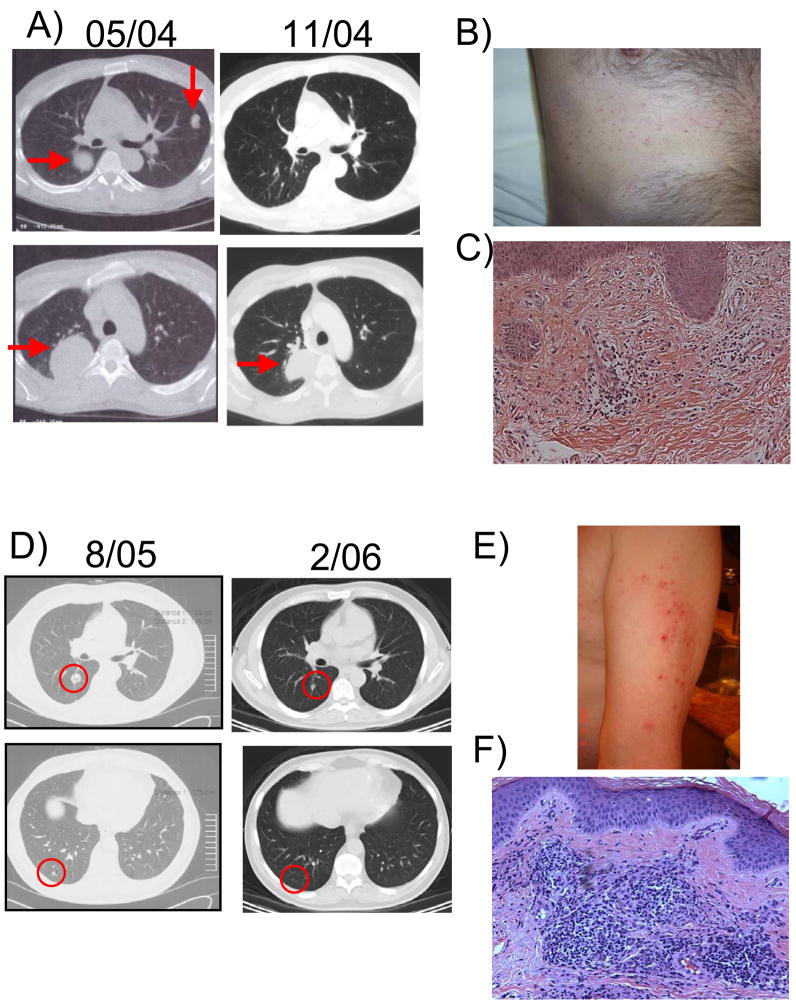
Examples of clinical events. A, B and C) Tumor regression and skin toxicity in patient NRA3. A) CT scan images of lung metastasis before (left column) and after (right column) starting treatment with MART-1/DC with concomitant tremelimumab at 3 mg/kg monthly. B) Skin eruption developed after 9 months of initiation of therapy. Discrete, erythematous, non-follicular, pruritic papules involving the upper part of the trunk. C) Histological features showing acantholytic dyskeratosis consistent with Grover’s disease (hematoxylin-eosin, original magnification 20x). D, E and F) Tumor regression and skin toxicity in patient NRA9. D) CT scan images of lung metastasis before (left column) and after (right column) starting treatment with MART-1/DC with concomitant tremelimumab at 10 mg/kg monthly. E) Skin eruption developed after 3 years of initiation of therapy. Erythematous maculopaular lesions coalescing to form thin plaques with some scaling. Most affected areas were the proximal extensor surfaces of the arms and legs followed by the trunk F) Histological features showing a mixed granulomatous inflammation (hematoxylin-eosin, original magnification 20x).
Figure 2
Figure 2
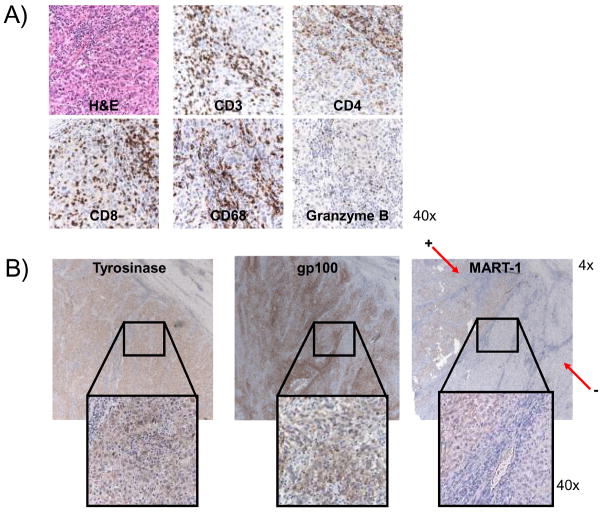
Pathological analysis of a partially regressed mass from patient NRA3. A) High power (40x) images of hematoxylin-eosin (H&E) and immune subset immunohistochemistry (IHC) stains, including CD3 staining for T cells, CD4 staining for T helper subset, CD8 staining for cytotoxic T lymphocyte (CLT) subset, CD68 for macrophages and granzyme B for CTL-associated cytotoxic granules. B) Low (4x) and high power (40x) images of IHC staining of the resected mass for the melanosomal antigen tyrosinase (left column) and gp100 (stained with the HMB45 antibody, middle column) showing uniform staining, and the melanosomal antigen MART-1 (right column) showing large areas without brown IHC staining.
Figure 3
Figure 3
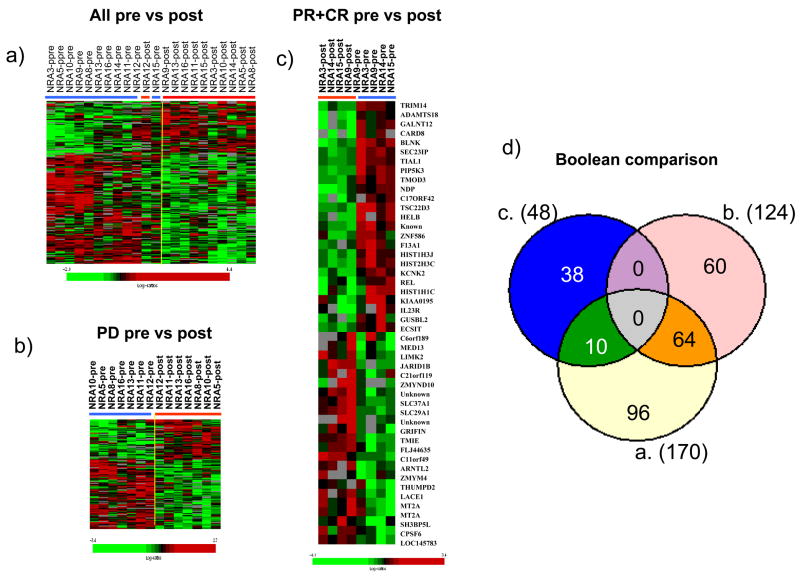
Heat map describing tremelimumab-induced PBMC gene expression; blue and red bars represent pre-treatment post-treatment samples, respectively. A) All pre- and post-treatment samples are displayed showing 170 transcripts whose expression was significantly (p<0.005) altered by treatment (paired two sample t test, permutation p<0.022). B) Samples for patients with progressive disease (PD) were compared between pre- and post-treatment collections (p<0.005, 124 genes). C) Clinical responder’s (PR+CR) pre- versus post-treatment analysis (p<0.005, 48 genes). D) Venn diagram displaying overlap of genes within the three groups (all patients, PD and CR+PR).

References

    1. Chambers CA, Kuhns MS, Egen JG, Allison JP. CTLA-4-mediated inhibition in regulation of T cell responses: mechanisms and manipulation in tumor immunotherapy. Annu Rev Immunol. 2001;19:565–94. - PubMed
    1. Leach DR, Krummel MF, Allison JP. Enhancement of antitumor immunity by CTLA-4 blockade. Science. 1996;271:1734–6. - PubMed
    1. Ribas A, Hanson DC, Noe DA, et al. Tremelimumab (CP-675,206), a cytotoxic T lymphocyte associated antigen 4 blocking monoclonal antibody in clinical development for patients with cancer. Oncologist. 2007;12:873–83. - PubMed
    1. Ribas A, Camacho LH, Lopez-Berestein G, et al. Antitumor activity in melanoma and anti-self responses in a phase I trial with the anti-cytotoxic T lymphocyte-associated antigen 4 monoclonal antibody CP-675,206. J Clin Oncol. 2005;23:8968–77. - PubMed
    1. Camacho LH, Antonia S, Sosman J, et al. Phase I/II trial of Tremelimumab in patients with metastatic melanoma. J Clin Oncol. 2009;27:1075–81. - PubMed

Publication types

MeSH terms