. 2009 Oct 1;15(19):6052-61.
doi: 10.1158/1078-0432.CCR-09-0586. Epub 2009 Sep 29.

CEACAM5-targeted therapy of human colonic and pancreatic cancer xenografts with potent labetuzumab-SN-38 immunoconjugates

Affiliations

CEACAM5-targeted therapy of human colonic and pancreatic cancer xenografts with potent labetuzumab-SN-38 immunoconjugates

Serengulam V Govindan et al. Clin Cancer Res. .

Abstract

Purpose: To improve the efficacy and reduce the gastrointestinal toxicity of the cancer prodrug, CPT-11, we have developed immunoconjugates of its active form, SN-38, and an anti-CEACAM5 antibody for targeted chemotherapy.

Experimental design: SN-38 conjugates of the anti-CEACAM5 monoclonal antibody, labetuzumab (hMN-14), varying in the nature of the cross-linker attachment at the drug's 20-hydroxyl position, were evaluated in vitro, in metastatic and/or s.c. human colonic and pancreatic cancer xenografts in nude mice using appropriate controls, and in a CEACAM5-negative tumor model.

Results: A pilot study in a s.c. LS174T model of human colonic carcinoma established the relative effectiveness of different conjugates. In the lung metastatic model of GW-39 human colonic carcinoma in nude mice, therapy with two specific labetuzumab-SN-38 conjugates, using 0.25 mg SN-38 equivalent/kg, q4d x 8, significantly extended median survival time versus controls (P < 0.002). In an expanded evaluation in the s.c. LS174T xenograft model, specific SN-38 conjugates produced significant tumor growth control and increases in median survival time versus other controls, including CPT-11 at a 33-fold greater cumulative dose (P < 0.01). An improvement was also observed in the therapy of a s.c. human pancreatic tumor xenograft. In a CEACAM5-negative systemic lymphoma xenograft, one labetuzumab-SN-38 conjugate examined was ineffective, whereas the conjugate specific for the tumor model produced 100% survival.

Conclusions: The promising labetuzumab-SN-38 conjugates developed showed selective therapeutic efficacy in human tumor models at nontoxic doses that were a fraction of the CPT-11 doses used.


Figures
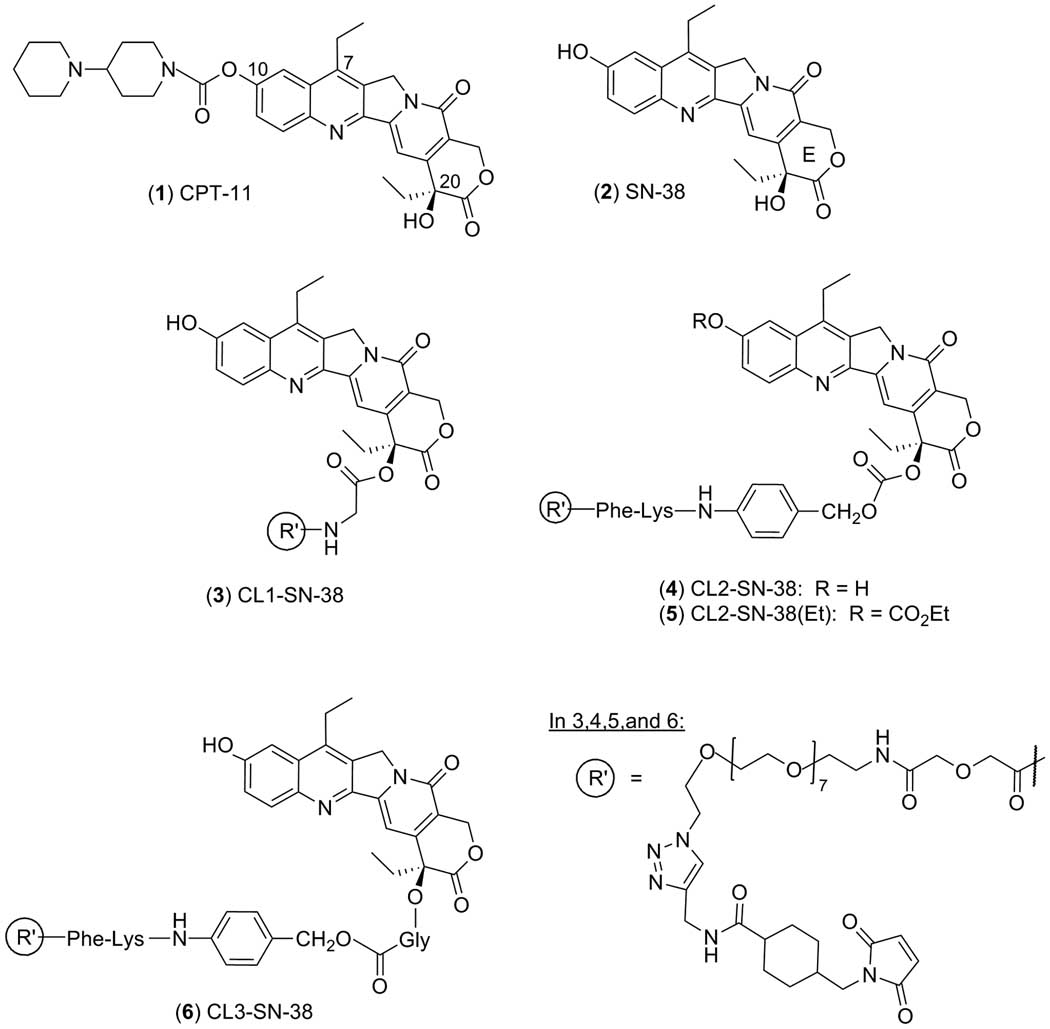
Figure 1
Figure 1
Structures of CPT-11, SN-38, and bifunctional SN-38 substrates CL1-SN-38, CL2-SN-38, CL2-SN-38(Et) and CL3-SN-38. The numbering is shown in the CPT-11 structure, and the ‘E’ ring is indicated in the SN-38 structure.
Figure 2
Figure 2
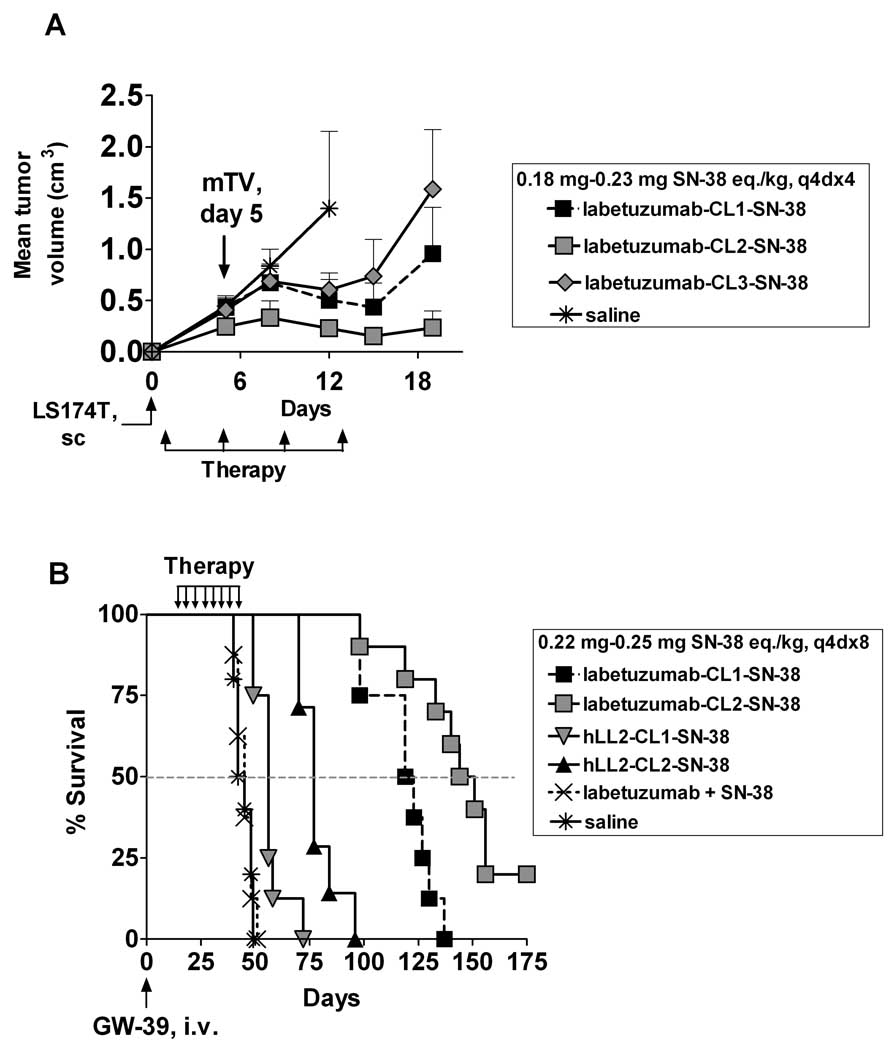
(A) Pilot therapy in the sc LS174T model of human colon carcinoma in nude mice. One day after sc injection of LS174T cells, groups of animals (n = 5) were administered labetuzumab (hMN-14) conjugates of CL1-SN-38, CL2-SN-38, and CL3-SN-38, i.p., at 0.18–0.23 mg SN-38 eq./kg, q4d×4. Control mice were given saline. The first measurement of tumor volumes was performed on day 5. (B) Evaluation in the lung metastatic model of GW-39 human colon carcinoma in nude mice. Animals were injected intravenously with GW-39 tumor suspension, and the therapy was begun 14 days later (n = 7–10). Labetuzumab conjugates of CL1-SN-38 and CL2-SN-38 and the corresponding non-targeting anti-CD22 mAb, hLL2, conjugates were administered, i.p., at 0.22–0.25 mg SN-38 eq./kg, q4d×8. Controls included saline and a mixture of labetuzumab (12.5 mg/kg) and SN-38 (0.25 mg/kg) administered at the same dose schedule. The figure shows Kaplan-Meier survival plots for the various treatments.
Figure 3
Figure 3
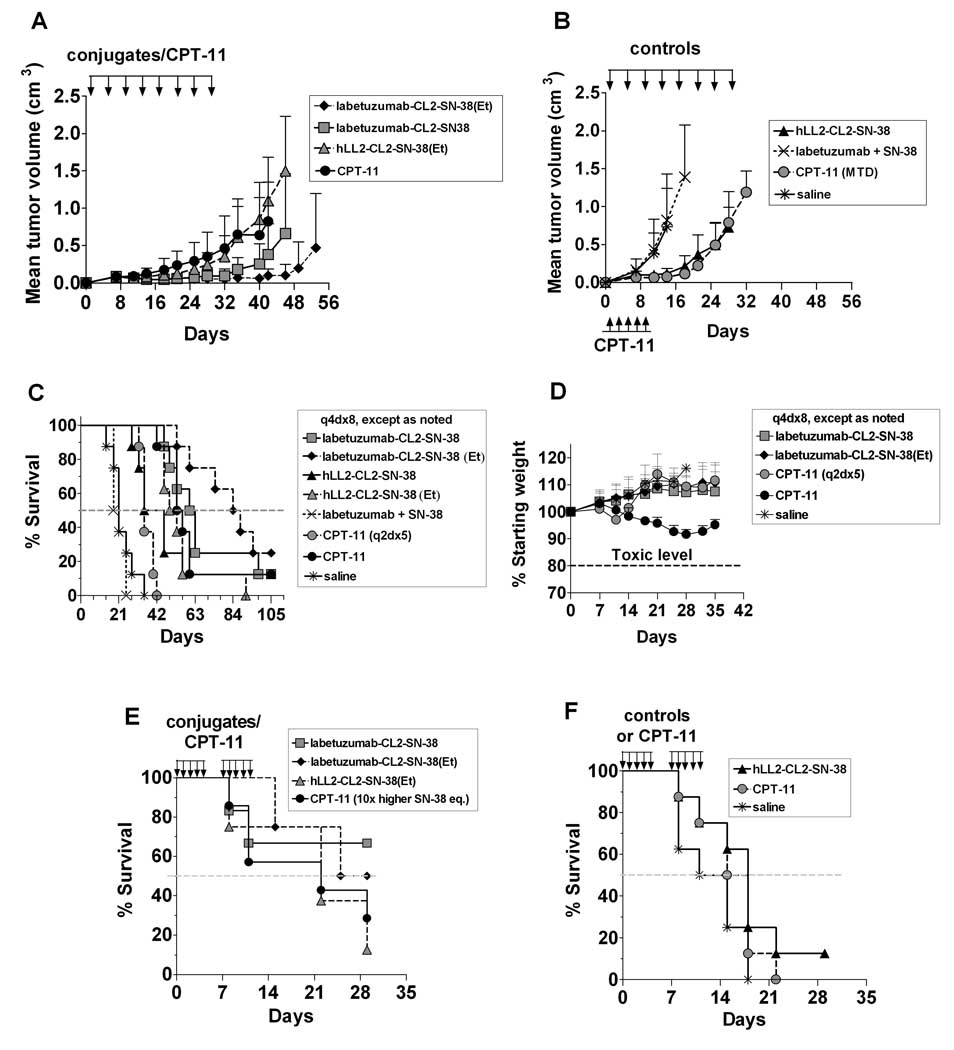
Expanded study in the sc LS174T model of human colon carcinoma in nude mice with labetuzumab-CL2-SN-38 and its longer-acting version, namely labetuzumab-CL2-SN-38(Et), with appropriate controls. (A–D) Therapy was started 1 day after sc injection of LS174T cells. Groups of animals (n = 8) were treated i.p. with specific labetuzumab or control hLL2 conjugates, each at 0.43 mg SN-38 eq./kg, q4d×8; treated i.v. with CPT-11 using a maximum-tolerated-dose schedule of 40 mg/kg (23 mg SN-38 eq./kg), q2d×5 (shaded circle, in 3B) or a lower dose of 30 mg/kg (17.25 mg SN-38 eq./kg) at the same dose schedule as for other test agents, namely q4d×8 (solid circle, in 3A); treated (i.p.) with a mixture of labetuzumab at 25 mg/kg and SN-38 at 0.43 mg/kg, q4d×8; and saline, q4d×8. Mean tumor volume vs. time plots are shown in two separate panels, A & B, for clarity; Kaplan-Meier survival plots for all the treatments are depicted in panel C; and percent weight gains in treatments with saline, specific conjugates, and CPT-11 are indicated in panel D. Panels E & F pertain to Kaplan-Meier survival plots in a 2nd therapy experiment that was started 9 days after LS174T tumor cell injection. Groups of animals (n = 4–7) were treated at a schedule of (q1d×5)×2, with 2 days of rest between courses, with specific labetuzumab conjugates of CL2-SN-38 and CL2-SN-38(Et), and the corresponding nontargeting conjugates of hLL2 mAb, each administered at 0.19 mg SN-38 eq./kg; CPT-11 given at 0.33 mg/kg (0.19 mg SN-38 eq./kg; shaded circle) or at a 10-fold higher dose of 3.25 mg/kg (1.9 mg SN-38 eq./kg; solid circle); and saline. The plots are given in two separate panels (E & F) for clarity.
Figure 4
Figure 4
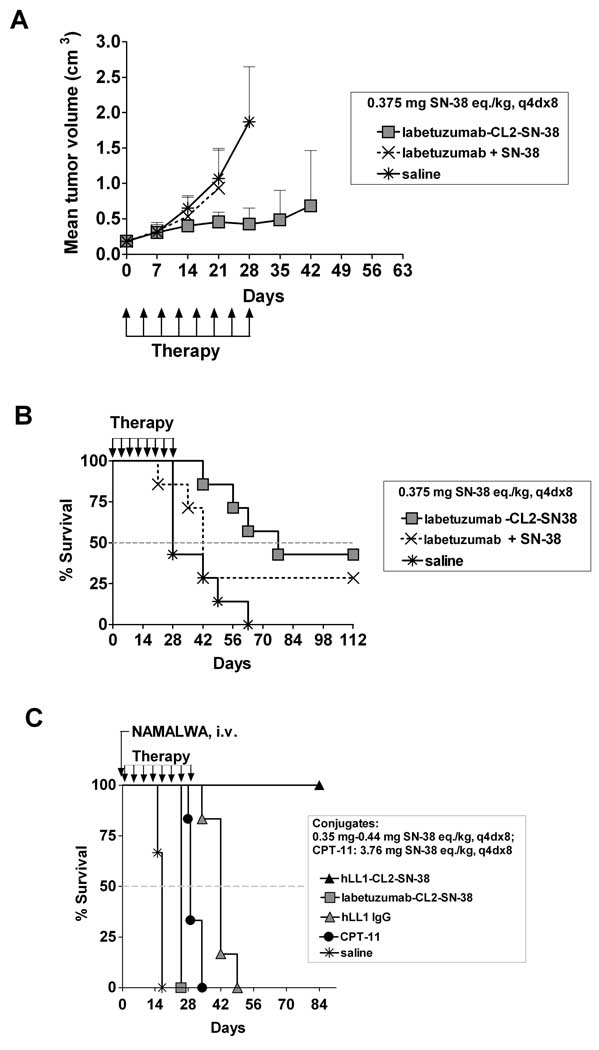
Therapy of the sc CaPan 1 human pancreatic adenocarcinoma xenograft in nude mice (A&B) and evaluation in a CEACAM5-negative systemic lymphoma model in SCID mice (C). In the sc CaPan 1 model, groups of mice (n = 7) were administered the specific labetuzumab-CL2-SN-38 conjugate at 0.375 mg SN-38 eq./kg, a noncovalent mixture of labetuzumab (25 mg/kg, same as in the conjugate) and SN-38 (0.375 mg/kg, same as in the conjugate), or saline, each at a dose schedule of q4d×8. (A) Plot of mean tumor volume vs. time, and (B) Kaplan-Meier survival plots. (C) Groups of SCID mice (n = 6) were injected i.v. with NAMALWA lymphoma cells, and the treatment was started one day later with the targeting anti-CD74 mAb, hLL1, the targeting hLL1-CL2-SN-38 conjugate, non-targeting hMN-14-CL2-SN-38 conjugate, CPT-11, or saline. The conjugates were administered at 0.35–0.44 mg SN-38 eq./kg, q4d×8; CPT-11 at 3.76 mg SN-38 eq./kg, q4d×8; hLL1 at the equi-protein dose of 25 mg/kg, q4d×8; and saline, q4d×8. Figure shows the Kaplan-Meier survival plots.

References

    1. Rougier P, Bugat R. CPT-11 in the treatment of colorectal cancer: Clinical efficacy and safety profile. Semin Oncol (suppl. 3) 1996;23:34–41. - PubMed
    1. Saijo N. Preclinical and clinical trials of topoisomerase inhibitors. Ann NY Acad Sci. 2000;922:92–99. - PubMed
    1. Kawato Y, Aonuma M, Hirota Y, Kuga H, Sato K. Intracellular roles of SN-38, a metabolite of the camptothecin derivative CPT-11, in the antitumor effect of CPT-11. Cancer Res. 1991;51:4187–4191. - PubMed
    1. Potmesil M. Camptothecins: from bench research to hospital wards. Cancer Res. 1994;54:1431–1439. - PubMed
    1. Sawada S, Okajima S, Aiyama R, et al. Synthesis and antitumor activity of 20(S)-camptothecin derivatives: carbamate-linked, water-soluble derivatives of 7-ethyl-10-hydroxycamptothecin. Chem Pharm Bull (Tokyo) 1991;39:1446–1450. - PubMed

MeSH terms