. 2010 Jan;332(1):4-16.
doi: 10.1124/jpet.109.158303. Epub 2009 Sep 29.

Reducing abuse liability of GABAA/benzodiazepine ligands via selective partial agonist efficacy at alpha1 and alpha2/3 subtypes

Affiliations

Reducing abuse liability of GABAA/benzodiazepine ligands via selective partial agonist efficacy at alpha1 and alpha2/3 subtypes

Nancy A Ator et al. J Pharmacol Exp Ther. 2010 Jan.

Abstract

Abuse-liability-related effects of subtype-selective GABA(A) modulators were explored relative to the prototypic benzodiazepine lorazepam. 7-Cyclobutyl-6-(2-methyl-2H-1,2,4-triazol-3-ylmethoxy)-3-phenyl-1,2,4-triazolo[4,3-b]pyridazine (TPA123) has weak partial agonist efficacy at alpha(1)-, alpha(2)-, alpha(3)-, and alpha(5)-containing GABA(A) receptors, whereas 7-(1,1-dimethylethyl)-6-(2-ethyl-2H-1,2,4-triazol-3-ylmethoxy)-3-(2-fluorophenyl)-1,2,4-triazolo[4,3-b]pyridazine (TPA023) has weaker partial agonist efficacy at alpha(2) and alpha(3) and none at alpha(1) and alpha(5) subtypes. For both compounds, preclinical data suggested efficacy as nonsedating anxiolytics. Self-injection of TPA123 (0.0032-0.1 mg/kg) and TPA023 (0.0032-0.32 mg/kg) was compared with lorazepam (0.01-0.32 mg/kg) in baboons. TPA123 and lorazepam maintained self-injection higher than vehicle at two or more doses in each baboon; peak rate of self-injection of lorazepam was higher than TPA123. Self-injected lorazepam and TPA123 also increased rates of concurrently occurring food-maintained behavior. After the availability of self-administered TPA123 doses ended, an effect consistent with a mild benzodiazepine-like withdrawal syndrome occurred. In contrast with lorazepam and TPA123, TPA023 did not maintain self-administration. Positron emission tomography studies showed that TPA023 produced a dose-dependent inhibition in the binding of [(11)C]flumazenil to the benzodiazepine binding site in the baboon, which was essentially complete (i.e., 100% occupancy) at the highest TPA023 dose (0.32 mg/kg). In a physical dependence study, TPA023 (32 mg/kg/24 h) was delivered as a continuous intragastric drip. Neither flumazenil at 14 days nor stopping TPA023 after 30 to 31 days resulted in the marked withdrawal syndrome characteristic of benzodiazepines in baboons. In the context of other data, elimination of efficacy at the alpha(1) subtype of the GABA/benzodiazepine receptor is not sufficient to eliminate abuse liability but may do so when coupled with reduced alpha(2/3) subtype efficacy.


Figures
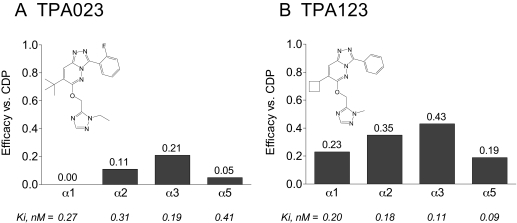
Fig. 1.
Fig. 1.
Comparison of the structures, binding affinity (Ki), and efficacy profiles of TPA023 and TPA123. Efficacy values were measured against human recombinant GABAA receptors containing β3, β2, and either an α1, α2, α3, or α5 subunit using whole-cell patch-clamp electrophysiology and are expressed relative to the efficacy measured at each subtype using the nonselective full-agonist chlordiazepoxide (CDP). Data are modified from McCabe et al. (2004), Carling et al. (2005), and Atack et al. (2006).
Fig. 2.
Fig. 2.
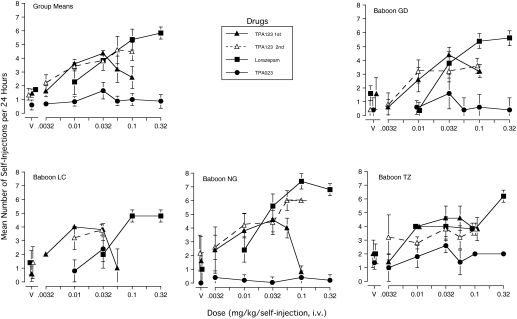
Mean daily number of self-injections delivered on the last 5 days of the 15-day period of availability of TPA123, lorazepam, TPA023, or their vehicles (V) in each of four baboons and for the group. Each self-injection was available under an FR-160 schedule of reinforcement; a time-out of 180 min followed completion of the response requirement, which limited maximal injections/day to eight. Each test dose or V was substituted for 0.32 mg/kg cocaine, which had maintained six to eight self-injections/day for the three preceding days (data not shown). Vertical bars indicate 1 S.D. for the individual baboons and 1 S.E.M. for the group means. Food pellets were concurrently available under a separate schedule of reinforcement (Fig. 3). TPA123 V for the second determinations for baboons GD and TZ are for the last 5 days in which vehicle was substituted directly for a dose of TPA123 (Fig. 4). TPA023 V for LC was not included due to his removal from the study for treatment of infection during that condition.
Fig. 3.
Fig. 3.
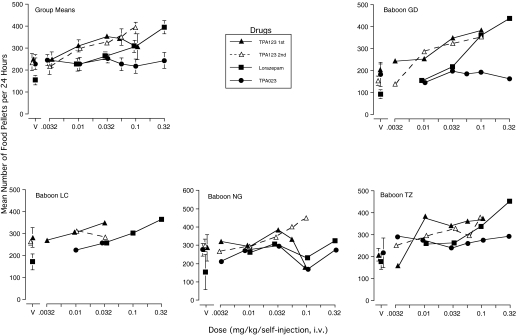
Mean number of 1-g food pellets per day produced by four baboons during the evaluation of self-administration of TPA123, TPA023, and lorazepam. Food pellets were available 24 h/day under an FR-20 schedule of reinforcement. Data are for the same periods of time as the self-injection data in Fig. 2. For the individual baboons, vertical bars around the vehicle (V) means indicate 1 S.D., and those around group means represent 1 S.E.M. Bars were omitted around the drug dose means for individual baboons for clarity. Pellet data for 0.056 mg/kg TPA123 were omitted for LC because pellet intake dropped and he received supplemental food.
Fig. 4.
Fig. 4.
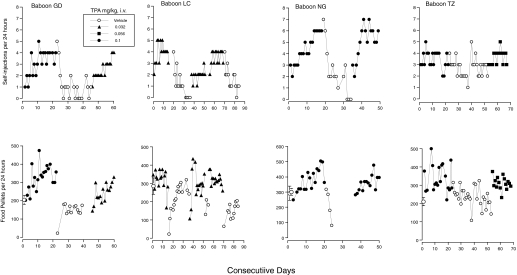
Number of self-injections (top) and pellets (bottom) per day for each baboon when a reinforcing dose of TPA123 was substituted for cocaine for 15 days (for the second determination of the effects of those doses), followed by substitution of vehicle (V) until extinction of self-injection was shown, followed by substitution of the same or another reinforcing dose of TPA123 for at least 15 days (for baboon LC, vehicle substitution and return to TPA123 was replicated; note that 3 days in which only pellets were available occurred after the first 15 days of return to 0.032 mg/kg). Data for days on which the baboon was anesthetized for the physical exam or on which equipment malfunctioned are omitted from both panels. Data for days on which supplementation with monkey chow occurred are omitted from the lower panels.
Fig. 5.
Fig. 5.
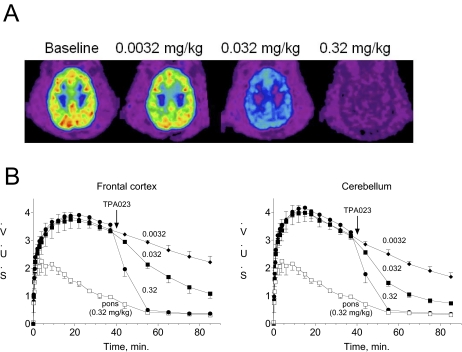
A, pseudocolor images of [11C]flumazenil binding to the benzodiazepine binding sites of GABAA receptors in the baboon brain. Images were collected and averaged 30 to 45 min after intravenous administration of either 0.0032, 0.032, or 0.32 mg/kg TPA023 (i.e., 70–85 min after commencement of scanning). Baseline scans were collected and averaged over a 10-min period (scan times, 20–30 min) before drug administration (which occurred at a scan time of 40 min). Red and orange colors represent areas of highest [11C]flumazenil binding, whereas blue and purple areas have lowest binding. B, time-activity curves for [11C]flumazenil in baboon frontal cortex, cerebellum, and pons. Each baboon received three separate scans during which they received either 0.0032, 0.032, or 0.32 mg/kg i.v. TPA023, 40 min after scanning commenced. For each dose group, the SUVs at each time point were averaged across the three baboons. The data for the pons (acquired during the 0.32 mg/kg TPA023 scan) are the same in each panel and represent the level of nonspecific uptake of [11C]flumazenil. Horizontal axis corresponds to mean frame time. Values shown are mean ± S.E.M.
Fig. 6.
Fig. 6.
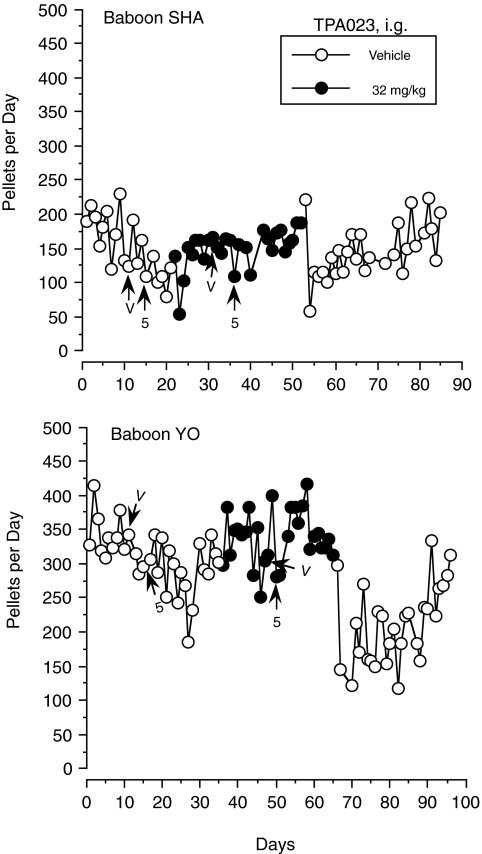
Numbers of 1-g food pellets earned per day by each baboon during (left to right) the TPA023 vehicle baseline, the period of continuous delivery of TPA023 32 mg/kg/24 h, and after TPA023 vehicle was substituted to assess the effects of drug withdrawal. Pellets were available for 20 consecutive hours each day under an FR-10 schedule of reinforcement beginning at approximately 9:00 AM. Shaded symbols indicate days on which either 5 mg/kg flumazenil (5) or its vehicle (V) was injected intramuscularly approximately 30 to 60 min after the period of pellet availability began. Data were omitted for days on which interpretation was confounded by ketamine administration for physical examination or an equipment problem that interrupted the period of pellet availability (i.e., vehicle baseline: day 16 for SHA; days 12, 16, and 29 for YO; TPA023 delivery: day 17 for both; and days 20 and 21 for SHA; vehicle substitution: day 21 for both; days 17–19 and 28 for SHA and days 3 and 4 for YO).
Fig. 7.
Fig. 7.
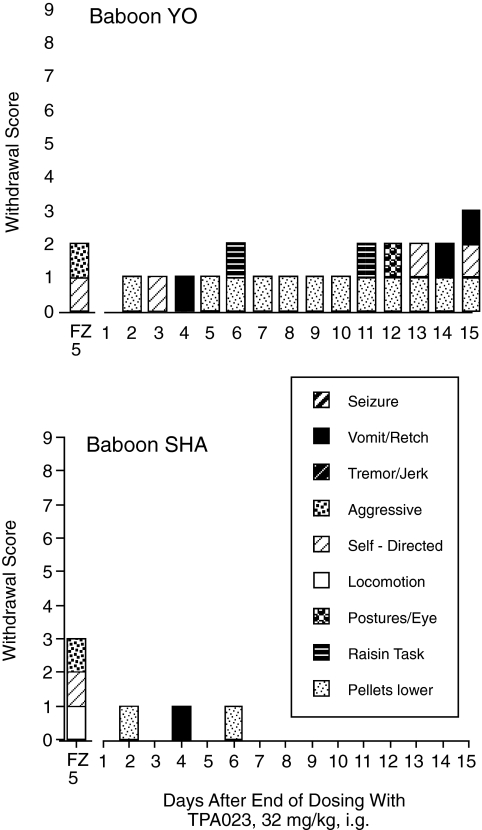
Withdrawal scores for assessment of withdrawal from continuous intragastric administration of TPA023 32 mg/kg/24 h. Precipitated withdrawal was assessed in a 60-min observation session that followed injection of 5 mg/kg i.m. flumazenil (FZ) (bar over FZ 5). Spontaneous withdrawal was assessed in daily 15-min observation sessions beginning the day after substitution of TPA023 vehicle for TPA023 (32 mg/kg/24 h i.g.) (bars over days 1–15). The maximal possible score was 9; 1 point was assigned for each of the nine behaviors (listed in the key) only if its frequency during the observation session was significantly different from control (see text).

References

    1. Abadie P, Rioux P, Scatton B, Zarifian E, Barré L, Patat A, Baron JC. (1996) Central benzodiazepine receptor occupancy by zolpidem in the human brain as assessed by positron emission tomography. Eur J Pharmacol 295:35–44 - PubMed
    1. Atack JR. (2005) The benzodiazepine binding site of GABA(A) receptors as a target for the development of novel anxiolytics. Expert Opin Investig Drugs 14:601–618 - PubMed
    1. Atack JR. (2009) Subtype-selective GABAA receptor modulation yields a novel pharmacological profile: the design and development of TPA023. Adv Pharmacol, in press - PubMed
    1. Atack JR, Wafford KA, Tye SJ, Cook SM, Sohal B, Pike A, Sur C, Melillo D, Bristow L, Bromidge F, et al. (2006) TPA023 [7-(1,1-dimethylethyl)-6-(2-ethyl-2H-1,2,4-triazol-3-ylmethoxy)-3-(2-fluorophenyl)-1,2,4-triazolo[4,3-b]pyridazine], an agonist selective for α2- and α3-containing GABAA receptors, is a non-sedating anxiolytic in rodents and primates. J Pharmacol Exp Ther 316:410–422 - PubMed
    1. Ator NA. (2000) Zaleplon and triazolam: drug discrimination, plasma levels, and self-administration in baboons. Drug Alcohol Depend 61:55–68 - PubMed

Publication types

MeSH terms

Substances