


Reducing abuse liability of GABAA/benzodiazepine ligands via selective partial agonist efficacy at alpha1 and alpha2/3 subtypes
- PMID: 19789360
- PMCID: PMC2802472
- DOI: 10.1124/jpet.109.158303
Reducing abuse liability of GABAA/benzodiazepine ligands via selective partial agonist efficacy at alpha1 and alpha2/3 subtypes
Abstract
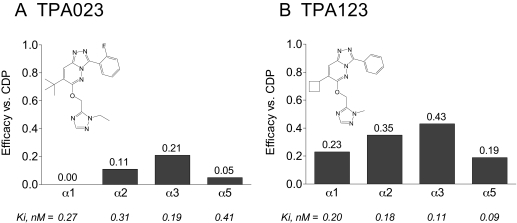
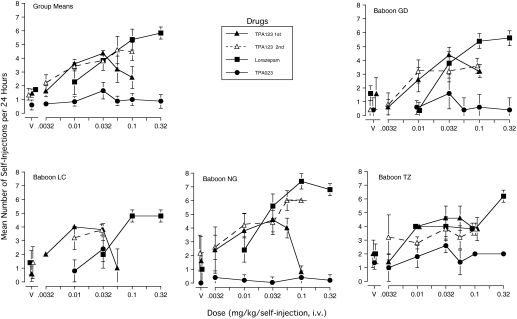
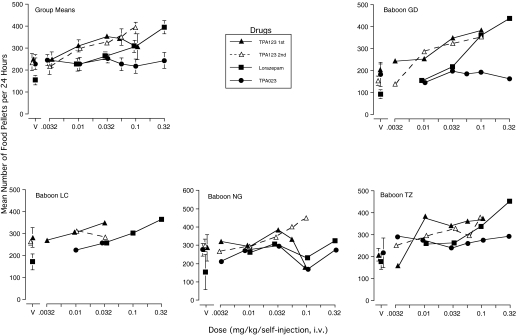
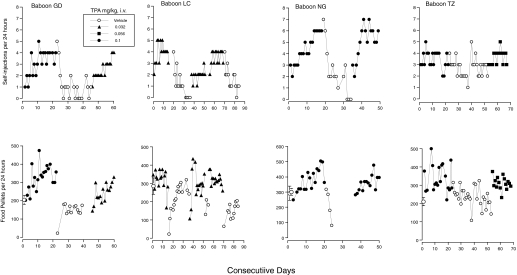
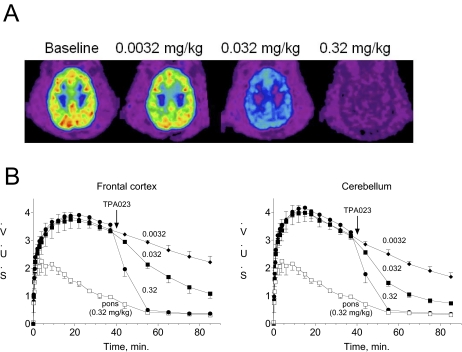
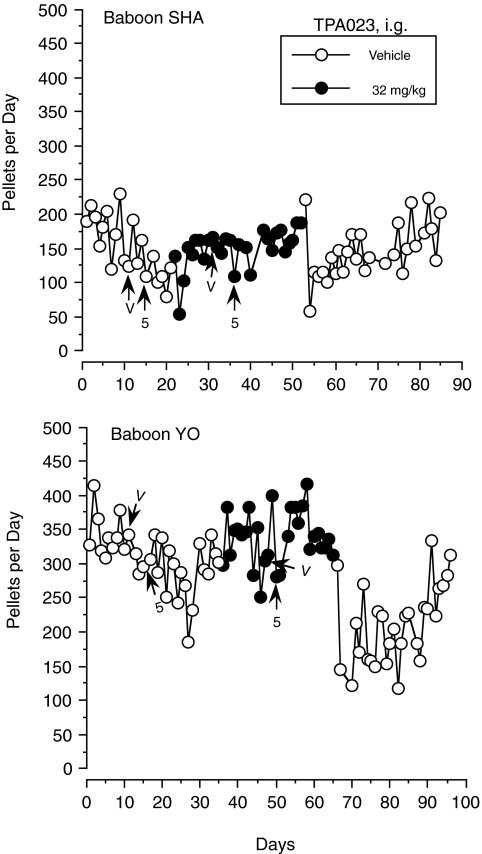
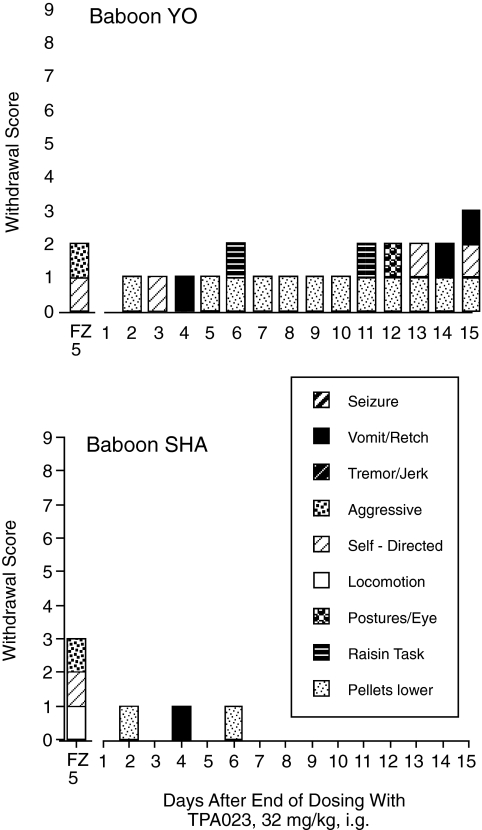
Abuse-liability-related effects of subtype-selective GABA(A) modulators were explored relative to the prototypic benzodiazepine lorazepam. 7-Cyclobutyl-6-(2-methyl-2H-1,2,4-triazol-3-ylmethoxy)-3-phenyl-1,2,4-triazolo[4,3-b]pyridazine (TPA123) has weak partial agonist efficacy at alpha(1)-, alpha(2)-, alpha(3)-, and alpha(5)-containing GABA(A) receptors, whereas 7-(1,1-dimethylethyl)-6-(2-ethyl-2H-1,2,4-triazol-3-ylmethoxy)-3-(2-fluorophenyl)-1,2,4-triazolo[4,3-b]pyridazine (TPA023) has weaker partial agonist efficacy at alpha(2) and alpha(3) and none at alpha(1) and alpha(5) subtypes. For both compounds, preclinical data suggested efficacy as nonsedating anxiolytics. Self-injection of TPA123 (0.0032-0.1 mg/kg) and TPA023 (0.0032-0.32 mg/kg) was compared with lorazepam (0.01-0.32 mg/kg) in baboons. TPA123 and lorazepam maintained self-injection higher than vehicle at two or more doses in each baboon; peak rate of self-injection of lorazepam was higher than TPA123. Self-injected lorazepam and TPA123 also increased rates of concurrently occurring food-maintained behavior. After the availability of self-administered TPA123 doses ended, an effect consistent with a mild benzodiazepine-like withdrawal syndrome occurred. In contrast with lorazepam and TPA123, TPA023 did not maintain self-administration. Positron emission tomography studies showed that TPA023 produced a dose-dependent inhibition in the binding of [(11)C]flumazenil to the benzodiazepine binding site in the baboon, which was essentially complete (i.e., 100% occupancy) at the highest TPA023 dose (0.32 mg/kg). In a physical dependence study, TPA023 (32 mg/kg/24 h) was delivered as a continuous intragastric drip. Neither flumazenil at 14 days nor stopping TPA023 after 30 to 31 days resulted in the marked withdrawal syndrome characteristic of benzodiazepines in baboons. In the context of other data, elimination of efficacy at the alpha(1) subtype of the GABA/benzodiazepine receptor is not sufficient to eliminate abuse liability but may do so when coupled with reduced alpha(2/3) subtype efficacy.
Figures
References
-
- Abadie P, Rioux P, Scatton B, Zarifian E, Barré L, Patat A, Baron JC. (1996) Central benzodiazepine receptor occupancy by zolpidem in the human brain as assessed by positron emission tomography. Eur J Pharmacol 295:35–44 - PubMed
-
- Atack JR. (2005) The benzodiazepine binding site of GABA(A) receptors as a target for the development of novel anxiolytics. Expert Opin Investig Drugs 14:601–618 - PubMed
-
- Atack JR. (2009) Subtype-selective GABAA receptor modulation yields a novel pharmacological profile: the design and development of TPA023. Adv Pharmacol, in press - PubMed
-
- Atack JR, Wafford KA, Tye SJ, Cook SM, Sohal B, Pike A, Sur C, Melillo D, Bristow L, Bromidge F, et al. (2006) TPA023 [7-(1,1-dimethylethyl)-6-(2-ethyl-2H-1,2,4-triazol-3-ylmethoxy)-3-(2-fluorophenyl)-1,2,4-triazolo[4,3-b]pyridazine], an agonist selective for α2- and α3-containing GABAA receptors, is a non-sedating anxiolytic in rodents and primates. J Pharmacol Exp Ther 316:410–422 - PubMed
-
- Ator NA. (2000) Zaleplon and triazolam: drug discrimination, plasma levels, and self-administration in baboons. Drug Alcohol Depend 61:55–68 - PubMed
Publication types
MeSH terms
Substances
Grants and funding
LinkOut - more resources
Full Text Sources
Medical
