


The vulnerable elders-13 survey predicts 5-year functional decline and mortality outcomes in older ambulatory care patients
- PMID: 19793154
- PMCID: PMC3181130
- DOI: 10.1111/j.1532-5415.2009.02497.x
The vulnerable elders-13 survey predicts 5-year functional decline and mortality outcomes in older ambulatory care patients
Abstract
Objectives: To test the predictive properties of the Vulnerable Elders-13 Survey (VES-13) a short tool that predicts functional decline and mortality over a 1- to 2-year follow-up interval over a 5-year interval.
Design: Longitudinal evaluation with mean follow-up of 4.5 years.
Setting: Two managed-care organizations.
Participants: Six hundred forty-nine community-dwelling older adults (> or = 75) enrolled in the Assessing Care of Vulnerable Elders observational study who screened positive for symptoms of falls or fear of falling, bothersome urinary incontinence, or memory problems.
Measurements: VES-13 score (range 1-10, higher score indicates worse prognosis), functional decline (decline in count of 5 activities of daily living or nursing home entry), and deaths.
Results: Higher VES-13 scores were associated with greater predicted probability of death and decline in older patients over a mean observation period of 4.5 years. For each additional VES-13 point, the odds of the combined outcome of functional decline or death was 1.37 (95% confidence interval (CI)=1.25-1.50), and the area under the receiver operating curve was 0.75 (95% CI=0.71-0.80). In the Cox proportional hazards model predicting time to death, the hazard ratio was 1.23 (95% CI=1.19-1.27) per additional VES-13 point.
Conclusion: This study extends the utility of the VES-13 to clinical decisions that require longer-term prognostic estimates of functional status and survival.
Figures

 Predicted probability of death
  Combined probability of functional decline + death VES-13 = Vulnerable Elders-13 Survey Predicted probabilities of death (dotted line) or the additive probability of functional decline and death (solid line) were calculated based on a multinomial logistic regression with cluster adjustment for primary care clinician and weighted for loss to follow up.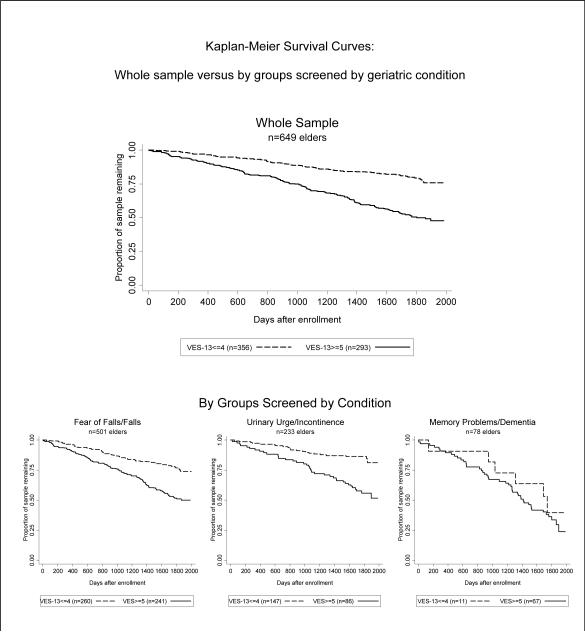
References
-
- Covinsky KE, Eng C, Lui LY, Sands LP, Yaffe K. The last 2 years of life: functional trajectories of frail older people. J Am Geriatr Soc. 2003;51:492–498. - PubMed
-
- Saliba D, Elliott M, Rubenstein LZ, et al. The Vulnerable Elders Survey: a tool for identifying vulnerable older people in the community. J Am Geriatr Soc. 2001;49:1691–1699. - PubMed
-
- Min LC, Elliott MN, Wenger NS, Saliba D. Higher vulnerable elders survey scores predict death and functional decline in vulnerable older people. J Am Geriatr Soc. 2006;54:507–511. - PubMed
-
- Arora VM, Johnson M, Olson J, et al. Using assessing care of vulnerable elders quality indicators to measure quality of hospital care for vulnerable elders. J Am Geriatr Soc. 2007;55:1705–1711. - PubMed
Publication types
MeSH terms
Grants and funding
LinkOut - more resources
Full Text Sources
Medical
