


Oral delivery of tumor-targeting Salmonella exhibits promising therapeutic efficacy and low toxicity
- PMID: 19793349
- PMCID: PMC11159130
- DOI: 10.1111/j.1349-7006.2009.01337.x
Oral delivery of tumor-targeting Salmonella exhibits promising therapeutic efficacy and low toxicity
Abstract
Tumor-targeting bacteria have been developed as powerful anticancer agents. Salmonella typhimurium VNP20009, a representative tumor-targeting strain, has been systemically administered as a single-agent therapy at doses of 1 x 10(6) to 3 x 10(6) colony-forming unit (cfu)/mouse, or in combination with other antitumor agents at doses of 1 x 10(4) to 2 x 10(5) cfu/mouse. Recently, we reported that oral delivery of VNP20009 at the dose of 1 x 10(9) cfu/mouse induced significant anticancer effects comparable to that induced by systemic administration of this strain at 1 x 10(4) cfu/mouse. To further address the efficacy and safety of oral administration of bacteria, here we performed a systemically comparative analysis of anticancer efficacy and toxicity of VNP20009 administered: (i) orally at a dose of 1 x 10(9) cfu/mouse (VNP9-oral); (ii) intraperitoneally at a dose of 1 x 10(4) cfu/mouse (VNP4-i.p.); or (iii) intraperitoneally at a dose of 1 x 10(6) cfu/mouse in tumor-free and tumor-bearing murine models. The results showed that VNP9-oral, similar to VNP4-i.p., induced significant tumor growth inhibition whereas VNP6-i.p. induced better anticancer effect in the B16F10 melanoma model. Among three treatments, VNP9-oral induced the mildest and reversible toxicity whereas VNP6-i.p. resulted in the most serious and irreversible toxicities when compared to other two treatments. Moreover, the combination of VNP9-oral with a low dose of chemotherapeutics produced comparable antitumor effects but displayed significantly reduced toxicity when compared to VNP6-i.p. The findings demonstrated that oral administration, as a novel avenue in the application of bacteria, is highly safe and effective. Moreover, the present preclinical study should facilitate the optimization of bacterial therapies with improved anticancer efficacy and reduced adverse effects in future clinical trials.
Figures
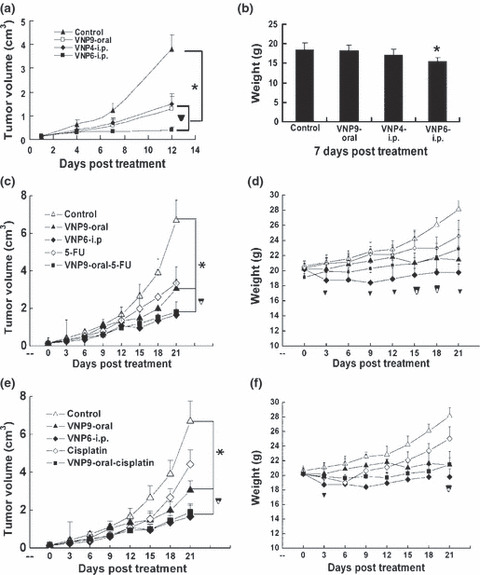
 ) P < 0.05, () P < 0.01, and *P < 0.001, combination group versus VNP6‐i.p.
 ) P < 0.05, () P < 0.01, and *P < 0.001 when compared to VNP6‐i.p.
 ) P < 0.05 and () P < 0.01 when compared to controls.

 ) P < 0.05, () P < 0.01, and *P < 0.001 when compared to VNP6‐i.p.
 ) P < 0.05, () P < 0.01, and *P < 0.001 when compared to controls.
References
-
- Pawelek JM, Low KB, Bermudes D. Bacteria as tumour‐targeting vectors. Lancet Oncol 2003; 4: 20–8. - PubMed
-
- Zhao M, Yang M, Ma HY et al. Targeted therapy with a Salmonella typhimurium leucine‐arginine auxotroph cures orthotopic human breast tumors in nude mice. Cancer Res 2006; 66 (15): 7647–52. - PubMed
Publication types
MeSH terms
Substances
LinkOut - more resources
Full Text Sources
Other Literature Sources
