


Attention moderates the fearlessness of psychopathic offenders
- PMID: 19793581
- PMCID: PMC2795048
- DOI: 10.1016/j.biopsych.2009.07.035
Attention moderates the fearlessness of psychopathic offenders
Abstract
Background: Psychopathic behavior is generally attributed to a fundamental, amygdala-mediated deficit in fearlessness that undermines social conformity. An alternative view is that psychopathy involves an attention-related deficit that undermines the processing of peripheral information, including fear stimuli.
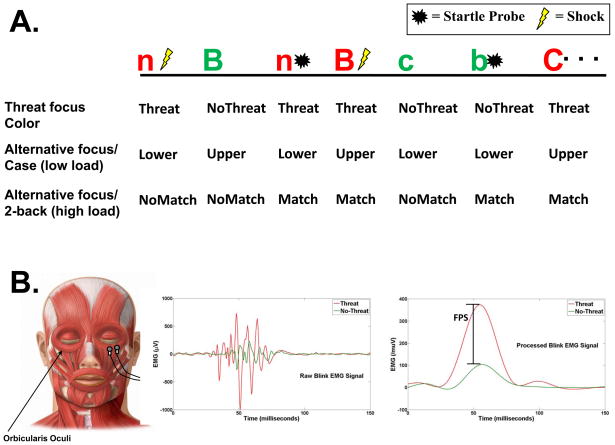
Methods: We evaluated these alternative hypotheses by measuring fear-potentiated startle (FPS) in a group of 125 prisoners under experimental conditions that 1) focused attention directly on fear-relevant information or 2) established an alternative attentional focus. Psychopathy was assessed using Hare's Psychopathy Checklist-Revised (PCL-R).
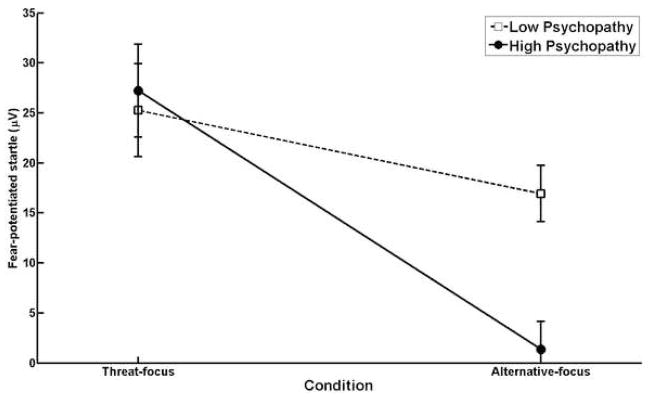
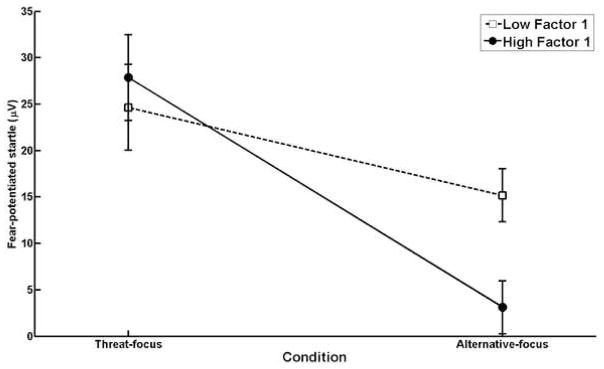
Results: Psychopathic individuals displayed normal FPS under threat-focused conditions but manifested a significant deficit in FPS under alternative-focus conditions. Moreover, these findings were essentially unchanged when analyses employed the interpersonal/affective factor of the PCL-R instead of PCL-R total scores.
Conclusions: The results provide unprecedented evidence that higher-order cognitive processes moderate the fear deficits of psychopathic individuals. These findings suggest that psychopaths' diminished reactivity to fear stimuli, and emotion-related cues more generally, reflect idiosyncrasies in attention that limit their processing of peripheral information. Although psychopathic individuals are commonly described as cold-blooded predators who are unmotivated to change, the attentional dysfunction identified in this study supports an alternative interpretation of their chronic disinhibition and insensitive interpersonal style.
Figures
Comment in
-
Psychopathy and fearlessness: an interhemispheric imbalance perspective.Biol Psychiatry. 2010 Apr 15;67(8):e51-2. doi: 10.1016/j.biopsych.2009.10.034. Epub 2009 Dec 23. Biol Psychiatry. 2010. PMID: 20031118 No abstract available.
References
-
- Hare RD. Manual for the Revised Psychopathy Checklist. 2. Toronto: Multi-Health Systems; 2003.
-
- Hare RD. Without Conscience: The Disturbing World of the Psychopaths Among Us. New York: Simon & Schuster; 1993.
-
- Lykken DT. The Antisocial Personalities. Hillsdale: Lawrence Erlbaum Associates; 1995.
-
- Lykken DT. A study of anxiety in the sociopathic personality. J Abnorm Soc Psychol. 1957;55:6–10. - PubMed
-
- Hare RD. Electrodermal and cardiovascular correlates of psychopathy. In: Hare RD, Schalling D, editors. Psychopathic Behavior: Approaches to Research. Chichester, England: Wiley; 1978. pp. 107–143.
Publication types
MeSH terms
Grants and funding
LinkOut - more resources
Full Text Sources
Miscellaneous
