


Androgen receptor gene sequence and basal cortisol concentrations predict men's hormonal responses to potential mates
- PMID: 19793749
- PMCID: PMC2842633
- DOI: 10.1098/rspb.2009.1538
Androgen receptor gene sequence and basal cortisol concentrations predict men's hormonal responses to potential mates
Abstract
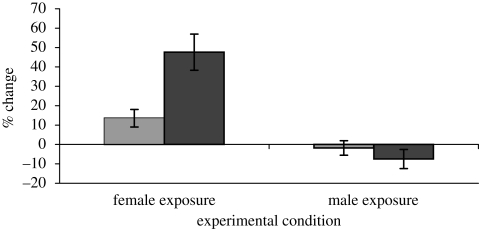
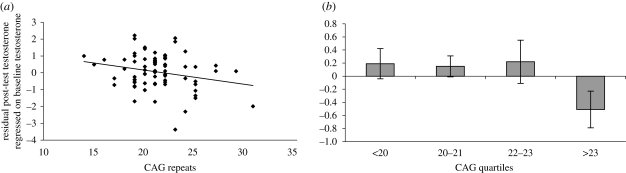
Exposure to potential mates triggers rapid elevations of testosterone and glucocorticoid concentrations in males of many non-human species, and preliminary studies support similar effects in human males. The human studies have all reported large individual differences in these responses, however, and the present study tested whether specific biological variables may help explain these differences. Replicating past research, the present study found that men's salivary testosterone and cortisol concentrations increased after a brief conversation with a young woman, but did not change (or slightly decreased) after a conversation with a young man. In addition, smaller numbers of CAG repeats in men's androgen receptor gene, and lower baseline cortisol concentrations, each predicted larger testosterone responses to the interactions with women. The CAG repeat finding demonstrates that a specific genetic polymorphism predicts physiological responses to social interactions that may in turn have important downstream consequences on men's mating behaviour. The effects of cortisol are consistent with past demonstrations of glucocorticoid inhibition of testosterone production and show that such inhibition also affects testosterone responses to social stimuli. In sum, the present study both confirms men's hormonal reactions to potential mates and identifies novel biological variables that predict individual differences in these responses.
Figures
References
-
- Aikey J. L., Nyby J. G., Anmuth D. M., James P. J.2002Testosterone rapidly reduces anxiety in male house mice (Mus musculus). Horm. Behav. 42, 448–460 (doi:10.1006/hbeh.2002.1838) - DOI - PubMed
-
- Alexander G. M., Packard M. G., Hines M.1994Testosterone has rewarding affective properties in male rats: implications of the biological bases of sexual motivation. Behav. Neurosci. 108, 424–428 (doi:10.1037/0735-7044.108.2.424) - DOI - PubMed
-
- Amstislavskaya T. G., Popova N. K.2004Female-induced sexual arousal in male mice and rats: behavioral and testosterone response. Horm. Behav. 46, 544–550 (doi:10.1016/j.yhbeh.2004.05.010) - DOI - PubMed
-
- Apicella C. L., Dreber A., Campbell B., Gray P. B., Hoffman M., Little A. C.2008Testosterone and financial risk preferences. Evol. Hum. Behav. 29, 384–390 (doi:10.1016/j.evolhumbehav.2008.07.001) - DOI
-
- Batty J.1978Acute changes in plasma testosterone levels and their relation to measures of sexual behavior in the male house mouse (Mus musculus). Anim. Behav. 26, 349–357 (doi:10.1016/0003-3472(78)90053-2) - DOI - PubMed
Publication types
MeSH terms
Substances
LinkOut - more resources
Full Text Sources
Miscellaneous
