


Sensory contributions to impaired emotion processing in schizophrenia
- PMID: 19793797
- PMCID: PMC2762631
- DOI: 10.1093/schbul/sbp109
Sensory contributions to impaired emotion processing in schizophrenia
Abstract
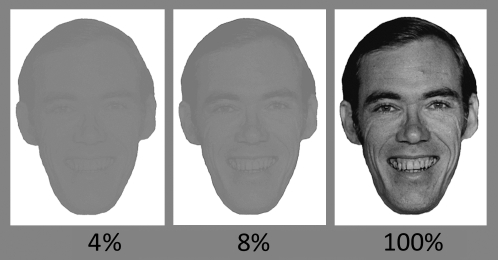
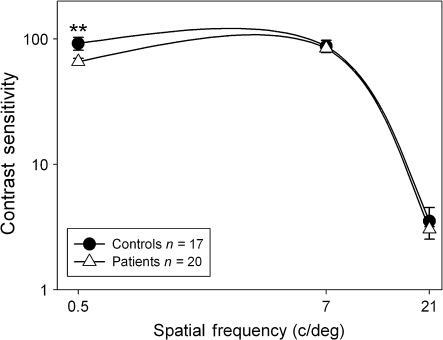
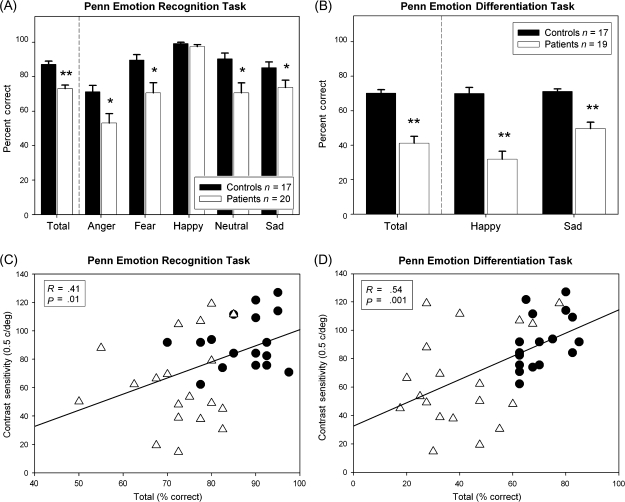
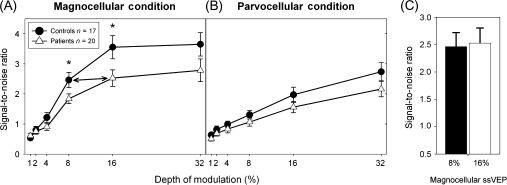
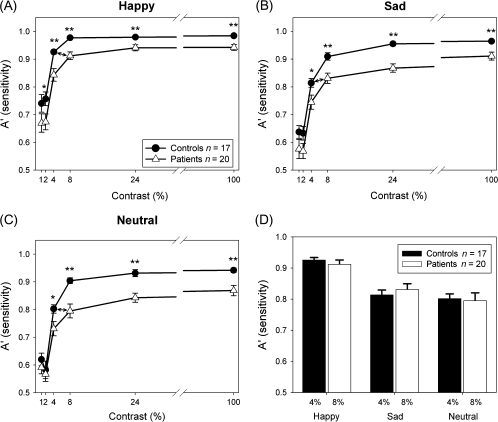
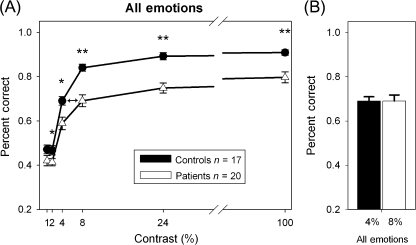
Both emotion and visual processing deficits are documented in schizophrenia, and preferential magnocellular visual pathway dysfunction has been reported in several studies. This study examined the contribution to emotion-processing deficits of magnocellular and parvocellular visual pathway function, based on stimulus properties and shape of contrast response functions. Experiment 1 examined the relationship between contrast sensitivity to magnocellular- and parvocellular-biased stimuli and emotion recognition using the Penn Emotion Recognition (ER-40) and Emotion Differentiation (EMODIFF) tests. Experiment 2 altered the contrast levels of the faces themselves to determine whether emotion detection curves would show a pattern characteristic of magnocellular neurons and whether patients would show a deficit in performance related to early sensory processing stages. Results for experiment 1 showed that patients had impaired emotion processing and a preferential magnocellular deficit on the contrast sensitivity task. Greater deficits in ER-40 and EMODIFF performance correlated with impaired contrast sensitivity to the magnocellular-biased condition, which remained significant for the EMODIFF task even when nonspecific correlations due to group were considered in a step-wise regression. Experiment 2 showed contrast response functions indicative of magnocellular processing for both groups, with patients showing impaired performance. Impaired emotion identification on this task was also correlated with magnocellular-biased visual sensory processing dysfunction. These results provide evidence for a contribution of impaired early-stage visual processing in emotion recognition deficits in schizophrenia and suggest that a bottom-up approach to remediation may be effective.
Figures
Comment in
-
Seeing Through Psychosis.Biol Psychiatry. 2021 May 15;89(10):e51-e53. doi: 10.1016/j.biopsych.2021.03.025. Biol Psychiatry. 2021. PMID: 33958036 Free PMC article. No abstract available.
References
-
- Kraepelin E. Dementia Praecox and Paraphrenia. (Translated by RM Barclay from the 8th German edition) Robertson GM, ed. Edinburgh: Livingstone; 1919.
-
- Edwards J, Jackson HJ, Pattison PE. Emotion recognition via facial expression and affective prosody in schizophrenia: a methodological review. Clin Psychol Rev. 2002;22:789–832. - PubMed
Publication types
MeSH terms
Grants and funding
LinkOut - more resources
Full Text Sources
Other Literature Sources
Medical
