


Nutritional supplementation in girls influences the growth of their children: prospective study in Guatemala
- PMID: 19793851
- PMCID: PMC2762161
- DOI: 10.3945/ajcn.2009.27524
Nutritional supplementation in girls influences the growth of their children: prospective study in Guatemala
Abstract
Background: Better early childhood nutrition improves schooling, adult health, skills, and wages, but there is little evidence regarding its effect on the next generation.
Objective: We assessed whether nutritional supplementation in children aged <7 to 15 y affected their children's nutritional status 29-38 y later.
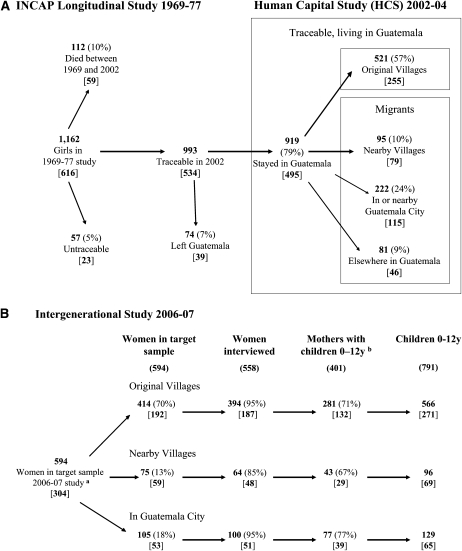
Design: We studied 791 children 0-12 y who were offspring of 401 Guatemalan women who had participated as children in a nutritional supplementation trial in which 2 villages were randomly assigned to receive a nutritious supplement (atole) and 2 were assigned to receive a less-nutritious supplement (fresco). We compared anthropometric indicators between the offspring of mothers exposed to atole and the offspring of mothers exposed to fresco.
Results: Compared with the offspring of women exposed to fresco, the offspring of women exposed to atole had a 116-g (95% CI: 17, 215 g) higher birth weight, were 1.3-cm (0.4, 2.2 cm) taller, had a 0.6-cm (0.4, 0.9 cm) greater head circumference, had a 0.26 (0.09, 0.43) greater height-for-age z score, and had a 0.20 (0.02, 0.39) greater weight-for-age z score. The association for height differed by offspring sex. Sons of women exposed to atole were 2.0-cm (95% CI: 1.0, 3.1 cm) taller than the sons of women exposed to fresco. Supplementation was not associated with 6 other offspring anthropometric indicators that reflect measures of adiposity. Supplementation in boys did not affect their children's anthropometric measures.
Conclusion: Nutritional supplementation in girls is associated with substantial increases in their offsprings' (more for sons) birth weight, height, head circumference, height-for-age z score, and weight-for-age z score.
Figures
References
-
- Walker SP, Wachs TD, Meeks Gardner J, et al. Child development: risk factors for adverse outcomes in developing countries. Lancet 2007;369:145–57 - PubMed
-
- Alderman H, Behrman JR. Reducing the incidence of low birth weight in low-income countries has substantial economic benefits. World Bank Res Obs 2006;21:25–48
-
- Hoddinott J, Maluccio JA, Behrman JR, Flores R, Martorell R. The impact of nutrition during early childhood on income, hours worked, and wages of Guatemalan adults. Lancet 2008;371:411–6 - PubMed
-
- Maluccio JA, Hoddinott J, Behrman JB, Quisumbing AR, Martorell R, Stein AD. The impact of improving nutrition during early childhood on education among Guatemalan adults. Econ J 2009;119:734–63
Publication types
MeSH terms
Substances
Grants and funding
LinkOut - more resources
Full Text Sources
Medical
