


doi: 10.1091/mbc.e09-04-0295.
Epub 2009 Sep 30.
Heat-shock factor 1 controls genome-wide acetylation in heat-shocked cells
Affiliations
- PMID: 19793920
- PMCID: PMC2785740
- DOI: 10.1091/mbc.e09-04-0295
Item in Clipboard
Heat-shock factor 1 controls genome-wide acetylation in heat-shocked cells
Mol Biol Cell.
2009 Dec.
Abstract
A major regulatory function has been evidenced here for HSF1, the key transcription factor of the heat-shock response, in a large-scale remodeling of the cell epigenome. Indeed, upon heat shock, HSF1, in addition to its well-known transactivating activities, mediates a genome-wide and massive histone deacetylation. Investigating the underlying mechanisms, we show that HSF1 specifically associates with and uses HDAC1 and HDAC2 to trigger this heat-shock-dependent histone deacetylation. This work therefore identifies HSF1 as a master regulator of global chromatin acetylation and reveals a cross-talk between HSF1 and histone deacetylases in the general control of genome organization in response to heat shock.
Figures

Heat shock induces a deacetylation of core histones. (A) Heat shock induces a decrease in nuclear acetylation level. Acetylated proteins were detected by immunofluorescence with an anti-acetylated lysine antibody in HeLa cells exposed (+) or not (−) to a 1-h heat shock at 43°C. Nuclei were counterstained with DAPI. Acetylated nuclear foci corresponding to the nuclear stress bodies are present in heat-shocked cells. Bar, 5 μm. (B) Heat shock induces a reversible deacetylation of H4. Whole cell extracts from HeLa exposed to different conditions of heat shock were analyzed by Western blot using an anti-acetylated H4 antibody: 37°C (−), heat shock 1 h at 43°C (0), 3 h (3), or 5 h (5) of recovery after the 1-h heat shock. H2B was used as loading control. (C) Heat shock does not affect histone level and solubility. Cytosolic (C), nuclear soluble (NS), and nuclear insoluble (NI) protein extracts from cells exposed (+) or not (−) to a 1-h heat shock at 43°C or recovery were run on 15% acrylamide and stained with Coomassie blue, and the same fractions were analyzed by Western blot with an anti-H2B antibody.
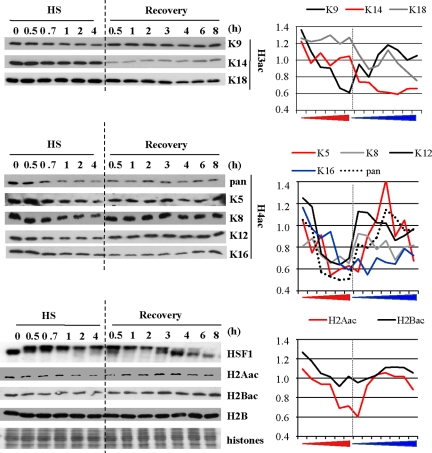
Identification of the heat-induced deacetylation lysine targets. Analysis by Western blot of the evolution of different epigenetic marks during heat shock (HS) and recovery in total cell extracts from HeLa cells. Unmodified H2B was used as a loading control, together with Coomassie staining of histones. H2A and H2B acetylation profiles, H3 acetylation profile on K9, K14, and K18. H4 acetylation profile using a pan-acetyl H4 antibody or antibodies to specific acetylated residues (K5, K8, K12, and K16). All fractions were loaded on the same gel. White bar indicate the place where blank lanes were cropped. HSF1 was detected as a marker of the heat-shock response. Delay in HSF1 migration is indicative of its hyperphosphorylated activated state (only in the case of HSF1, fractions were not equilibrated before loading). Quantification of the Western blot signals are also represented with a dash line indicating the transition between the heat-shock and recovery period. Red arrow, increasing time of heat exposure; blue arrow, increasing time of recovery.
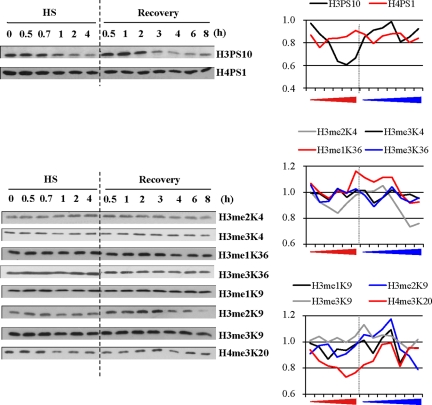
Evolution of histone H3- and H4-specific methylated and phosphorylated residues in the course of the heat-shock response. Analysis by Western blot of the evolution of phosphorylated and methylated epigenetic marks during heat shock (HS) and recovery in total cell extracts from HeLa cells. As in Figure 2, unmodified H2B was used as a loading control, together with Coomassie staining of histones (shown in Figure 2). H3 and H4 phosphorylation profiles on S10 and S1. H3 and H4 methylation profiles using antibody or antibodies specific to methylated residues (me2K4, me3K4, me1K36, me3K36, me1K9, me2K9a, and me3K9 of histone H3 and me3K20 of histone H4). All fractions were loaded on the same gel. White bar indicates the place where blank lanes were cropped. HSF1 was detected as a marker of the heat-shock response. Delay in HSF1 migration is indicative of its hyperphosphorylated, activated state (only in the case of HSF1, fractions were not equilibrated before loading). Quantification of the Western blot signals are also represented, with a dash line indicating the transition between the heat-shock and recovery period. Red arrow, increasing time of heat exposure; blue arrow, increasing time of recovery.

HSF1 controls acetylation and heat-induced deacetylation of core histones. Western blot analysis of H4 acetylation level in parental (WT) and HSF1 KO mouse cells exposed to different conditions: 37°C (−), 30-min heat shock at 43°C (0.5), 1-h heat shock at 43°C (1), or 3 h of recovery following a 1-h heat shock (rec). Unmodified H2B was used as a loading control. No heat-induced deacetylation is observed in heat-shocked samples in HSF1 KO cells.

HDAC1 and HDAC2 mediate the changes in histone acetylation profile upon heat shock. (A) Impact of TSA on heat-induced deacetylation of histones. Protein extracts were obtained from heat-shocked cells or from cells allowed to recover for 3 h after a 1-h heat shock at 37°C (rec). Protein extracts were analyzed by Western blot with an antibody against pan-acetylated H4. H2B was used as a loading control. Inhibition of class I and II HDACs by TSA prevents the heat-induced deacetylation of histone H4. (B) Impact of HDAC1 and 2 knockdown on heat-induced global nuclear protein acetylation level determined by immunofluorescence with an anti-acetylated lysine antibody. Heat-shocked cells were treated with scrambled siRNA (top) or with siRNAs against HDAC1 and 2 (middle) or HDAC3 (bottom). Anti-HDAC1 and 2 or Anti-HDAC3 were used to identify the cells in which the corresponding protein expressions were lowered (right column). Knockdown of HDAC1 and 2 prevents heat-induced deacetylation. Bar, 5 μm. (C) Impact of HDAC1 and 2 knockdown on the level of heat-induced histone deacetylation. Western blot analysis was performed on cellular extracts from non-heat-shocked (−) or heat-shocked (+) HeLa cells treated with siRNA against HDAC1 and 2. H4 acetylation level was analyzed in nontransfected HeLa cells (lanes 1 and 2), in HeLa cells transfected with a scrambled siRNA (lanes 3 and 4), and in HeLa cells treated with an siRNA against HDAC1 (lanes 5 and 6), or HDAC2 (lanes 7 and 8) and in HeLa cells treated with both HDAC1 and HDAC2 (lanes 9 and 10). H4 acetylation level was analyzed using a pan acetyl-H4 antibody (H4ac). The active slow-migrating hyperphosphorylated form of HSF1 is present in both normal cells and in siRNA-treated heat-shocked cells. Unmodified H2B was used as a loading control, as well as Coomassie staining of histones (bottom panel). HDAC1 and 2 were detected with specific antibodies.
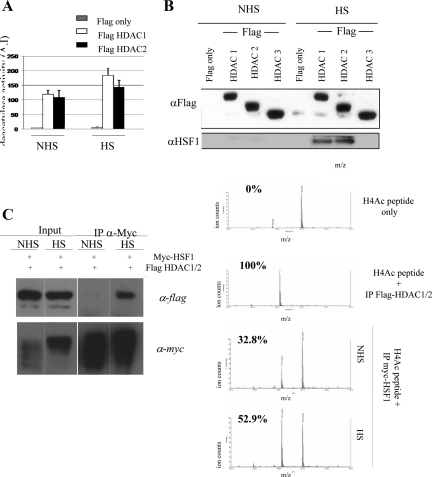
HSF1 binding to HDAC 1 and HDAC2 in heat-shocked cells correlates with increased HDAC activities. (A) Increased HDAC1 and 2 activities after heat shock. Immunoprecipitation of transiently transfected Flag-tagged HDAC1 and 2 or Flag tag alone from non-heat-shocked (NHS) or heat-shocked (HS) HeLa cells were performed with anti-Flag antibodies. The same amounts of immunoprecipitates were used in a deacetylase assay to quantify the HDAC activity in each sample. Increased HDAC1 and 2 activities were both observed in heat-shocked cells. Each sample was analyzed in duplicates in two independent experiments; error bars, SEM. (B) Endogenous HSF1 coimmunoprecipitates with Flag-HDAC1 and HDAC2 but not with HDAC3 in heat-shocked cells. Flag immunoprecipitations were performed as in A on cellular extracts from unstressed and heat-shocked cells transiently transfected with Flag-HDAC1, -HDAC2, or -HDAC3. Western blot analysis of the immunoprecipitates were performed with anti-Flag (top panel) and anti-HSF1 (bottom panel) antibodies. (C) Increased HDAC activity in HSF1 immunoprecipitates after heat shock. Cos cells were transiently cotransfected with Myc-tagged HSF1 and a mixture of flag-tagged HDAC1/2. Immunoprecipitations from non-heat-shocked (NHS) or heat-shocked (HS) cells were performed with anti-Myc or anti-Flag antibodies as indicated. The level of HSF1 and HDAC1/2 in NHS and HS cells and the level of HSF1 and of HDAC1/2 in the corresponding immunoprecipitates are analyzed by Western blot using the anti-Flag and anti-Myc antibodies. Each immunoprecipitate was incubated ON with an acetylated H4 synthetic peptide. The percentage of deacetylated and acetylated peptides in the reaction was determined by MALDI-TOF mass spectrometry. The peak at 1655 Da (left peak) corresponds to the acetylated H4 peptide and the peak at 1613 Da (right peak) to the deacetylated H4 peptide. The percentages of deacetylated H4 peptides is indicated on each spectrum.
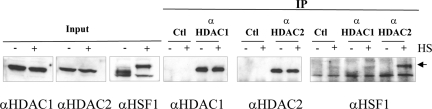
Endogenous HSF1 immunoprecipitates with endogenous HDAC1 and 2. Immunoprecipitations anti HDAC1 and HDAC2 were performed with anti HDAC1 and 2. Equal amounts of HDAC1 and 2 and HSF1 in non-heat-shocked and heat-shocked extracts was controlled by Western blot in total cell extracts (Input). Immunoprecipitations were performed on cellular extracts from unstressed (−) and heat-shocked (+) cells. Equal level of HDAC1 and 2 in the immunoprecipitates was also controlled by Western blot. The presence of HSF1 in the immunoprecipitates from heat-shocked cells was determined by Western blot with anti-HSF1 (the arrow indicates the signal corresponding to HSF1). Immunoprecipitations were also performed with nonspecific rabbit IgG used as controls of specificity (Ctl).
References
-
- Biamonti G. Nuclear stress bodies: a heterochromatin affair? Nat. Rev. Mol. Cell Biol. 2004;5:493–498. - PubMed
-
- Boussouar, Rousseaux F., Khochbin S., S. A new insight into male genome reprogramming by histone variants and histone code. Cell Cycle. 2008;7:3499–3502. - PubMed
-
- Chen C., Xie Y., Stevenson M. A., Auron P. E., Calderwood S. K. Heat shock factor 1 represses Ras-induced transcriptional activation of the c-fos gene. J. Biol. Chem. 1997;272:26803–26806. - PubMed
Publication types
MeSH terms
Substances
LinkOut - more resources
Full Text Sources
Miscellaneous
