


Diagnosis of endotoxemia with gram-negative bacteremia is bacterial species dependent: a meta-analysis of clinical studies
- PMID: 19794055
- PMCID: PMC2786621
- DOI: 10.1128/JCM.01189-09
Diagnosis of endotoxemia with gram-negative bacteremia is bacterial species dependent: a meta-analysis of clinical studies
Abstract
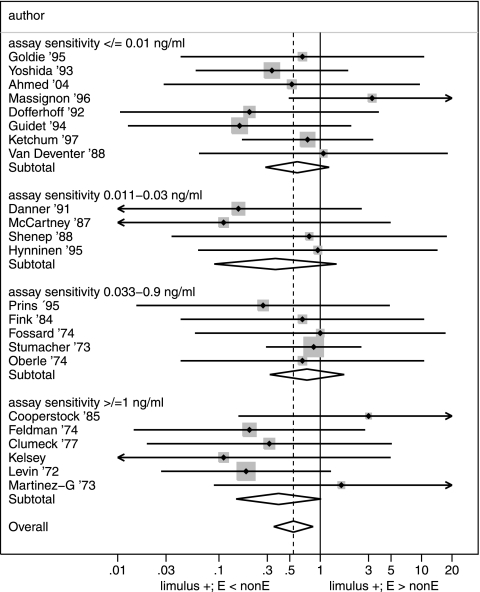
Endotoxemia is undetectable for up to 60% of cases of bacteremia caused by gram-negative (GN) species, a discordance attributed to the limitations of the Limulus assay for endotoxemia. The lipid A structure of the endotoxin molecule is critical for the sensing of GN bacteria by the host immune system although not so for sensing by the Limulus assay. The lipid A structure of commensal Enterobacteriaceae is hexa-acyl, whereas non-Enterobacteriaceae have a broader range of structures. By using a previously published classification of lipid A structures (R. S. Munford, Infect. Immun. 76:454-465, 2008), the association of endotoxemia with bacteremia caused by GN organisms is reexamined for 580 GN bacteremic patients from 46 studies. Endotoxemia was less commonly detected for cases of bacteremia caused by Salmonella enterica serovar Typhi (four studies; 15 of 55 cases of bacteremia [27%]) than for cases of bacteremia caused by Neisseria meningitidis (five studies; 69 of 84 cases [82%]) and Pseudomonas pseudomallei (one study; 38 of 41 cases [93%]) among studies restricted to those with specified cases of bacteremia caused by GN organisms. Among 23 unrestricted studies, endotoxemia was less commonly detected for cases of bacteremia with a commensal member of the Enterobacteriaceae (104 of 240 cases [43%]) than with non-Enterobacteriaceae (59 of 100 cases [59%]) (summary odds ratio, 0.53 [90% confidence interval, 0.33 to 0.85]). This finding is consistent across all the unrestricted studies, even including studies with seemingly contrary results for endotoxemia diagnosis among cases of bacteremia caused by GN bacteria overall. Surprisingly, with bacteremia caused by commensal Enterobacteriaceae, the diagnosis of endotoxemia appears to be unrelated to the Limulus assay sensitivity. Across these 45 studies, the association of endotoxemia with GN bacteremia is variable but consistent for different types of GN bacteremia.
Figures
References
-
- Adinolfi, L. E., R. Utili, G. B. Gaeta, P. Perna, and G. Ruggiero. 1987. Presence of endotoxemia and its relationship to liver dysfunction in patients with typhoid fever. Infection 15:359-362. - PubMed
-
- Ahmed, T., M. A. Azam, N. Armed, K. M. Jamil, F. Hassan, N. Ogura, H. Tamura, and T. Yokochi. 2004. Detection of endotoxin in sera from children hospitalized for treatment of diarrhea in Bangladesh. J. Endotox. Res. 10:223-228. - PubMed
-
- Bion, J. F., I. Badger, H. A. Crosby, P. Hutchings, K. L. Kong, J. Baker, P. Hutton, P. McMaster, J. A. Buckels, and T. S. Elliott. 1994. Selective decontamination of the digestive tract reduces gram-negative pulmonary colonization but not systemic endotoxemia in patients undergoing elective liver transplantation. Crit. Care Med. 22:40-49. - PubMed
-
- Brandtzaeg, P., P. Kierulf, P. Gaustad, A. Skulberg, J. N. Bruun, S. Halvorsen, and E. Sorensen. 1989. Plasma endotoxin as a predictor of multiple organ failure and death in systemic meningococcal disease. J. Infect. Dis. 159:195-204. - PubMed
Publication types
MeSH terms
LinkOut - more resources
Full Text Sources
