NKG2D gene polymorphism has a significant impact on transplant outcomes after HLA-fully-matched unrelated bone marrow transplantation for standard risk hematologic malignancies
- PMID: 19794085
- PMCID: PMC2754959
- DOI: 10.3324/haematol.2009.008318
NKG2D gene polymorphism has a significant impact on transplant outcomes after HLA-fully-matched unrelated bone marrow transplantation for standard risk hematologic malignancies
Abstract
Background: NKG2D, an activating and co-stimulatory receptor expressed on natural killer cells and T cells, plays pivotal roles in immunity to microbial infections as well as in cancer immunosurveillance. This study examined the impact of donor and recipient polymorphisms in the NKG2D gene on the clinical outcomes of patients undergoing allogeneic T-cell-replete myeloablative bone marrow transplantation using an HLA-matched unrelated donor.
Design and methods: The NKG2D polymorphism was retrospectively analyzed in a total 145 recipients with hematologic malignancies and their unrelated donors. The patients underwent transplantation following myeloablative conditioning; the recipients and donors were matched through the Japan Marrow Donor Program.
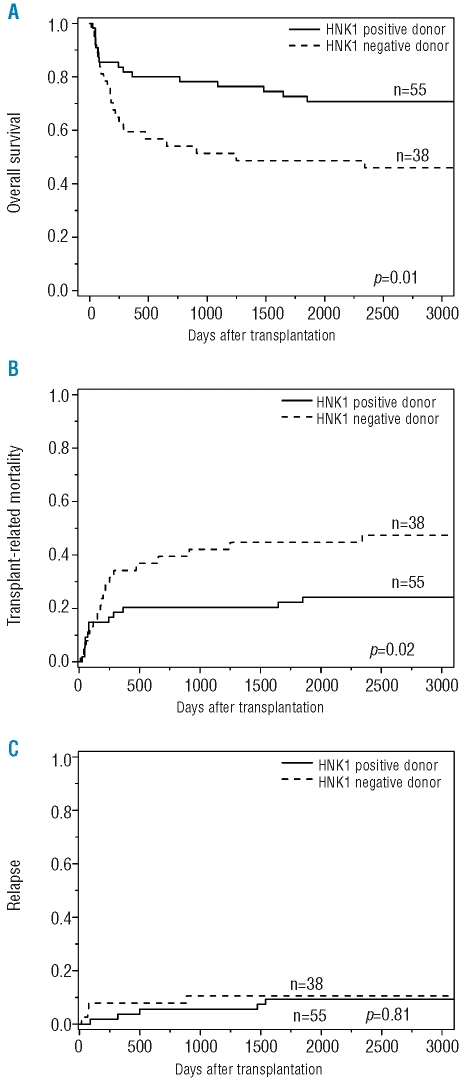
Results: In patients with standard-risk disease, the donor NKG2D-HNK1 haplotype, a haplotype expected to induce greater natural killer cell activity, was associated with significantly improved overall survival (adjusted hazard ratio, 0.44; 95% confidence interval, 0.23 to 0.85; p=0.01) as well as transplant related mortality (adjusted hazard ratio, 0.42; 95% confidence interval, 0.21 to 0.86; p=0.02), but had no impact on disease relapse or the development of grade II-IV acute graft-versus-host disease or chronic graft-versus-host disease. The NKG2D polymorphism did not significantly influence the transplant outcomes in patients with high-risk disease.
Conclusions: These data suggest an association between the donor HNK1 haplotype and better clinical outcome among recipients, with standard-risk disease, of bone marrow transplants from HLA-matched unrelated donors.
Figures
References
-
- Weisdorf DJ, Anasetti C, Antin JH, Kernan NA, Kollman C, Snyder D, et al. Allogeneic bone marrow transplantation for chronic myelogenous leukemia: comparative analysis of unrelated versus matched sibling donor transplantation. Blood. 2002;99:1971–7. - PubMed
-
- Gratwohl A, Brand R, Frassoni F, Rocha V, Niederwieser D, Reusser P, et al. Cause of death after allogeneic haematopoietic stem cell transplantation (HSCT) in early leukaemias: an EBMT analysis of lethal infectious complications and changes over calendar time. Bone Marrow Transplant. 2005;36:757–69. - PubMed
-
- Dickinson AM, Middleton PG, Rocha V, Gluckman E, Holler E. Genetic polymorphisms predicting the outcome of bone marrow transplants. Br J Haematol. 2004;127:479–90. - PubMed
-
- Elmaagacli AH, Koldehoff M, Landt O, Beelen DW. Relation of an inter-leukin-23 receptor gene polymorphism to graft-versus-host disease after hematopoietic-cell transplantation. Bone Marrow Transplant. 2008;41:821–6. - PubMed
Publication types
MeSH terms
Substances
LinkOut - more resources
Full Text Sources
Medical
Research Materials