


Evaluation of abnormal synergy patterns poststroke: relationship of the Fugl-Meyer Assessment to hemiparetic locomotion
- PMID: 19794132
- PMCID: PMC4434590
- DOI: 10.1177/1545968309343215
Evaluation of abnormal synergy patterns poststroke: relationship of the Fugl-Meyer Assessment to hemiparetic locomotion
Abstract
Background: Assessment of poststroke motor impairment has historically focused on the ability to move within and outside of abnormal synergistic motor patterns and is typically quantified by the Fugl-Meyer Assessment (FMA). However, it is unclear if the voluntary, isolated movement tasks of the FMA are appropriate for evaluating walking task-specific motor control requirements because walking is cyclical and involves considerable sensorimotor integration.
Objective: The purpose of this study is to test whether the motor impairment measured by the FMA is indicative of motor dysfunction during walking in poststroke adults.
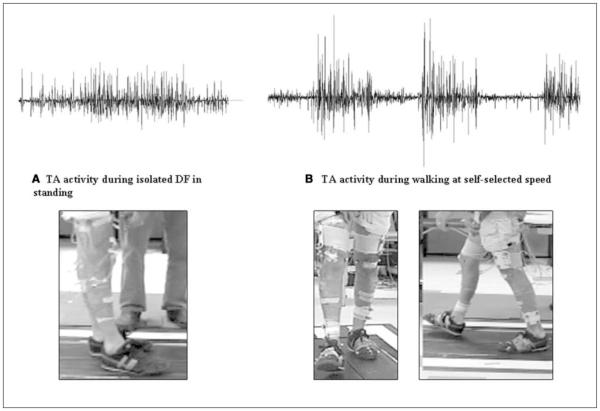
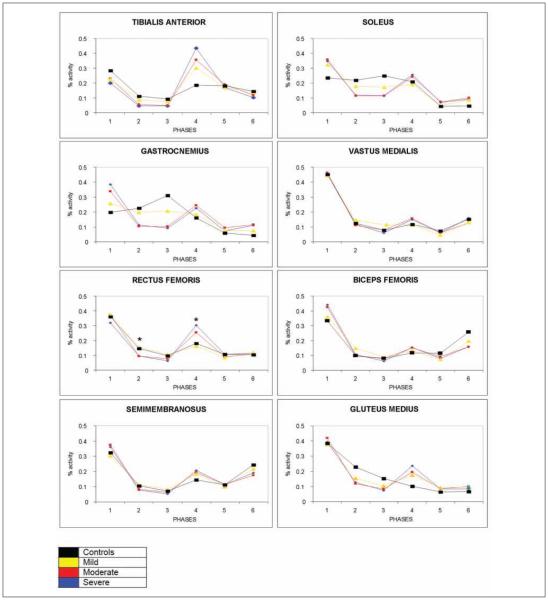
Methods: Thirty-four individuals with chronic poststroke hemiparesis and 17 healthy controls walked for 60 seconds on an instrumented treadmill while recording electromyographic activity (EMG) from 8 lower extremity muscles. EMG recordings were also obtained during the FMA for those with hemiparesis to examine muscle activation patterns. Each participant was examined with a battery of walking-specific clinical and biomechanical assessment tools and stratified based on the FMA synergy (FMS) score. To further quantify muscle activation patterns during walking, a nonnegative matrix factorization (NNMF) determined the number of independent modules required to describe 90% of the total variance in the EMG patterns.
Results: Stratification poorly differentiated motor activation across FMA tasks as well as EMG patterns during walking. While FMS correlated with 2 of 6 walking assessments, the number of EMG modules significantly correlated with all 6 walking performance measures.
Conclusions: Voluntary, discrete activities as performed in the FMA may be inadequate to capture the complex motor behavior in walking. Conversely, walking-specific evaluations such as NNMF appear more appropriate.
Figures

References
-
- Twitchell TE. The restoration of motor function following hemiplegia in man. Brain. 1951;74:443–480. - PubMed
-
- Brunnstrom S. Motor testing procedures in hemiplegia: based on sequential recovery stages. Phys Ther. 1966;46:357–375. - PubMed
-
- Fugl-Meyer AR, Jaasko L, Leyman I, Olsson S, Steglind S. The post-stroke hemiplegic patient: 1. A method for evaluation of physical performance. Scand J Rehabil Med. 1975;7:13–31. - PubMed
-
- Duncan PW, Propst M, Nelson SG. Reliability of the Fugl-Meyer assessment of sensorimotor recovery following cerebrovascular accident. Phys Ther. 1983;63:1606–1610. - PubMed
-
- Wang CH, Hsieh CL, Dai MH, Chen CH, Lai YF. Inter-rater reliability and validity of the stroke rehabilitation assessment of movement (stream) instrument. J Rehabil Med. 2002;34:20–24. - PubMed
Publication types
MeSH terms
Grants and funding
LinkOut - more resources
Full Text Sources
Medical
Miscellaneous
