


Age-related impairments of new memories reflect failures of learning, not retention
- PMID: 19794183
- PMCID: PMC2769163
- DOI: 10.1101/lm.1503209
Age-related impairments of new memories reflect failures of learning, not retention
Abstract
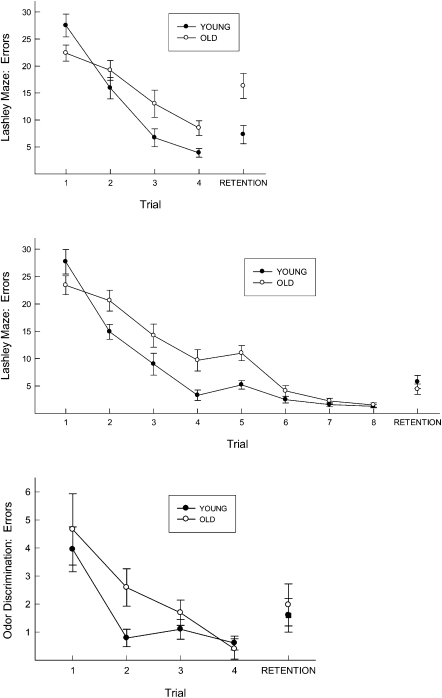
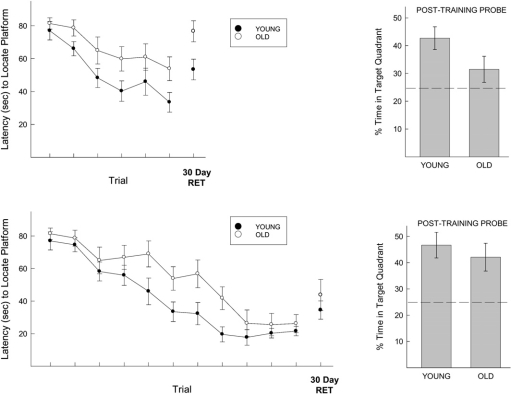
Learning impairments and the instability of memory are defining characteristics of cognitive aging. However, it is unclear if deficits in the expression of new memories reflect an accelerated decay of the target memory or a consequence of inefficient learning. Here, aged mice (19-21-mo old) exhibited acquisition deficits (relative to 3-5-mo old mice) on three learning tasks, although these deficits were overcome with additional training. When tested after a 30-d retention interval, the performance of aged animals was impaired if initial learning had been incomplete. However, if trained to equivalent levels of competence, aged animals exhibited no retention deficits relative to their young counterparts. These results suggest that age-related "memory" impairments can be overcome through a more effective learning regimen.
Figures
References
-
- Barnes CA, McNaughton CL. An age comparison of the rates of acquisition and forgetting of spatial information in relation to long-term enhancement of hippocampal synapses. Behav Neurosci. 1985;99:1040–1048. - PubMed
-
- Campbell BA. In: Early behavior: Comparative and developmental approaches. Stevenson HW, et al., editors. Wiley; New York: 1967.
-
- Campbell BA, Jaynes J. Reinstatement. Psychol Rev. 1966;73:478–480. - PubMed
-
- Campbell BA, Spear NE. Ontogeny of memory. Psychol Rev. 1972;79:215–236. - PubMed
-
- Gage FH, Dunnett SSBA. Spatial learning and motor deficits in aged rats. Neurobiol Aging. 1984;5:43–48. - PubMed
Publication types
MeSH terms
Grants and funding
LinkOut - more resources
Full Text Sources
Medical